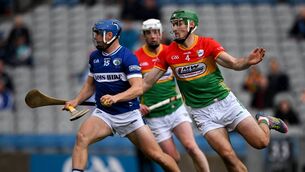
Éire Óg draw strength and identity from their old glories
Tradition, it’s one of the great GAA intangibles. Does it actually count for anything? Does it help put a ball over the bar or stand to a team when they’re struggling?
Jordan Lowry obviously can’t say for certain but, in Éire Óg’s case, he’s pretty sure it means a great deal. A quarter of a century on from when they set the standard in Leinster club football, winning five provincial titles between 1992 and 1998, he tells an anecdote to explain its significance now.
“Well, I spoke to a few people in Dingle not so long ago who knew who Éire Óg were,” said Lowry, an experienced defender for the Carlow town club. “So because of what happened in the ’90s, the club is well known around Ireland which is a great thing. There is a sense of aura or respect given to Éire Óg because of that achievement, that they have won five Leinsters.”
Joe Murphy, the current Éire Óg manager, was captain for their last Leinster win in 1998. When he took over as bainisteoir, he felt the club had lost some of the connection to that era, even to the local community; that the club was drifting a little.
So they worked hard on re-establishing the same clear and strong identity with the parish that had been there in the ’90s and which had allowed them to project so successfully outwards, all the way to Dingle as it happens.
One of the ideas they came up with was to make a direct link between the underage teams and the senior stars, picking out adult players to engage with specific underage groups, like the U7s. Several seasons later, Murphy feels it’s working well and he senses a tightening of club and community.
It’s not quite a Trumpesque ‘Make Éire Óg great again’ approach although he doesn’t miss an opportunity to remind his players of who they are and where they’ve come from.
At the start of each year, for instance, Murphy tells them they have a Leinster title in them. Not a county title.
“Joe often says, ‘I hate going back to it lads ... but I’m just going to say it’. That’s literally his first words and you know when he says that that he’s going to talk about that team of the ’90s,” said Lowry. “But he’s right in a way in a lot of the things he does say about that team of the ’90s.”
It’s a fine line between reminding the players of the club’s past and burdening them with expectations they don’t feel they can live up to. In the latter scenario, resentment can quickly creep in.
Lowry acknowledges that in his 11th year of senior football with Éire Óg, he can’t recall a January when someone in the club hasn’t reminded him about how good they used to be.
“As a young lad, you watched those games, you went to those games in Newbridge, Tullamore, Portlaoise, I’ve watched them on video I don’t know how many times,” he said. “You want that, you want that Leinster title for yourself, that you can say you had it, that you lived the dream too.”
What Murphy does to ensure his players are inspired by that history, and not inhibited by it, is tell them over and over how good they are. Better than the ’90s lot in fact.
“He often says that team wouldn’t get near the team we have now, that’s where Joe holds us, in such high regard,” said Lowry. “He well and truly believes there is a Leinster or an All-Ireland in this team, and now we’re only seeing that maybe in ourselves. It’s taken a while to get that belief in ourselves that we do actually have a very good panel here together and that we could do something special.”
Another ploy of Murphy’s has been to collar a few of the club’s icons from the 1990s and get them to speak to the players before games. They’ve done that since the Carlow semi-finals, always careful to cajole and to encourage and not reminisce.
There are strong tangibles at play too, of course, like Éire Óg’s ultra efficient counter-attacking strategy, built on a rock solid defence. They held Portlaoise scoreless from play in the semi-finals, restricted Palatine to 0-5 in the county final.
And there’s genuine talent in their ranks as Ballyboden experienced only last August when the Dubliners scraped two late goals to salvage a 3-8 apiece draw in a challenge.
There’s also the strong sense among the players that they simply didn’t do themselves justice last year when Mullinalaghta, the eventual champions, hammered them by 2-15 to 0-3 in the semi-finals.
“We let ourselves down last year, big style,” said Lowry, who doesn’t want to feel that way again. “I’m happy enough to go into this game as underdogs again. I’m more than confident in the players we have and that if we turn up on the day, we can beat Ballyboden.”


CONNECT WITH US TODAY



Be the first to know the latest news and updates