Strength in numbers or too many cooks? The backroom conundrum
Over the coming weekends, luxury buses with complimentary wifi and mobile phone chargers will roll into county grounds all over Ireland.
Players will clamber out to make their final preparations for a Championship game and a legion of others in a variety of county tracksuits will beat the same path clutching massage tables, medical kits, and laptops.
This is the ‘backroom team’, an indefinable, sometimes sprawling number of loose associates or inner sanctum essentials connected with the squad.
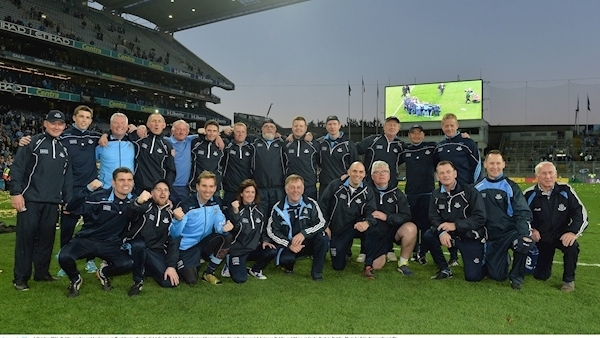
Three years ago, there was considerable interest over two pictures taken after both All-Ireland finals. Tipperary set the ball rolling with what they thought was a private image, but was captured also by Daire Brennan of Sportsfile. A few weeks later, the Dublin support structure was captured.
23 people, including team managers Michael Ryan and Jim Gavin were captured in the pictures, but there could have been far more.
For example with Dublin at least, there was no sign of strength and conditioning coach Bryan Cullen, or selector David Hickey, while the respected high-performance coach Gary Keegan would run a mile from being frozen in such an image.
Nothing divides traditionalists and modernisers in GAA debates more than where they stand on the size of the modern-day backroom team.
And the prevailing trend is towards further growth.
In 2011 while the Donegal revolution was still getting going, Michael Murphy made a speech after beating Derry in the Ulster final. He thanked 18 people in all including manager Jim McGuinness and his assistant, Rory Gallagher. Being the thorough sort, Murphy also thanked the bus company, catering company, county board, and sponsors.

There are factors to be noted. In the speech, no fewer than five people were in the medical team; Dr Charlie McManus, Dr Kevin Moran, JD McGrenahan, Shane Collins, and Tommy Kerr.
In the early stages of McGuinness’s management, he preferred to take on a number of responsibilities himself. Rory Kavanagh needed to put some muscle on so McGuinness himself drew up a weights programme and offered advice on nutrition.
As his four-year spell wore on, more and more people were trusted and with McGuinness in Glasgow and employed by Celtic during the week, he delegated roles out. Students of physical training were handed responsibility for overseeing gym sessions and this in turn looked good on their CVs, while not eating into the budget.
Take it back 30 years ago and things were different. When Antrim reached the All-Ireland hurling final in 1989, they had the late Jim Nelson as manager while Limerick man Brother Michael O’Grady — who previously had coached both Tipperary and Limerick to national league titles — was coach.
After that, there were selectors John Crossey, PJ O’Mullan, and Brendan McGarry. The doctor was former SDLP leader Dr Alasdair McDonnell, physio was Dan Turley, and Henry McCabe was kitman. Add in hurling board chairman Fergus McNaughton and it still didn’t reach double figures.

That stands in stark contrast to the reputed 28 currently involved in the senior Wexford hurling team, and 27 with Dublin’s hurling team.
The make-up of backroom teams can be varied, but aside from the roles previously mentioned, there can be anything from two to four people involved in compiling statistical analysis.
One physio has now become two in most counties; a masseur is now seen as essential. The growing amount of kit requirements has seen a kitman needing a deputy.
The GPS equipment used by most teams needs an operator. The vast majority of counties will also have some kind of sports psychologist or high-performance expert in the mix, while it is commonplace to have a full-time nutritionist.
There are other services too. Within the Dublin team, Anne-Marie Kennedy was listed as their yoga instructor while it was reported she helped players with breathing techniques.
A role has also been created as ‘Media Manager’ while others have been described as ‘lifestyle coaches’ or ‘facilitators’. With all this activity, it can create a whole layer of problems for a team manager to solve.
“The manager’s job really is to create an environment around that backroom where people understand their role and are not crossing over, into other people’s roles,” explained former Cork manager Brian Cuthbert.
That’s what a manager has to do, keep all these people very, very clear, concise in terms of what is expected of them. I think in many counties the manager ends up being the volunteer, surrounded by people who work as professionals. That’s a funny slant to it.
“So, you are ultimately the volunteer, bringing in the help to get the most out of this group of players. But you ultimately could be in some way, not as qualified as the many others in their roles and their understanding of it. I think the GAA need to be very, very clear on how far a manager can go.
"He could be working a normal job and trying to manage this big group of backroom staff, plus, you are managing a group of players, it’s not an easy thing to do.”
It is Cuthbert’s belief that in order to keep them motivated and believing they are contributing something worthwhile, management have to regularly check in.
“You have to allow your team to have a forum. If you have a management team and you are meeting every three or four weeks which is what you should be doing as a team, you need a forum where everybody can throw their opinion into the mix and ultimately the manager can decide, but at least he is listening. At least he is giving people the opportunity.
“That’s all they want, in terms of being involved in this high-level sport, giving and having an opinion and doing their own job. If people are unsure of their role, then it becomes complicated.”
Sometimes, a backroom team just does not work. Seamus ‘Banty’ McEnaney felt his Monaghan management could do with a shake-up at the end of the 2006 season, his second in charge.

Gerry McCarville was leaving anyway but McEnaney asked Gerard Hoey and Bernie Murray to leave with him in order to freshen things up. He recruited Adrian Trappe and started his long working relationship with Martin McElkennon.
“And it was one of the most difficult things I had to do in my GAA management career,” says McEnaney now, still wincing at the awkwardness it caused. But, I felt that we needed to go a different training route. Martin McElkennon brought a different training regime altogether.
At the time, the reality was we needed the nastiness that was developing in the northern teams and we hadn’t got it. We needed the intensity that Tyrone was bringing to the table. And that’s why I went that way.
Right now, McEnaney is getting ready for the Ulster U20 Championship campaign as Monaghan boss. Last year he brought the minor team to an All-Ireland semi-final and all of the backroom team moved up with him.
He has his former senior captain Damian Freeman as selector along with Tony Graham and David McCague, who also doubles up as his football coach.
McElkennon looks after strength and conditioning, Gerry Nolan is a physio, and they have one kitman and one stats man while they get a doctor in for games. It’s a tight circle, exactly the way McEnaney wants it.
“It’s mad. I don’t care what county team it is, 10 of a backroom team is where it should be at,” he says.
“You should have a maximum of three selectors and not one more, one of them being your football coach.”
Some of the more technological developments inhibit McEnaney’s ‘feel’ for a game, he senses.
“In the main, I wouldn’t use GPS systems in a game. If the game was important, I wouldn’t,” he states.
“A manager, if he has any confidence in his own ability, he’d see a man tiring. And if he has any confidence he wouldn’t have more than three advisers. It complicates the thing if he has any more.
“And you are spending your time, in some cases, keeping some of them humoured.”
He outlines the potential stresses.
“The amount of people that managers have in backroom teams is crazy. I think first of all, the manager is crazy to have big numbers in the backroom team.
“You are managing 30 different players and you have 30 different opinions of players, 30 different problems with players.
“For you to have 20-plus of a backroom team, you are eating up far too much energy around you. Energy you could be using on the most important people, the players.”