Philly McMahon: ‘Every time I get a Dublin jersey it’s a chance to ease a small bit of pain and suffering for someone’
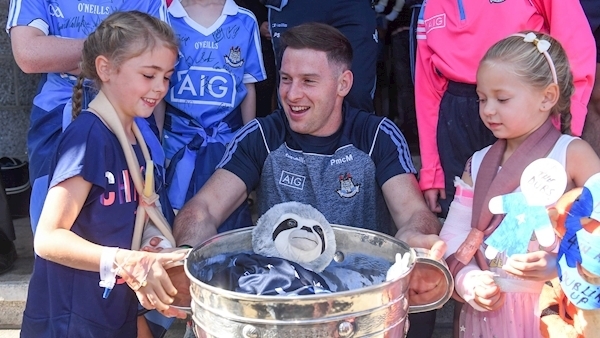
In person, Philly McMahon is measured and thoughtful, a considered speaker, a committed activist for the greater good.

Philly McMahon: ‘Every time I get a Dublin jersey it’s a chance to ease a small bit of pain and suffering for someone’

In person, Philly McMahon is measured and thoughtful, a considered speaker, a committed activist for the greater good.

In caricature McMahon is the Dublin footballer as enforcer, an assassin with a quiff, prowling Croke Park. He’s aware of the cartoon imagery which swirls about him, though he also acknowledges that for some Dubs, the image and reality mesh.

A reference to Jim Gavin, impassive in public, but surely emotional in the dressing room, for instance.

“I’ll tell you what the funny part is,” says McMahon with a laugh.

“It’s that people think he’s different with us than he is with other people. He’s not.

“It’s funny, you see people getting frustrated trying to break him down or understand him, but he’s exactly what you see.

“That’s what’s funny to me — people’s heads are wrecked because they think that he’s different in the dressing room, or on the training ground. “He’s not. He’s exactly the same.”

McMahon pocketed that fourth All-Ireland medal in a row last September.

If you fish for the opponent he’s worried about in 2019, he flips the question around.

“Here’s the thing. There’s not one county team looking to do that job, to beat us — every team will be thinking ‘you know what, we could knock them off their stool, we’ll be known as the team which stopped Dublin doing five in a row’.

“That’s the energy going around, and because of that I couldn’t pick one team based on last year’s league and championship. The league is really competitive, the All-Ireland final we were up against Tyrone — who can pick the team that’ll make waves next year? I can’t.”

Still, though it’s the time of year when that kind of speculation runs rife, McMahon has other fish to fry.

“There’s definitely a bit more free time in the evenings and so on, so there’s that bit of time to share my experiences with people that need it. I try to do a few voluntary talks and on top of that, there’s some corporate work, so I try to get that done at this time of the year.”

He’s referring to his advocacy work in the areas of drugs and addiction: the documentary he presented, The Hardest Hit, dealt with those areas and struck a deep chord with people when broadcast on RTÉ. The messages, emails, texts — all of those from people after it screened first on television, those were unbelievable. People were sharing their stories, stories of family members who had struggles with addiction.

“I hope it’ll make a dent in the stigma out there around addiction. The question now is how much it affects the thoughts of those in control of policy in that area?”

Why don’t other sportspeople get more involved in that kind of activism, though?

“I can only give you my view on it — why I went in that direction, the big thing is that I didn’t want to experience what I experienced. I saw more reason to get involved and to do it than not to get involved, than not doing it.

“I think it’s down to the individual, what kind of person they are, what they’ve experienced in their life.

“It comes down to what you view as your purpose in life, and I’d see my purpose as trying to help people. To me, the world is being built on legacies, that’s how history is created — there’s nothing more powerful than when you’re dead and gone, the energy and the help you gave people.

“Nobody cares how much money you had, or how famous you were, but they’ll remember if you used your profile or fame to help people.”

To some readers that might sound like the preface to a political career.

“No, definitely not,” he says.

“Not the way it is at the minute. I’m just looking for a platform to help others, and I believe I can help more people through my sports platform.

“I understand that platform won’t be around forever as well, I don’t know what I’ll be at next year, but while I have that platform I think I’ll use it to help people. Addiction is obviously not something that a lot of people want to speak about, whether that’s in the political world or elsewhere. Same with the homeless crisis, that’s not nice to talk about.

“The only people who like to speak about addiction, unfortunately, are the media, because that’s what sells. For me, other people probably don’t have that connection with the subject; if you have that connection, then you’ll find a way to help.

“That’s why if you get people involved in politics who’ve been involved in struggle and adversity, then things could get done a little bit quicker.”

McMahon chronicled the adversity faced by his own family in his terrific autobiography, which detailed his brother John’s struggles with drugs and eventual death. Family is a driving force on and off the field of play, and will be again next year when Dublin hunt a fifth senior title in a row.

“I suppose I’m very lucky that the appetite is there, but it’s for other reasons. If I didn’t have that appetite, I’m sure I’d be thinking of the opportunity to win five in a row.

“But I don’t see that. My Dad got to see his last All-Ireland with me last year, and I saw the energy that gave him fighting his illness. I know that every time I get a Dublin jersey it’s a chance to ease a small bit of pain and suffering for someone.

“That keeps me grounded. That’s more important, to me, than someone talking about five in a row — the impact you could have on someone’s life if they see Dublin winning five in a row, or even to see the Dubs going out to play a match.

“That’s just me. I can’t speak for the other lads, but that’s how I am. I enjoy what I’m doing. Your career doesn’t last forever and it gets shorter every year, the competition gets better and better, so you have to enjoy it while you can.”

People don’t always acknowledge the bond between Dublin GAA and its constituency, but McMahon makes a strong case for it: “Definitely, the connection between the Dublin players and their communities is very strong. Culturally we know what we represent. We don’t just represent the team, we represent our parishes, our communities — the whole GAA community.

“That’s not just true of Dublin, it’s true of the whole GAA community. How we represent ourselves, that travels all over the country, and when you hear people outside the county say Dublin footballers are a credit to their clubs or well behaved, or a credit to Jim (Gavin), that’s what we want.”

Not the kind of recognition conferred by an All-Star? There was a good deal of talk about Dublin goalkeeper Stephen Cluxton being ‘snubbed’ this year.

“The All-Stars are tricky. It’s one of those things that’s always controversial about something, so you wouldn’t buy into that kind of thing.

“In 2010 I won a GPA All-Star, which was voted by my peers, yet I didn’t win a GAA All-Star. Those things happen all the time so you don’t buy into it a huge amount. Then you have the Player of the Year situation, which is voted for by the players. It’s a popularity contest, so unless you have three Dublin players, you’re not going to win. That’s just the dynamic of it.

“Personally I don’t buy into it. Is it great to win an All-Star? Yeah, of course it is. It’s an add-on, I suppose, but even though it’s a cliche, winning an All-Ireland is what it’s all about. That’s what you have in the drawer.”

And another one next year? Wait and see.

x

More in this section

Cookie Policy Privacy Policy Brand Safety FAQ Help Contact Us Terms and Conditions

© Examiner Echo Group Limited