Austin Flynn: Minding Waterford’s legacy and tradition
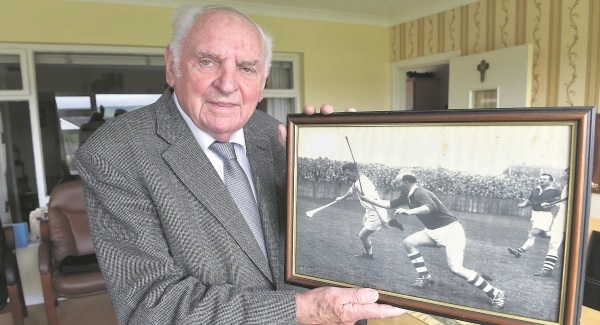
In his second coming as a Waterford hurler, Austin Flynn, who tonight receives a Hall of Fame gong at the Munster Council’s annual awards ceremony in the Fota Island Resort Hotel, won an All-Ireland medal, a National League medal, three Munster medals, and a Railway Cup medal.
It was quite the era, the Déise’s greatest, and he was an integral part of it at full-back.
But the opening chapter of the Flynn story is a tale worth telling too, if only to illustrate the trough into which the game in the county had so suddenly and inexplicably sunk between the towering peaks of 1948 and 1959.
On a summer’s night in 1952, a young Flynn was coming home from the pictures in Dungarvan when he found Michael Fives, the Abbeyside GAA chairman, and Seaneen O’Brien, the club captain, waiting for him at the Poor Man’s Seat.
He’d been called up for the Munster quarter-final against Clare the following day, they told him.
Far from being elated, Flynn was surprised, even upset. This was big news all right, but for him it was a bridge too far, too soon. His informants weren’t having any of it.
“You can’t leave the village down tomorrow,” warned O’Brien. “You’ll have to turn up.”
Hoping he wouldn’t be called upon, Flynn travelled into Waterford the next day and came on as a substitute.
The match ended in a draw. He kept his place for the replay in Thurles, where he was picked to mark the great Clare forward Matt Nugent. Clare won but were run over by Tipperary in the semi-final.
And that was it for Flynn for the next five years.
Waterford weren’t going anywhere in particular and he had no desire to accompany them. Looking back on it, what strikes him most forcefully now is the fact the county had done the All-Ireland senior and minor double (“an amazing achievement”) only four years earlier, in 1948.
“Things had slipped so much in a short space of time. We were so disorganised.”
They were so disorganised and there was no indication they’d be organised anytime soon.
Here ended the First Coming of Austin Flynn.
Eearly 1957, an evening in Fraher Field. The Second Coming of Austin Flynn.
This time it’s serious. This time it’s for keeps. Because Waterford, at long last, are serious.
Pat Fanning, the new chairman of the county board and a future GAA president, is addressing the members of the panel.
Fanning is a wonderful orator and tonight he isn’t sparing the rhetoric.
“As God is my judge,” he announces, “I believe there’s the winning of an All-Ireland for Waterford in this team. It will take a great effort. “You will have to give a great commitment. You will have to give until it hurts and then give more. Everything possible will be done by the county board.
“But lads, it’s a matter of pride in the Waterford jersey. Cork and Tipperary and Kilkenny have their tradition. But we have our tradition too.
"It’s easy to come back when you’re winning. Picking yourself up and coming back for more — that’s Waterford’s tradition.”
To Flynn the words were nothing less than an epiphany. He’d been happy with life as it was, playing hurling and football for Abbeyside and messing about with boats.
He’d just finished building a 16-footer with his brother, based on the model of a stormy petrel in a book of boat plans someone had given him and, in the absence of marine plywood, fashioned out of larch from the priory in Mount Melleray.
“I was fulfilled. I had no great ambition to play for Waterford again. That all changed that night in Fraher Field.”
Pat Fanning knew whereof he spoke. Within a few months Waterford were Munster champions with a team built around a golden generation that had burst out of Mount Sion, supplemented by a barnstorming centre-forward from Ballyduff in Tom Cheasty.
They were beaten by a point by Kilkenny in a classic All-Ireland final but gained their revenge two years later in a replay. League success and a third provincial medal followed in 1963.
Memories? Flynn has plenty.
Liam Devaney, who died recently, scratching his head in bafflement at one of thenine goals Waterford hit to beat Tipperary, the reigning All-Ireland champions, in the 1959 Munster semi-final. (“I was as surprised as he was.”)
Seamus Power soloing in and hitting the shot that Jim the Link Walsh, the Kilkenny full-back, deflected past Ollie Walsh for Waterford’s late equaliser in the All-Ireland final.
Victory in the replay four weeks later and the rattle of the lorry as it made its way across Rice Bridge the following night with the new champions aboard.
If Fanning was the group’s inspiration, a speaker so gifted that “you were ready to break down the door for Waterford or die in the attempt”, John Keane, the centre-back on the 1948 team, was their trainer and unofficial psychologist.
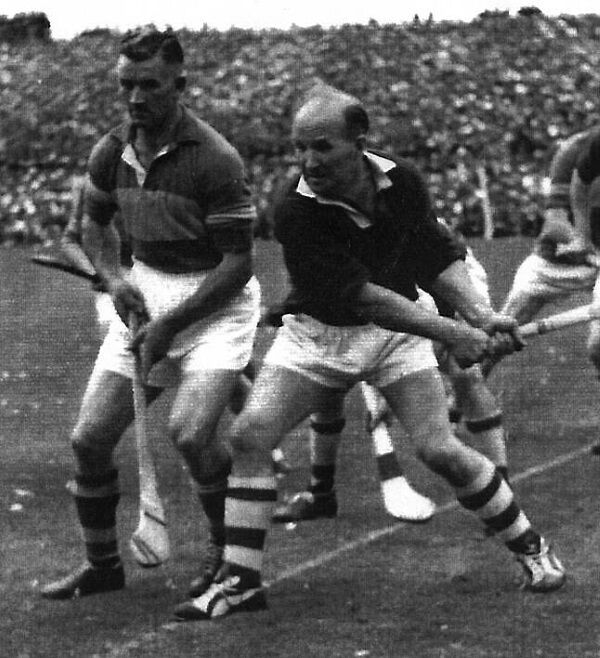
Keane’s speciality was the quiet word in a player’s ear when he felt the occasion required it, as he did in Flynn’s case before the 1959 replay.
Due to renovations at Walsh Park, they trained in Dunhill and Flynn was going so well that one night he was stunned to be taken aside by Keane.
“Austin, you’ve done enough tonight,” said Keane. “Go in and get a rub.”
Keane’s logic became gloriously clear on October 4 as Waterford saw off their neighbours by 3-12 to 1-10. “We were much fitter.
That was the telling factor. John had pulled us back a bit in training because he could see we were just right and he didn’t want us to overdo it.”
To listen to him, Flynn was merely a member of the supporting cast, albeit a determined and strongly built one. He silently recited a sportsman’s prayer before every match. He lived by it on the field.
“In my time all you were doing at full-back was trying to protect the goalkeeper from being killed. The game is much better now.”
He was, he says, lucky to come on a scene peopled by hurlers who even then were living legends.
Christy Ring was the most obvious example of the species — and yes, according to Austin, the cliché about Ring is true. He never did the same thing twice in succession with the sliotar.
“He had a low centre of gravity and was swerving all the time. He constantly changed tactics. With one ball he’d pull as hard as he could. Next ball you’d be expecting the same and he’d slip down and pick it. An amazing man.”
Another cliché about Ring that Austin similarly discovered to be true: His reserve. “He kept a distance. It was up to you to break the ice.”
Our man did. In 1966 the pair hurled together in the US — Chicago, Boston, New York — during the Cardinal Cushing Games, instituted to raise money for the missions in South America. Ever afterwards they were firm friends, with Ring frequently calling into Flynns’ on the Youghal Rd in Dungarvan when around town as a driver, and later rep, for Shell.
Marking Nickey Rackard (“much taller than Ring but straightforward”) required an entirely different portfolio of hurling smarts. Now Austin wasn’t a small man but he was in no way as big as Rackard. Nobody was as big as Rackard. What to do?
Bear with us while we go around the houses to get to the payoff line.
At national school in Abbeyside a young Austin Flynn had the great good fortune to come into contact with Michael Foley, the principal. When lessons were over, Mr Foley instructed his student in the basics of full-back play.
But lessons came first and lessons weren’t always over when the bell rang in the evening. Mr Foley had three particularly promising boys in sixth class and was determined they should be given every chance in life, which in practice meant winning a scholarship to Dungarvan CBS secondary school.
This in turn meant after-school tuition, the three lads sharing the one book. Two of the trio secured scholarships in the end, Austin included.
Moving on. A few years later he was playing for Dungarvan CBS inside in Waterford in a game against De La Salle. The opposition full-forward was a big lump of a lad who couldn’t hurl snow off a rope but who nonetheless was driving Flynn mad with his size and strength.
“He kept getting tangled up with me every time the ball came in. I was getting really frustrated.”
Advice came from an unlikely source. Out of nowhere one of the umpires piped up. “Keep away from him. Don’t be standing with him under the ball.”
Flynn did as bidden. The next ball that dropped from the air on top of them, he timed his challenge, barged the full-forward out of the way and cleared the sliotar down the field.
Any time Waterford were facing Wexford and he was marking Rackard, he remembered that match and that umpire.
“I knew I had no business standing with somebody bigger and stronger. So I’d arrive at the vital time and hit Nickey with my stomach and shoulder.” Bottom line, Flynn usually did pretty well on Rackard.
The identity of the helpful umpire, incidentally? A man he would encounter again. Pat Fanning.
Ask Austin Flynn if Waterford’s greatest ever team should have won more than just the one of the four All-Ireland finals they contested, he replies that the real tragedy is that it took them 45 years after 1963 to return to Croke Park in the autumn, another nine years to make their next visit and that the MacCarthy Cup still hasn’t traversed the Suir in the meantime. He remains the last full-back to win an All-Ireland medal with the Déise.
He’s not exactly one of a kind, mind. There’s a bunch of them still hanging in there from 1959: Mickey O’Connor, Joe Harney, Mick Flannelly, Martin Óg Morrissey, Larry Guinan, Freddie O’Brien.
Not that he minds talking about the glory days, although he remains uncomfortable with what he terms the “exaggerated importance” assigned to himself and the rest of the old stagers from 1959.
“We’re too old to be heroes anymore.”
And yet, for obvious reasons, they continue to be. Eleven years ago, after Waterford beat Kilkenny in the National League final, he was on the pitch in Semple Stadium with grandsons Gus, Cormac, and Cathal. Along came a husband and wife of a certain vintage. “God be with 1959,” the woman beamed.
“We came back from our honeymoon in London for the replay.”
All well and good, but sometimes he imagines how things would have unfolded had he been from, say, Kilkenny. He might have won a couple of All-Irelands, then retired and faded into the background.
A younger man would have taken his place, won a couple of All-Irelands himself, retired, and been succeeded. And so on and so forth. This being Waterford and 1959 still being 1959, he’s still being wheeled out.
Not that he doesn’t enjoy it. Not that he minded being in The Local in Dungarvan for a fundraising event the Monday night before the All-Ireland final, with Mickey O’Connor and himself the star guests. He has any number of stories with which to regale an audience, including one about the 1963 Munster final and the concrete blocks.
In brief: He spent the Saturday hauling concrete blocks from the road to the site of what would be the Flynns’ new bungalow.
The following morning, in the hotel in Limerick before the provincial decider against a Tipperary team who’d won the last two All-Irelands, he was tired. “Afraid I’d overdone it with the concrete blocks. It turned out to be just tension.” He kept Liam Devaney quiet, Waterford won, and he was duly named Sports Star of the Week in the Irish Independent, at the time a much-coveted honour.
The apples did not fall far from the tree. His grandson Cormac Curran won an All-Ireland minor medal in 2013.
Another grandson, Gus Flynn, plays with Ballygunner. For years Austin travelled to matches with the two of them, Cormac’s brother Cathal and their dad John.
Having completed his tour of duty as a supporter he followed the matches this year from the comfort of his living room: fair enough for a man of 84, you’ll agree. He enjoyed every moment of it, give or take Waterford’s no-show in the Munster semi-final and of course the All-Ireland final, and he enjoys the modern game.
“Oh God I do, yes. The bar is being raised the whole time. The strength, the speed, the fitness, the skill, the excitement. Everything’s faster. There’s excellence on the field and excellence on the sideline.”
He likes Austin Gleeson, naturally, but he recently discovered that Jamie Barron is the grandson of a man he went to school with back in the day and it pleased him enormously. “Jamie is something special. He’d keep running for a week.”
Naturally the All-Ireland final was a bit of a letdown.
“A fright to lose at the last jump again. But it was a mighty effort against a really good team and you still have to admire them.” And Waterford will be back again next year and Austin Flynn, mighty and indefatigable and still with stories to tell, will be cheering them on.
Their story continues. So does his.
CONNECT WITH US TODAY



Be the first to know the latest news and updates