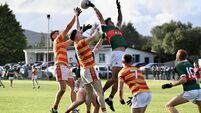
Ten rules we don’t want to see in the GAA
Here are five for football and five for hurling that would be best kept away from the sports.
FOOTBALL
We appreciate the reasoning behind this call (which has grown louder in recent times) is well-placed but there’s a strong possibility it would be counter-productive.
You can imagine opposing teams would sit back, inviting the other players on before pouncing as they panicked close to the limit and counter-attacked.
It might see the ball transfer quicker between sides but that doesn’t necessarily mean it would be conducive to more aesthetically-pleasing football.
Giving referees something else to count — steps, scores, stoppages, advantage rule to name but four — would also be asking too much of officials.
The forthcoming mark will be scrutinised closely but even if it does defy most predictions and become a success let it not provide an opportunity for people to think it could also work say beyond the 20-metre lines as well.
The last thing Gaelic football needs is to become more like Australian Rules.
Experimented with during the 1998 pre-season competitions, it was thrown out much, as it would transpire, to the relief of Michael Donnellan.
It would be a redundant rule now given players are less and less in such vulnerable situations.
Solo runs are high-risk in an era when possession is king but they aren’t exactly the worst thing to look at on a Gaelic football field.
Obviously, this would also have to come in for hurling also but then it applied only to football in the 1989/’90 National League.
Thankfully, there has been no inclination of this being proposed again.
However, it is the format of the Super 11’s hurling concept and with attention spans getting shorter it may be soon seen by a marketing whizz of jazzing up the game when in fact it would lengthen the match-day experience.
The sport just doesn’t need it.
If this ever was to be green-lighted, the hope is the goalkeeper would have the choice of kicking from either the hand or the ground.
Being able to kick from the hand would likely be preferable when attempting a short restart — we’ve seen plenty of hiccups in that regard over the last few seasons.
It certainly shouldn’t be compulsory.
Many of a certain vintage have mourned the gradual but definite decline of ground kicking and having been removed from sidelines and most close-range frees it’s essential for the heritage of the game that it shouldn’t disappear.
HURLING
How often has it been said that for the sake of the game the physical aspect of hurling simply can’t be tempered?
Obviously, the introduction of mandatory helmets has allowed players to be too liberal with the well-being of themselves and opponents but by and large things are good. The craft of sending a sideline cut over the bar is special but it also an uncontested exercise and can’t be ranked higher than the efforts of a player to shrug off the attentions of his marker to find his range.
Also, the punishment for conceding one would hardly fit the crime.
There are many followers of the game who would love to see this practice curbed even though everybody seems to be at it right now. Foul play is certainly fair game but the GAA has to be careful when considering implementing rules to address perceived negative or possession-driven tactics.
Short restarts keep opposing forwards honest, provide different avenues to the attacking team. No harm there.
Obviously, there is cynicism in hurling, much more than people think, but it hasn’t reached the saturation level Gaelic football experienced a few years back.
Perhaps a red card could be shown to a player who deliberately denies an opponent a goal-scoring chance by cynical play but a black card, similar to football’s version, would be too drastic.
Brought in to accommodate the black card in Gaelic football, the increase in the maximum number of substitutes to six has shown to favour the strongest counties.
Hurling has little need for such a measure, which would only further polarise the haves and the have-nots.
Hurling has a beautiful way of organically improving itself as seen by how Tony Kelly and Austin Gleeson manage to keep possession whether it be worming their way around defenders or batting the ball back to themselves from the ground.
The latter mightn’t be to some traditionalists’ liking but it is a new skill and should be treated as such.

CONNECT WITH US TODAY



Be the first to know the latest news and updates