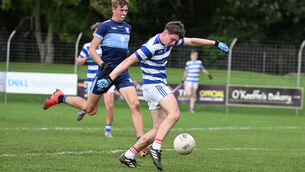
Ross O'Carroll Q&A: ‘There’s a sense in which nothing has really changed there in the last century or so’


Ross O’Carroll, Dublin hurler and footballer has contributed to a new book on the GAA in the turbulent years between 1913 and 1923.

Ross O'Carroll Q&A: ‘There’s a sense in which nothing has really changed there in the last century or so’

Q: Why did you decide to focus, in your contribution to the book, on the GAA’s reaction to the First World War in the first place?

A:

If you look at it, it’s a subject that hasn’t really been touched too much, but Paul Rouse, the historian, suggested to me that it might be worth examining, to see if there was anything there that could be uncovered. His prompting was what sent me into it, and I ended up doing my thesis on it. Gearóid (Ó Tuathaigh, editor of the book) got on to me and I managed to get some more information together on the subject for publication.

As I say, there’s more to be done on it, and Donal McAnallen is doing a lot of work on this up in Ulster, but you’d nearly need to treat it as a full-time job to get on top of it.

Q: This period or the way the GAA has developed?

A:

I think probably the way the association dealt with this whole area, this particular part of its history. What fascinated me when I looked into this was that some officials in some counties weren’t necessarily in favour of men going to the war, while other counties had no issue, really — that you had a diversity of outlook within the GAA. And that sort of highlighted the way the association often reacts — the higher echelons in Croke Park gave no specific direction on the matter centrally, really, and it was up to county boards how they reacted at a local level. That fascinated me, that opinions could vary from county to county. That really drew me into it.

Q: Sometimes there’s a view that the GAA is a monolith when it comes to opinion, rather than allowing for diversity?

A:

Definitely, I’d agree with you fully there, and that really hasn’t changed a lot since 1914. It’s not unlike the issues you see now along the lines of the intercounty scene and then, within that vast number in the playing population, you have people who are disgusted with how the club player is treated, though that differs widely from county to county too.

If you look at it, there are loads of different areas where different counties will have different opinions, and those are issues on which there’s no real unified voice coming from Croke Park. So there’s a sense in which nothing has really changed there in the last century or so.

Q: What were the other effects of the war? Did GAA revenue suffer as a consequence?

A:

Obviously attendances weren’t as high as they had been before the war, and that was reflected, in turn, in the coffers of county boards. Certainly I don’t think there was any county which didn’t suffer because of World War One. What was striking to me, though, was that even though they suffered a lot, subsequently there didn’t seem to be any issue in terms of developing the games and expanding their reach once the war ended. If anything the association got stronger and stronger, so obviously the difficulties of the war didn’t have a huge impact in later years.

Q: Was it surprising, the extent to which counties went their own way when it came to attitudes to the war?

A:

It did. Take Wexford as an example - Seán Etchingham was very anti-war and seemed quite vociferous in his opposition to it. And In Cork JJ Walsh (of the Cork County Board) wasn’t pro-war himself, I think he joked one time about having the pitch in order for the British Empire.

That kind of outlook didn’t really surprise me, because I came to the subject with an idea of the narrative of the GAA being part of the nationalist movement. I don’t think quite that way now, or to the same extent, maybe.

For instance, in Wicklow, where there was a priest who went off to the war, they gave him a rousing endorsement. So you have the other side of it there.

All of that did surprise me initially, but then, looking back at the period maybe not so much in the historical context but looking at it in terms of common humanity, if you had a member of your team or your club going off to fight in a war, then while you might have certain political views about that war and participating in it, you’d still be wishing him the best of luck and hoping he’d come back safe.

Q: Is there a complete book in the subject?

A:

I had the opportunity a couple of years ago to do a larger version, but I just didn’t have the time for it, being heavily involved in my own club, and working full-time. I don’t know if I’ll have the time to do it in the near future but I’d like to get further into researching it, certainly.

Q: So there’s more to find out?

A:

I’d love to stress that if anyone reading the piece has any information related to the period or the matter, I’d love to hear from them. Just like in all matters to do with history, it’d be great to unearth some more evidence about what happened and you’d love to think there’s more material out there to be discovered. It’s very much an ongoing subject for me.

The GAA & Revolution in Ireland: 1913-1923 (Collins Press, EU29.99).

More in this section

Cookie Policy Privacy Policy Brand Safety FAQ Help Contact Us Terms and Conditions

© Examiner Echo Group Limited