Put physicality back into football
I’VE seldom enjoyed an hour in front of the TV as much as I did last Sunday night watching the Tipp Galway highlights on the Sunday Game. The absorbing contest was complemented by the engaging post-game analysis from Donal Óg Cusack, Anthony Daly and Henry Shefflin.
Passion, intellect, insight, and humour exuded seamlessly from the panel. At one stage, I thought Henry was going to get up and swing a hurl at Des Cahill, he was so involved in the analysis. The best game of the championship to date needed to be celebrated and the pundits played their part in talking the game up to the optimum. Let’s face it, this year’s hurling championship badly needed it.
However, it is becoming increasingly difficult to ignore the drastically different approaches that have been taken when assessing our national sports. The last two weekends’ action has provided the best examples of this. In that regard, I found it hard to believe how everyone casually glossed over an incident that effectively cost Tipperary a place in this year’s All-Ireland final, never mind nearly seriously injuring a player who gave one of the finest exhibitions ever witnessed in Croke Park.
After all previous efforts to stop Seamus Callanan had failed miserably, John Hanbury was left with no option in the closing stages but to execute what WWE fans would call a ‘Tombstone’. Based on his form that day, it is fair to say that Callanan was odds-on to plunder his fourth goal and likely push Tipperary on to victory.
Callanan probably had to get his upper vertebrae checked out on Monday morning, yet, in relative terms, this incident barely got a mention. Three years ago, in very similar circumstances, Seán Cavanagh became enemy number one after dragging down Conor McManus in almost the exact same location. The uproar provided a catalyst for a reaction that eventually led us to the ‘black card’. Regrettably so.
You can’t blame the three lads for not allowing incidents like Hanbury’s pile-driver override the thrilling battle that took place last Sunday. Don’t get me wrong; I’m not looking to have the hurlers hauled over the coals for their misdemeanours. Far from it. All I am asking is that football is allowed to be played along similar lines.
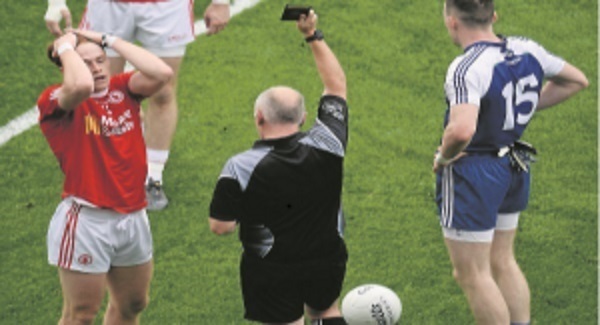
We have arrived at a point now that a mistimed shoulder tackle in Gaelic football could get you sent off the pitch, while we allow our hurlers to stay on the field after committing acts that in other circumstances might get you a criminal conviction. Let’s be honest, that is where we currently are.
From day one, I knew that the black card would be a regrettable introduction to Gaelic football. Hard case makes bad law and, instead of dealing with the specific instances that initiated its inception, a one-hat-fits-all approach was taken. The unforeseen impact has left us in a much worse place than when we started, and only its most blinkered proponents could honestly say the game is better since the introduction of the black card.
Freakonomics, a great book I might have referenced here before, explores the real and often hidden underlying causes for changes in societal behaviour. In one chapter, it explores the unforeseen behaviour of parents collecting their children from daycare. To curb the growing instance of parents arriving late to collect their children, they introduced a fine system. What happened? The ‘late pick-up’ incidents increased. Doubled even!
The moral incentive to pick up their kids on time was replaced with a financial transaction that the parents were happy to pay, for the extra few minutes free time in the afternoon. A not dissimilar pattern has emerged since the introduction of the black card. Without the stats in front of me, I would chance a bet on there being an actual increase in ‘cynical’ fouls of the drag-down variety, rather than a decrease, since the black card’s introduction. At the very least, it hasn’t acted as an effective deterrent. The moral disincentive against perpetrating a black card offence has been replaced with a legitimate transaction that many players are continually happy to pay. Equally, offences that would never have raised the ire of anyone in the past have seen the offenders sent to the stand, simply because a referee now feels he is obliged to.
A further example that illustrates how poorly thought out the black card solution was, is the recent prevalence of neck-high challenges. Instead of now attempting to stop a player with a direct shoulder charge or strong tackle, the likes of which we cheer in hurling, players won’t commit for fear of being led into ‘black card territory’.
The low-risk option now is to take the player high by the neck, but make sure you don’t go to ground with him. A yellow card is all that can be shown here, yet it is unquestionably a more dangerous and equally cynical tackle than anything on the black card menu. The whole thing is a mess.
Another regressive symptom of the black card is the continued erosion of physicality from our game, which is now being replaced with cynicism, largely borne out of frustration. For fear of mistiming a physical challenge out the field, players are now more inclined to retreat and tackle in numbers than put themselves in line for an early shower. This isn’t the case in hurling, as players like Iarla Tannion, Padraic Maher and Jackie Tyrrell ferociously fling their bodies into collisions. As Cyril Farrell says ‘tis great manly shtuff’.
We celebrate the physicality and intensity witnessed in hurling matches, yet implement rules that curb the same in football. That a player should be sent off for a single infraction, some of which are on the low side of cynical, continues to be an embarrassment to our game and an injustice to its players. I know of no other field sport in the world where a similar rule applies.
In nearly every game I play in these days, there are countless examples of players pulling out of challenges for fear of being a fraction of a second late and ending up in a referee’s book. Instead we retreat, and retreat until the risk reward is so low all is left is an unsightly, yet effective, mass defence approach. Managers are recognising this, and subsequently coaching the same.
Supporters and commentators alike relish the physicality in games and want to see more. I can guarantee you players want to see more of it also. In my opinion, a lot of the cynicism we are currently witnessing is borne out of frustration through the lack of physicality permitted. A few body checks and mistimed shoulder charges never caused anyone too many sleepless nights. God knows there were plenty of them back in the alleged golden days of yore. This is the small price we need to be willing to pay in order to encourage more honest physicality back into our game.
At the end of the day, our games are sold on the basis that they are physical contact sports. With that, there has to be an acceptance that the lines can be crossed at times without the game being called into disrepute. That philosophy has been afforded to hurling, and it is the better for it. It is time we return the same to football.
CONNECT WITH US TODAY



Be the first to know the latest news and updates