Shane Moloney seizes moment in game for the ages
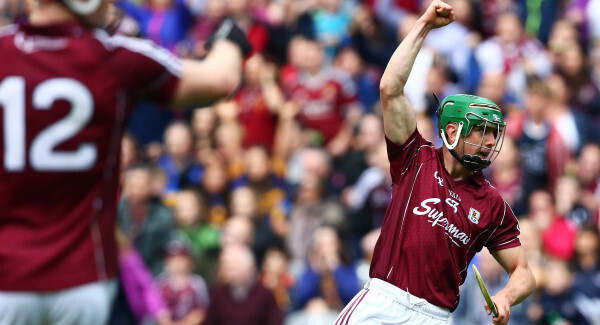
The game made a hero of Shane Moloney, who scored his first championship point to send Galway into an All-Ireland final. It made a prophet of his manager, Anthony Cunningham, whose promise to Kilkenny boss Brian Cody that he’d see him in September was duly fulfilled.
It also sent a dose of adrenaline straight into the bloodstream of a championship that has often seemed to lack a heartbeat. Can a single superlative contest elevate an entire tournament and make it memorable?
Well, the impulse is to say 2015 has been illuminated by yesterday but not elevated, but this isn’t a moment for philosophical niceties. First to yesterday’s contest for the ages, which met one of the lesser-known criteria for classic championship games: temporal compression.
Unlike practically every other inter-county game this summer, when you looked at your watch quarter-of-an-hour into Galway-Tipperary, you were surprised there was so much time gone.
That curious accelerating sensation you associate with a real championship game was present yesterday at last. Real evidence? On 46 minutes, Joe Canning swerved inside the 20-metre line, embodying the verb to maraud, and chopped a shot that Darren Gleeson somehow parried away. In less time than it takes to read that sentence, Tipperary worked the ball downfield until John O’Dwyer could see the whites of Colm Callanan’s eyes, but the Galway keeper turned his shot away.
A quick audit of the opening three minutes alone would reveal a goal after just 38 seconds and a hurley broken across the stick of the man who got that goal; three players required attention and there were two temporary replacements. We’ve seen entire provincial championships this year which couldn’t match that for incident. After a breathless first half, we awaited an inevitable dip in intensity, only for Joe Canning to golf over the first score of the second half from a sideline cut.
The winners were left winded by three Tipperary goals but they managed 26 scores and had a better spread of scorers than their opponents, who were overly reliant on their number 14. Seamus Callanan abbreviated his swing to stroke home a goal in the first minute and only improved afterwards, but he couldn’t do it all by himself. It was emblematic of Galway’s collective effort that they conjured up a winner from a player who’d been discarded earlier in the year for not being fit enough.
However, when Anthony Cunningham said that Galway had plenty still to work on, he wasn’t kidding. Padraig Mannion was left to suffer in Seamus Callanan’s company for far too long, with each of the Tipperary man’s goals following a familiar pattern: a high fetch and a sharp finish.
Cunningham advised that John Hanbury, who was named at number three, was nursing an injury but Galway were still forced to move him into the centre to relieve Mannion, whereupon the new marker conceded a penalty.
The Galway boss might have been correct in saying Callanan was unmarkable, and a final tally of 3-9 argues his point strongly, but Kilkenny will surely have noted the profit reaped by Tipperary from a direct approach.
On the other hand, Galway’s appetite for work wore away Tipperary’s resolve. The westerners had overpowered Cork in the previous game and in the final quarter they were too physical for Tipperary also, turning over ball in the middle third of the field which eventually led to Moloney’s point, itself a matter of calm collection and cool conversion.
For Tipperary, there’s a grim parallel to be found in yesterday’s game. In 2010, they were the ones who found a way out of an All-Ireland semi-final by a single point when they beat Galway to the tape, and they rounded that season off with Liam MacCarthy. Now, half a decade on, a team rich in talent has yet to add to that title, and will embark on 2016 with a new manager, Michael Ryan, as yesterday was Eamon O’Shea’s last day at the helm.
True to form, O’Shea was gracious as he departed: “I just want to say that I really think Galway deserve huge credit. Just in case I fail to say it. They deserve huge credit for coming with a display like that today in terms of their energy and so on.
“I think we didn’t always meet that or reach the fluency that our game requires and that probably cost us in the end but it was a really strong performance from the opposition. We tried really hard to fight it but in the end, they got the point to win and huge credit.”
Tipp have Seamus Callanan and will have him next year. His contribution yesterday was immense, but they never got John O’Dwyer into the play as they managed in the Munster final, for instance, and one wonders if Padraic Maher’s season as a spare man dulled the edge of urgency in his play, given the number of times he was turned over by Galway yesterday.
The day belonged to the Tribesmen, though. Brian Cody and Kilkenny have already beaten Galway in the Leinster final, but Anthony Cunningham threw new light on that particular game yesterday.
“We’d always believe we were probably playing better in training and working harder than we could produce in the Leinster final,” said the Galway boss.
“To be honest we were disappointed. I had no doubt if we improved - the same for today - that we’d have a shot at it. If we don’t improve, we won’t win. You have to improve from day to day.” Galway’s improvement looked marked yesterday, and their power in traffic will ask serious questions of opponents who have key players nursing injuries and other big characters likely to miss the game completely. Close observers will have noted a relatively orthodox formation was adopted by both teams yesterday: will Kilkenny be as amenable to playing on Galway’s terms next month? Doubtful.
Before leaving the game, a word to the man whose appearance drew warm applause from every corner of the stadium. Noel McGrath faced a tough opponent earlier this year but he recovered to take the field for Tipperary with 10 minutes remaining. It was almost Bob Champion and Aldaniti all over again when he nudged Tipp ahead, but Jason Flynn and Shane Moloney had other ideas. No matter. Napoleon used to say he had only one requirement, success, but he was wrong. There are other requirements. Other successes.