The day Louth football can’t forget or forgive
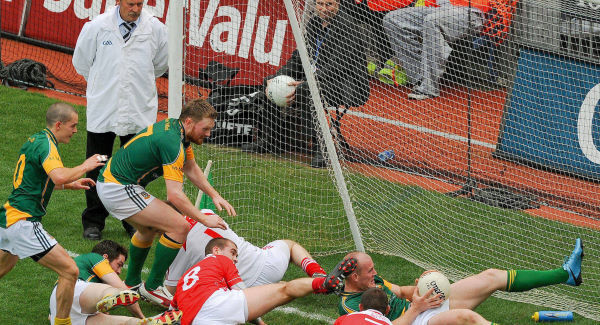
Widely regarded as one of the greatest injustices ever to befall a Championship game, the fallout from Sheridan’s illegitimately scored but ultimately permitted goal was colossal. Martin Sludden’s refereeing career never really recovered, two Louth supporters who aggressively accosted him were brought up in front of court, the GAA were accused of being Pontius Pilate while relations between Louth and Meath supporters hit a new low. Meath players maintain their victory wasn’t sullied. A documentary this year returned to that fateful Leinster final that won’t be forgotten in a hurry.
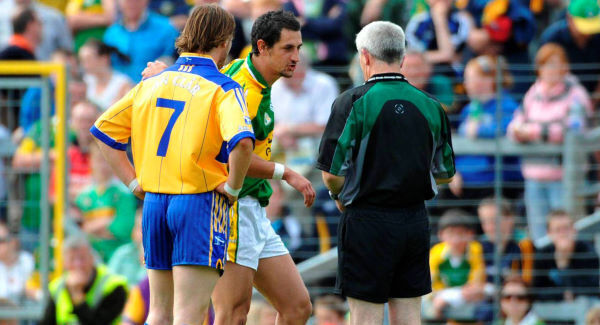
Both men have revisited the remarkable incident in Fitzgerald Stadium in their autobiographies, with then Kerry captain Galvin revealing it was a moment of pure frustration while maintaining it was a bad decision considering his Clare marker John Hayes was the aggressor. The second yellow card was bad enough on his debut as skipper but knocking the notebook out of Russell’s hands saw him handed with a six-month ban, later reduced to three after it was taken to the Disputes Resolution Authority. It was as close to a Paulo di Canio moment as inter-county Gaelic games has got.
It didn’t start on the field but it certainly spilled onto it as Clare and Cork hurlers clashed having left their dressing rooms at the same time for that year’s Munster quarter-final. Both county boards were fined and seven players were handed down four-week suspensions — Clare quarter Barry Nugent, Colin Lynch, Andrew Quinn and Alan Markham and Cork trio Dónal Óg Cusack, Diarmuid O’Sullivan and Seán Óg Ó hAilpín. The Cork players released a statement after failing to have their bans overturned claiming there was a bias against the county in the media and in the GAA’s disciplinary system.
Earlier this year, GAA president Liam O’Neill apologised for the calibration mishap which saw a legitimate Barry Nash score deemed a wide by the Hawk-Eye score detection technology during Limerick’s All-Ireland minor semi-final with Galway. The game finished level at the end of 60 minutes and Galway won it in extra-time. The problem caused severe embarrassment for Hawk-Eye before it redeemed itself by calling Tipp’s John O’Dwyer’s free a wide this year.
The Siege of Ennis. After referee Jason O’Mahony and his umpires were escorted off the field by gardaí, Clare supporters staged a sitdown protest. Clare had initially been awarded a free only for O’Mahony to be called back by his umpire who informed him in starting that passage of play, Clare goalkeeper Donal Tuohy had taken a step outside the box. As per rule, Tipperary were awarded a 65, which Pa Bourke sent over for the match-winning score. The rule has since been changed with the penalty being a throw-in on the defending team’s 20-metre line.
Before the square ball rule was changed and in what was Pat McEnaney’s last senior inter-county game as a referee, the respected official allowed a Benny Coulter goal to stand against Kildare in that year’s All-Ireland semi-final. That was despite the fact the Down forward was clearly in the area before the ball reached it. On top of an Alan Smith effort which was waved wide but should have been acknowledged with a white flag, it marked a cruel day for the Lilywhites.
One of Gaelic football’s ugliest days where four players were sent off by Paddy Russell in the Tyrone-Dublin Division 1 game and five more were retrospectively charged with other offences but escaped due to procedural technicalities. Dublin won the game and claimed to have won the fight but it was a sorry sight as the players became embroiled in violent episodes. Russell later revealed he almost considered abandoning the game.
With seven minutes of normal time remaining and Tipperary two points ahead, Kilkenny were award a penalty when Diarmuid Kirwan adjudged Richie Power to have been fouled in the area. Replays showed he wasn’t and with that Henry Shefflin found the net to put the Cats in front for the first time since the 40th minute. They didn’t look back, as Martin Comerford found the net shortly afterwards.
A year after a square ball goal helped to seal their feat, irony was to hit Kildare straight in the jaw when O’Connor had a perfectly fine goal disallowed in their epic quarter-final encounter with Donegal. Had it been allowed, Kildare would have gone six points ahead, possibly too far ahead of Donegal who prevailed with a mega Kevin Cassidy point in extra-time.
As if Mayo supporters weren’t aggrieved enough that this year’s replay was brought to Limerick, things became sourer for them when referee Cormac Reilly elected not to show an already yellow carded Shane Enright a black card for a deliberate pull-down on Cillian O’Connor in conceding an 18th minute penalty. Enright soon made way for Marc Ó Sé and Kerry were never numerically disadvantaged. Close to the end of the game, one Mayo fan was so disgruntled with Reilly’s performance it took several stewards to remove him from the field.
The mention of Reilly’s name in Mayo is greeted with as much frustration as McQuillan’s in Kerry. They won’t forget how he failed to notice Kevin McManamon double-hopping the ball with three minutes to go in a scoring area for Kerry and getting away with it. Also, McQuillan’s failure to either speed up Stephen Cluxton in kicking what turned out to be the winning free — he took 60 seconds — or allow sufficient additional time was met with anger in the Kingdom. As for the awarding of the winning free? We still believe it was one but many don’t.
For an administrator criticised often and often by his own, Frank Murphy has got Cork out of more tight spots than some of the county’s finest footballers and hurlers. Twelve years ago was a prime example when Cork used more than 20 different players in their Munster SFC final victory over Tipperary. Murphy pointed out in the subsequent investigation that there was no penalty laid out for breaching the blood sub rule, which he admitted Cork had contravened.
In that year’s All-Ireland MFC semi-final against Derry, the Cork minor midfielder was shown a second yellow card by Gerry Kinneavy but he failed to send him to the line. Cork quickly replaced him and went onto win the game by a single point before going onto win All-Ireland title. Cork, advised by Frank Murphy, didn’t speak after the game. The GAC, the then disciplinary body, accepted Murphy shouldn’t have been yellow carded in the first half and the result was allowed to stand.
After Dublin salvaged a draw to relegate Donegal last year, claims emanated that Paddy McBrearty had been bitten during the game. They were substantiated in investigations that followed but as the Donegal player was not prepared to pursue the matter by appearing in front of the Central Hearings Committee, the Dublin player involved escaped punishment.
In taking down Conor McManus and denying him what looked to be an almost certain goal, Cavanagh knew exactly what he was doing but he couldn’t have foreseen the anger that it provoked. Joe Brolly was later forced to apologise for the ferocity of his criticism of Cavanagh. The rugby-style takedown was held up as the perfect reason why the black card had to be introduced. Cavanagh argued in the context of his career he was more sinned against than sinning.
Who was right, who was wrong? Cavan? Armagh? Make your own mind up but the decision by Armagh to line up behind the Cavan flag was the trigger for the brawl that followed between several players on both sides. Retrospective one-match bans were dished out to Brendan Donaghy, Andy Mallon and Kieran Toner as were Cavan pair Fergal Flanagan and Martin Dunne, who broke his hand in the incident. Both counties were fined €5,000. Cavan accepted their punishment but Armagh claimed they were victims of a “raw deal”.
Kildare, as you can gather from our list, have been hard done by down through the years and to this day they maintain Offaly exceeded their limit of five subs as it was then in the counties’ Leinster quarter-final. Offaly insisted they only used five. Pascal Kellaghan came back on for Trevor Phelan, having been replaced by James Coughlan for a blood injury. Coughlan remained on the field from the time of his “temporary” introduction. As is often the case in these situations, the result stood.
For a lot of people, it was funny but at the time there was mayhem prior to that All-Ireland semi-final as Mayo decided to warm-up on the Hill 16 side of Croke Park, most commonly used by Dublin. Mayo coach John Morrison got a dunt in the back from Paul Caffrey as each side lay claim to the area of the field. In the same game, Ciaran Whelan escaped sanction for a high, dangerous tackle on Ronan McGarrity.
The bookmakers made no friends in the GAA when they indulged in some “ambush marketing”, their brand appearing on the hurleys of three players. Damien Fitzhenry, Paul Codd and Seán Óg Ó hAilpín who were each paid the sum of €750. The loophole in the GAA rulebook, which didn’t extend to hurleys, was later closed as a result of the controversy.
At the time, it appeared nothing more than an extremely brave/foolish dash by one goalkeeper to stop the speedy bullet of a penalty from another. Only what O’Keeffe did in denying Nash a goal not only left a lasting impression on his thigh but on the rest of the Championship as the GAA moved to enforce all penalties be taken on or before the 20 metre line.

CONNECT WITH US TODAY



Be the first to know the latest news and updates