A Kerry education
In late 2010, he was in conversation with a friend about the difference between individual and team sport when Jim McGuinness’ name came up. O’Donnell told her that Donegal would win the following year’s Ulster title.
Despite Donegal having been wiped by Armagh that previous summer, he had one reason to believe the county would be back better than ever. “Because of the man taking over, I said.”
So when his friend presented him (on his birthday) with a betting slip to the effect of O’Donnell’s forecast, he could only smile. “But the house was being renovated and the ticket was moved.”
Fr O’Donnell knew McGuinness was different as soon as he arrived in IT Tralee, where he was chaplain, in 1997. He was older, for a start. A mature student. Having completed his Leaving Cert at the age of 24 after leaving school early, Jim McGuinness enrolled for a sports studies diploma.
“He wanted to come to study in Tralee because he knew it was a good place for football,” recalls former Kerry trainer Pat Flanagan, an IT Tralee lecturer who prepared the college’s three-in-a-row Sigerson Cup teams. “The good players were starting to come and he came all the way from Donegal. He was, and still is, the type of guy who wants to be at the pulse of things.”
McGuinness arrived as an All-Ireland winning panellist five years previous. Seamus Moynihan, who was studying a Masters, picked up his first in 1997. A year later, other students such as Pádraic Joyce and Michael Donnellan would claim another.
Under Val Andrews, IT Tralee were the Harlem Globetrotters of college football, setting a precedent for several to follow. But what distinguished them, McGuinness maintains, was the work ethic.
“We trained four days on and three days off and we trained twice a day — seven in the morning and evening. Gym and pitch sessions in Kerins O’Rahillys. Seamus Moynihan, for example was living in Glenflesk and Jack Ferriter was in Dingle; they were travelling. They were leaving to be in Tralee for 7am so were on the road before six. And Seamus didn’t have to prove anything at that stage. So that was a wake-up call.
“When you were going away, every hour was on the flipchart and organised and structured. It was good to be in that environment. We had Pádraic Joyce and Michael Donnellan and all these players and six or seven of the Kerry players who won an All-Ireland that September. So it was a great dressing room to be involved in. And it was great fun. The whole team used to go out on a Thursday night together. And there was great camaraderie.
“It was similar to what DCU and those colleges are running now but it was 15 years ago. So it was good to see what was going on and when I was going back to Donegal... we weren’t on that level.”
Kerry’s 1997 All-Ireland winner, Barry O’Shea, fondly remembers those nights in Horan’s in late ‘97 and early ‘98. “I can remember himself and myself jumping off a railing onto the dance floor in a nightclub! The bouncer, God rest him, the same man has passed away since, let’s say we gave him a few headaches over those two years but it was all in good fun. It wasn’t too serious.
“We were all different people at the time. You wouldn’t have seen him being one of the top GAA managers in the country at the time. None of us thought we would be. Maybe a Seamus Moynihan or Pádraic Joyce but you wouldn’t have put Jimmy McGuinness at the top of the list.
“We weren’t really too worried about football out on those social events. He was probably a little bit different. I’ve been asked a lot was he a big influence in the dressing room but I don’t think he was. He was a little calmer than we were when it came to the football because he was older. When it came to football he was serious.”
McGuinness was vital but only a cog in beating UUJ in a dog of a 1998 Sigerson Cup final played on home soil. “Jimmy loved the tough, hardy stuff against those fellow Ulster players that year,” recounts Flanagan, “but the next year he was the driving force.”
He had changed. In August 1998, he was a passenger in the car when his brother Mark died in a crash in Fermanagh while driving the younger McGuinness to Dublin airport to fly out to New York to play football.
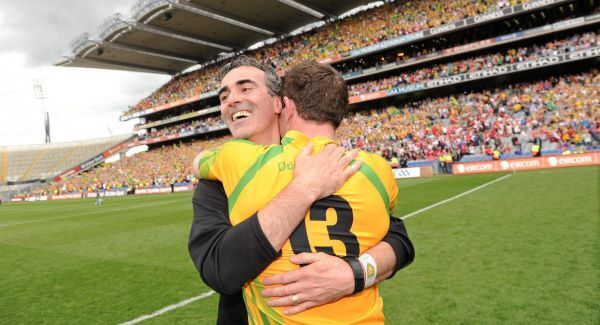
Fr O’Donnell noticed how steelier he became after it. “That was a particularly hard time in his own life. I wasn’t surprised when Donegal won the All-Ireland that on the way back they stopped on the side of the road to remember his brother. They’re a very close family and that really knocked Jimmy to his foundations. He found great strength and developed a toughness from life and a willingness to overcome obstacles.
“When we got to the Sigerson final, Joycey managed to get himself off up in Galway which meant we didn’t have him for the Sigerson final (v Garda College). Jimmy took on the role of leader, but he was that anyway. What Jimmy engendered on the lads back then was a great sense of self-belief. I remember the morning of the Sigerson final he gave a great talk as captain. There were fellas who were made 10 foot tall after it but not so hyped that they weren’t thinking.”
Two years ago, former Laois footballer Colm Parkinson, who joined IT Tralee in late 1998, told this newspaper McGuinness was the de facto coach when they claimed the ‘99 Sigerson Cup title. “Vinny O’Shea took over (after Andrews) but Vinny didn’t have that much experience. Jimmy was captain and in all fairness, he was the player-manager. He took all the training sessions and Vinny was more of a selector. As far as I’m concerned, you can add that Sigerson title to Jimmy’s managerial CV.
“We did enjoy ourselves but we trained hard. I remember Jimmy banging at my door at 7 in the morning to do weights at 7.30. Yeah, lads like to hear stories about being on the beer and in most cases they don’t get it for no reason. There was a bit of partying but without Jimmy we wouldn’t have won that Sigerson.”
All the time, McGuinness, that year’s club person of the year in IT Tralee, was travelling regularly up to Glenties to line out for Naomh Conaill. “I don’t think I missed a league game for my club, definitely, because we were trying to ground ourselves at that stage so I felt that was important. People talk about those sacrifices but it is not a big deal. You are driving up the road because you are looking forward to the game and you want to play.”
He’s fond memories of those times when IT Tralee needed him as much as he needed them, describing next Sunday as “a lovely final for myself”. He laughs: “I have a great group of friends down there and I am sending them an odd text at the moment that if you hear anything in the Kerry team to let me know. But there is nobody responding to anything!”
They hear him knocking but he can’t come in. Not this time anyway.