Role reversal from 2003 final
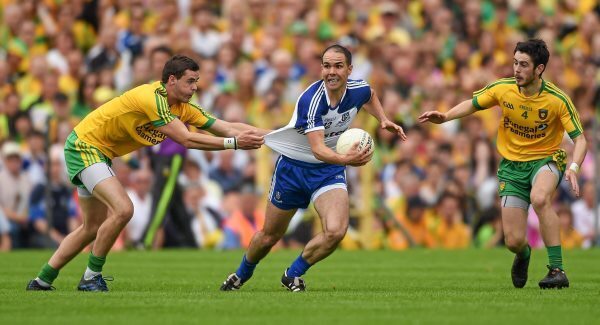
It was the day Donegal’s ‘likeable losers’ tag stuck.

Role reversal from 2003 final

After Pat Spillane denounced Tyrone’s ‘puke football’ following their 2003 All-Ireland semi-final win over Kerry, the championship was down to three teams all from Ulster.

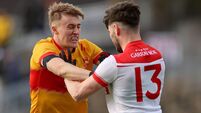
Tyrone possessed a swarming defensive system and the muscular Armagh players’ veins popped through those orange jerseys that seemed painted on, while rank-outsiders Donegal were from a throwback through time.


That season, Brian McEniff, who’d won the first of their five Ulster titles in 1972 and Donegal’s only All-Ireland 20 years later, began his fifth tenure as manager.

“I was county chairman and nobody wanted the manager’s job,” he says. “I was 60, there in Tuam for National League in late January. My back was gone and I was barely fit to walk, thinking ‘what the hell am I doing?’.”

Joe Kernan’s Armagh, on their way to a first All-Ireland, defeated Mickey Moran’s Donegal 1-14 to 1-10 in the 2002 Ulster final. Monaghan, a year later, provided an Ulster preliminary round shock with a 0-13 to 0-9 win over Armagh and McEniff’s return ended in a drab 0-10 to 0-6 provincial quarter-final loss to Fermanagh.

Both pottered away in the qualifiers, Armagh notably beating Dublin as Donegal overcame Longford, Sligo, Tipperary and Down. People only took notice after their victory over 2001 Sam Maguire winners Galway in an All-Ireland quarter-final replay at Castlebar.

“Armagh was going to be completely different — more of a battle — compared to a pure football team like Galway,” says corner-back Niall McCready, who watched the previous All-Ireland final at the Heritage in Yonkers.

“It was only when we played them in the league I saw how physically imposing Armagh were,” McEniff says. “I remember saying they played to the edge of the rule book — and beyond it. They were intimidating.”

Stephen McDermott, then a 21-year-old midfielder in his debut championship season, added: “There was no point in trying to take on Armagh physically. Our natural short-passing game, moving the ball at speed and trying to avoid contact was the best chance we had.”

With Armagh kicking 20 wides, Donegal used their core competencies – bar avoiding contact — to create the opening goal. Paul McGonigle fed McDermott, who released Christy Toye to drill past Paul Hearty at Hill 16.

Showing more innocence than experience, there was a succession of Donegal players splattered on the turf, taken late by Armagh challenges, with McDermott the last of that queue.

“I didn’t know where I was,” he continues. “At half-time, I’d tunnel vision. Niall McCready was sitting beside me and I couldn’t see him unless I turned around.”

“Stephen was rattled,” McCready adds.

With McDermott concussed and replaced, full-back Raymond Sweeney was given a second yellow as the second half began, with Donegal 1-5 to 0-4 up.

In the Hogan Stand tunnel, substitute Jim McGuinness, who’d wear the Donegal jersey for the last time that afternoon, offered a shoulder to cry on. Sweeney still seldom speaks on the matter, although he did on his inter-county retirement in 2010.

“It was our one great chance to reach an All-Ireland,” he told The Donegal Democrat.

“That game... it is the one that hurts and annoys me most. It was bad enough being sent off but when I look back on that game, we had Armagh.”

The 14 men performed admirably, with John McEntee fortunate to remain on the field having elbowed Barry Monaghan. Armagh equalised when Stevie McDonnell got the better of McCready and goalkeeper Tony Blake.

“When hand-passes start to go sideways instead of forwards, you’re going to get turned over,” McCready says. “Raymond’s dismissal meant we’d lost an aerial presence and Armagh began to pump in balls.”

Philip Loughran put Armagh ahead and in injury-time’s fifth minute, McConville’s penalty was the final nail: Armagh 2-10 Donegal 1-9.

When Donegal lost 1-12 to 1-11 to Galway in the 1983 All-Ireland semi-final after Val Daly’s mis-kicked winning goal, McEniff sat on a park bench in Rathmines all night wondering why.

“In 1983, we were better than Galway,” he says. “But in 2003, Armagh were better than us. W”

McDermott added: “Who knows what kind of a lift Donegal might’ve got had we reached that All-Ireland final. That was the crossroads. Armagh had something over us from then on.”

That 2003 All-Ireland semi-final was the second of Armagh’s five successive championship season wins over Donegal. When Brendan Devenney’s pop at a point fell into Hearty’s net in the 2007 Ulster quarter-final, Donegal found all their luck repaid on one day.

Armagh, in 2010, walloped John Joe Doherty’s Donegal 2-14 to 0-11 in a first round qualifier at Crossmaglen. That match, the last of the pre-McGuinness era, was another crossroads. By then, Donegal weren’t even likeable losers.

Donegal’s contemporaries are favourites for today’s All-Ireland quarter-final. They’ve three Ulster titles and one All-Ireland since Crossmaglen. McGuinness has relegated Armagh from Division 1 to 3.

Armagh’s victory over Meath last Saturday was their first championship win at Croke Park since the 2006 Ulster final – the last of their five-in-a-row stranglehold on Donegal.

“The Donegal of 2003 are like the Armagh of now and vice versa,” McCready concludes. “Armagh are the unknown quantity coming through the qualifiers, while Donegal have experience from an All-Ireland and a few Ulster titles.

“Like 2003, it might come down to experience. That’s what cost us then. But that’s what might win it for us today.”

x

More in this section

Cookie Policy Privacy Policy Brand Safety FAQ Help Contact Us Terms and Conditions

© Examiner Echo Group Limited