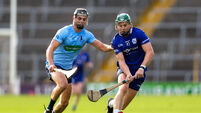
Delaney questions viability of FRC ‘fixes’
Leinster Council secretary Michael Delaney has come down hard on the Football Review Committee (FRC)’s championship proposals.

Delaney questions viability of FRC ‘fixes’

In his annual report, Delaney strongly criticises the group’s second part of the report, describing their variation of the provincial structure as “a bit of head scratcher”.

He argues their recommendation, to transplant beaten first round teams in Leinster and Ulster into Munster and Connacht so that there are an even eight counties in each province by the quarter-final stage, lacks appeal.

Delaney also claims the FRC fails to address what he regards as the biggest problem posed to club fixtures by inter-county qualifiers, and is disappointed by the lack of respect given to hurling in the FRC’s devised championship format for football.

Although he praises the FRC for several innovative and constructive proposals, he writes: “The scheduling proposals for the football championship are neatly packaged (although I thought the committee might have addressed the possibility of Friday night games) but there appears to be little or no consideration given to the need to also factor in dates for the provincial and All Ireland hurling championship fixtures. This is most blatant when the committee proposes that the four provincial football finals would be played over two successive weekends in July. What happens to the Leinster and Munster senior hurling finals? — surely it is not envisaged that they be played on the same day!”

Delaney takes issue with the idea of two Leinster counties beaten in the first round moving into Munster.

“The proposal to have eight teams in each province at the start of the inter-county provincial championships is a bit of a head scratcher. Are we to persuade ourselves that the first three games in the Leinster Senior Football Championship are not really that at all?

“Besides, can somebody honestly tell me what is the attraction — for players, supporters or media — of the loser of a Carlow/Wicklow SFC game heading off to play Waterford or Kerry in the Munster championship or for the loser of a Longford/Laois game heading off to Castlebar to play Mayo in the Connacht championship?”

It is Delaney’s assertion the eradication of the qualifiers for all teams beaten outside provincial semi-final and finals will benefit county boards in arranging club fixtures.

“Early on in the document it is stated that this report attempts to address the prevailing view that club players are badly treated in terms of their competitions and fixtures. That is a noble ambition but, in my opinion, the report does not remotely deal with this problem. Years of experience have led me to the conclusion that the biggest obstacle to the organisation of any kind of viable club competition schedule is the qualifier system in the inter-county senior championships. It is unwieldy, time-consuming and practically pointless until August.

Yet the FRC barely touched on its existence. In fairness, if you are going to knock something, you should have some kind of an alternative. For what it’s worth, this is mine. If the Qualifier Series is not to be dispensed with then it should only come into play for beaten provincial semi-finalists and finalists. That would certainly free up a lot of weekends for club football in many counties.”

Also in his report, Delaney praises outgoing chairman Martin Skelly for his campaign to introduce Friday night inter-county games. Carlow hosted Laois in their first round qualifier on a Friday last year and next month Armagh and Down face off in a Division 2 game on a Friday.

On Skelly, Delaney says: “It’s worth saying also that he continues to promote the idea of Friday night fixtures in the All-Ireland and Leinster Championships — these may become a reality before much longer.”

Leinster reported a slight increase of €48,513 in their operating surplus last year from 2012. The Dublin-Meath senior football final, which attracted 54,485 to Croke Park, realised €1,042,138. The Dublin-Galway senior hurling final, staged a week earlier in HQ and drawing a 36,657 crowd, brought in €582,270.

x

More in this section

Cookie Policy Privacy Policy Brand Safety FAQ Help Contact Us Terms and Conditions

© Examiner Echo Group Limited