GAA now boosted by continental drift
It is unarguable that the one that generated the fewest column inches served its purpose better.
The European Gaelic Football Championship Finals hosted by Athlone Institute of Technology last weekend have done much more to promote the GAA to a wider public than the International Rules series.

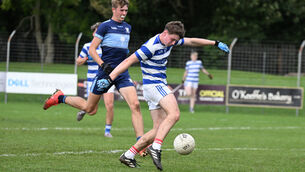
In excess of 70 games were played in both men’s and ladies’ codes, involving 27 teams from 20 countries, comprising more than 350 players.
You cannot imagine more unlikely pairings than The Hague taking on Jersey Irish, Inneoin Zurich battling Malmo, and Paris Gaels facing Slovak Shamrocks.
The story surrounding European GAA is scarcely believable and while the proliferation of Irish around the continent has contributed significantly to the phenomenon, the number of clubs established by people with no affiliation to Ireland is remarkable.
Monaghan native, Brian Clerkin is PRO of the European Board. Having won a few Monaghan hurling titles with the Harps, he moved to Zurich in 2008. The teacher was flabbergasted to learn that there was a continental championship in the ancient game and that Zurich were one of the kingpins.
As the male community in his international school increased, the idea was formed over a beverage or two in an Irish bar to set up a new football club in St Gallen.
“It’s an hour outside Zurich and we became rivals,” says Clerkin. “We built a team and a culture there together. We played the first ever Swiss (Gaelic football) match and eventually pushed that on so we got another team in Geneva. There’s talk of two more teams setting up in Switzerland and there’s a ladies team that’s a mix of players from a few different places in the country.”
As Clerkin speaks, Munich and Belgium are in opposition. Around 90% of the Munich team is non-Irish. The growth and development of the GAA outside of the expatriate community is simply staggering.
Brittany is one of the strongest regions in Europe with 11 clubs. The structures are developed to such an extent that they have 6,000 children playing Gaelic games as part of the school curriculum. PE teachers have secured the required qualifications via the Leinster Council and are now master coaches, tutoring other prospective coaches. The same approach applies to refereeing.
Amsterdam, Belgium and Guernsey have a strong Irish base but Brittany has started a revolution in terms of non-Irish playing the games.
Three years ago, Galicia in northern Spain had no team. Now they are on the cusp of breaking 10 teams, while they have four ladies football teams as well.
“The games stand up to any sport that’s out there,” insists Clerkin. “Throw into that the volunteer aspect, the amateur ethos. The way people do it for friends and family, the love of the community. When you have a core bunch of locals that are taking to the games, the possibilities are endless, and Brittany and Galicia have proven that.”
Lorient are newcomers, having only been established last year. Yet with a team comprised entirely of French players, that was playing on a pitch with proper goalposts for the first time ever, they overcame a Slovak Shamrocks unit that boasted a significant Irish representation.
Fabien Regnier formed Lorient GAC, having first been exposed to Gaelic football by Gwaned Vannes Football Gaélique at home, and then played for a year in Montreal.
“There were already seven clubs in Brittany so there were many people interested in Lorient that had heard about Gaelic games but not enough to make a team,” says Regnier. “I had the motivation though so I called these people, put some posters in Irish pubs, got some friends and colleagues and started with 35 members.”
The explosion of GAA clubs in Brittany can be linked to the region’s Celtic roots and Regnier points to love of all things Irish; the similarities in music and language. They are naturally drawn to the games.
“I think this will get stronger and stronger,” predicts Regnier. “We have 11 clubs in Brittany and more than 20 in France. Each time a player moves to a city where there is no team, he wants to continue playing so he creates a new team. This is how most of the clubs in France have been created. So there will be more.
“Looking at the games in Athlone this weekend, the standard is really high and playing against many teams with Irish players is very good. We are learning, even if we lose many games. Many of us started one year ago and you are playing Irish people that are playing all their lives. But when we go home, we will be stronger and more efficient on the pitch.”
James Kinihan comes from Rosemount in Westmeath but followed his future wife to Italy in 2001 when he was 23 and played rugby for 10 years. He pined for football though and discovered Rovigo GFC on Facebook two years ago. The club was established by Raffaello Franco after he had attended a game at Croke Park while on honeymoon. Franco returned home with an O’Neills ball purchased at the Croke Park Museum.
He invited his friends to the park and with 24 cans of Guinness brought along to sweeten the deal, a first training session was held. The vast majority of the players are Italian. Diarmuid Gallagher and Kevin Curren are the only other Irish players.
“It started off as a social event but Diarmuid came down and said that there was a European GAA board so we got in contact with Beano (Clerkin),” says Kinihan. “The organisation of the club is 100% Italian, and myself and Diarmuid help out when we can. I don’t think you have as much fun playing football in Ireland as you should. Here, it’s like a bunch of grown-ups playing underage football. We lost a semi-final today but lads are just delighted to get a good solo in, a good catch or a nice score. They love the culture behind it which makes you a lot prouder of it yourself. You don’t’ appreciate that, when you’re living in Ireland.”
Roviga now have a keenly-contested derby with Padova and compete for the Adige Cup, named after the river that separates them. Meanwhile, Gallagher is helping Verona and Milan develop, with some Aussie rules teams in those cities expressing an interest in going Gaelic.
It is all a far cry from the scenario in 1999, when the European board was established with just four clubs. Now there are 80, Strasbourg and Galicia adding to the tally in the past week. The Belgium club in Brussels, which has dominated ladies football in Europe in recent years, celebrated its 10th anniversary last week and had 120 players in action on the day. There are clubs in Ireland that couldn’t muster that.
“The ladies football president (Pat Quill) told me everyone he’s talked to said Gaelic games had changed their lives and nine times out of 10, the people that tell him this story are not Irish,” discloses Clerkin. “It’s a health and well-being thing, it’s a sport thing, it’s a social thing, a job recruitment thing; it’s everything.”
Europe had representation in the national club championships this year for the first time via Guernsey Gaels’ extremely competitive outing against Carlow’s Fenagh Gaels in the Leinster JFC. That is an area the board wants to develop, while they are also targeting the 100-club mark in the next two years, “filling in the lines” between Finland and Gibraltar, where the GAA is currently represented.
Progress is inevitable, as much as it is extraordinary. “My proudest day in the GAA was seeing one of our Swiss boys taking a heavy shoulder tackle, executing the basics of the game and putting over a lovely point,” smiles Clerkin. “As far as I’m concerned, I reached my ceiling that day. Everything else is a bonus.”