Keaveney: Dubs won’t have it easy
The Dubs are 4/9 with some bookmakers to book a final place against Mayo, but the St Vincent’s great points to Kerry’s record against the Dubs when entering games as underdogs.
“It’s going to be a tough one against Kerry on Sunday, no matter what people say,” insists Keaveney. “Micko (O’Dwyer) says there that he mightn’t even go to the match — I’ll take that one with a grain of salt anyway.”
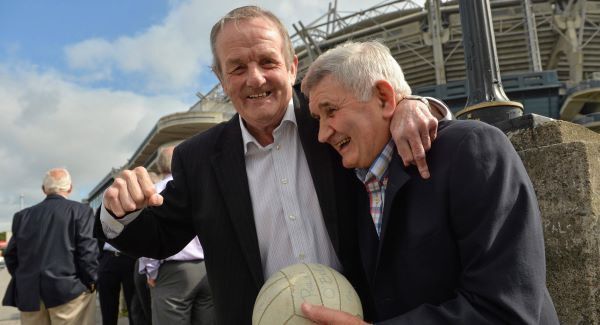
O’Dwyer, who along with Keaveney was in attendance as former Mayo star Willie Joe Padden was inducted into the DAA (Dublin Airport Authority) Kick Fada Hall of Fame, publicly feels his county have a good chance.
“A lot of people would be saying that the legs of some of the players have started to wane a bit but there could be still a good game in this Kerry team,” says O’Dwyer.
“They’ve trained hard since the Cavan game and now they’re rested up so I think they’re not going to be beaten too easily in Croke Park.”
The Dublin-Kerry rivalry first truly came to life back in the 70’s when O’Dwyer took over as manager, several seasons after Keaveney made his debut for the capital.
The teams met in four All-Ireland finals between 1975 and 1979, with Kerry winning that series 3-1, including a 5-11 to 0-9 victory in 1978 when the Dubs went in as favourites.
“I know we were favourites a good few times in the 70s and were beaten,” recalls Keaveney. “I hear people saying in Dublin that we’re going to get it handy on Sunday. I don’t believe that.
“There’s not a word out of Kerry people, not a word at all. And I’m talking to Micko there a while ago and he’s the very same; he’s the biggest bluffer of the whole lot.
“He’s the very same, ‘Ah sure Jimmy we don’t have a chance, ye will beat us by seven or eight points’.
“I don’t go for that thing at all. We’ve a good team there and we should be there for a few years from the point of view that we have good young lads there, good underage structures.
“I think the bad old days of football in Dublin, the early 70s where we more or less played Division 2 football, I don’t think you’ll ever see that again.”
O’Dwyer recalls some of the lessons taught to the Dubs down through the years by sides he was involved with both as a player and manager.
“If you go back over the years — 1955, 1975, 1978 — Dublin were raging-hot favourites for all those games and the results went Kerry’s way,” explains O’Dwyer. “Dublin were never hotter than they are at the moment; they expect to win the All-Ireland, never mind beating Kerry. But Sunday is going to be a good test. Looking at the two teams and going on form, you would have to say that Dublin are that little bit ahead.”
Will Dublin’s 2011 All-Ireland final win over the Kingdom give O’Dwyer’s county extra motivation to win this one?
“That’ll be at the back of their minds,” he says. “When you beat Kerry at any stage, there will always be a fight back. But losing Killian Young to a broken ankle, he would be one of the younger of the senior brigade; then you have Eoin Brosnan struggling with an injury, and the back line didn’t look too good all along.
“But Anthony Maher is back and I think he will make a big impression. I think he is going to be a marvellous midfielder, he’s one of the best we’ve had for a long time.
“You have James O’Donoghue then — I think we have five of the best forwards in the country still on a given day if they perform.”
Keaveney would like to see plenty of changes in the modern game, all of which essentially revert to how it was played in the past. The three-time All-Ireland winner wants to see a maximum of two handpasses in a row, all kickouts required to go beyond the 45-yard line, and frees to be taken from the ground. He’s unsure if the black card will have a major impact but he is quite empathic when asked about cynical play, paying particular focus to Sean Cavanagh’s foul on Monaghan’s Conor McManus.
“That’s a load of bullshit, 999 people of out 1000 would have done what Sean Cavanagh done, otherwise you’d get the arse kicked off you when you go back into the dressing room,” Keaveney says.
“I don’t go for that sort of thing. If that happened further out the field, there would be nothing said about it.”
CONNECT WITH US TODAY



Be the first to know the latest news and updates