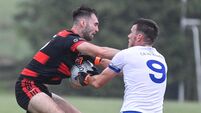
Fogarty has no time for cynical play
Black cards and videos shown to Congress, the FRC and cynicism. All of that good stuff.
It was interesting, therefore, to chat to Kilkenny hurling selector Martin Fogarty about the level of cynical fouling in the small ball game.
“I think, by and large, players are going out to play the ball in hurling, because the last thing a hurler wants to do is to give away silly frees,” says Fogarty.
“From 70 to 80 yards out, if you give away a free in inter-county hurling, it’s a point.
“That’s not the case in Gaelic football where, if you foul someone on halfway, the backs behind you have a chance to get set up and the free-taker won’t put the ball over the bar from 70 yards.
“Every (intercounty hurling) team has an accurate free-taker, someone who’ll score almost every chance he gets in the opposition half, and maybe beyond. And because of that, teams are being told to go out and not to foul.
“We certainly work hard on not giving away stupid frees. I think players go out to play hard, which is correct but players giving away stupid frees will hear it from their managers.
“You’d see the odd player trying to interfere with his opposite number, but in today’s game it’s difficult to do that without being caught.”
Fogarty doesn’t see today’s game as being necessarily more physical than in recent decades.
“I don’t think so,” he says. “If I go back to my own time as a kid watching, there were plenty of players you didn’t want to collide with — Pat Henderson, Eddie Keher, Mick Brennan, Pat Delaney, just to take Kilkenny.
“We had huge battles with Wexford, and you wouldn’t be too keen on walking into the likes of Tony Doran or the Quigleys or Mick Butler either.
“It was the same in every county. What I see is that more players are fit and are better conditioned — all of them.
“Long ago, you’d have very dedicated players, men who’d prepare at the same level as nowadays, but you might also have had players who were just very skilful, but who weren’t as fit.
“That’s changed. Nowadays everyone’s at the same level of fitness. If a player comes in who’s very skilful, he’ll have to get up to that level of fitness, whereas years ago a lot of teams carried a player or two for his skill level alone. Before you mightn’t have 15 super-fit men. Now you do. Though in fairness, you’d have to say that years ago most of the players were fit; the approach to collective training wasn’t as strong but most of those guys trained on their own. And it was a time when people did more physical work. A lot of hurlers going back the years were farmers and so on; they didn’t need gym work.”
Recently Ger Cunningham said in these pages that there was a danger gym work was cutting into hurlers’ time for sharpening their touch in the ball alley.
Fogarty agrees a balance must be found by players.
“I wouldn’t be giving away any trade secrets when I say we do a certain amount of gym work, but we don’t go mad on it. There’s no whip being cracked or anything — our focus would be on working on the skills, the touch, the sharpness. But to play inter-county hurling, you also need to be strong. If your work does not involve physical exertion, then you must supplement it. Noel Hickey didn’t need a lot of gym work because he was farming all day long; most lads are in offices and so on so they need that gym work.
“I think there’s a myth out there that 80% of team preparation has to be gym-based, but that’s terribly wrong.
“Some players who are naturally light, they’ll need some gym work to help them, but I’d see it as dangerous if management teams culled players because they weren’t at a specific level of fitness or strength.”
Fogarty has a fondness for the instinctive forward: “I’d be inclined to pick a guy who can just get a goal, that’s something that’s hard to train a guy to do — Jimmy Barry-Murphy was on Laochra Gael recently, planting a ball in the corner of the net. You can’t train a guy to do that.”
The Kilkenny man disagrees with suggestions that ground hurling is a) extinct and b) the answer to players bunching over the sliotar: “Ground hurling is still there. The availability of videos and DVDs of games means, though, that players can see what they’ve done and they realise, ‘hey, I gave away possession there’.
“Look at the good Cork team of 10 years ago — their approach was, presumably, ‘we won’t give the ball away when we have it’. That’s common sense. If you blindly lash a ball, then at best, it’s 50-50 where it goes. You don’t want to strike a great ball on the ground that goes straight to an opponent; then it becomes a stupid ball.
“There’s still ground hurling, though. Scores are made by moving the ball quickly on the ground — and out of the hand — even if it’s only five or 10 yards. But if you give the opposition the ball, it’s not helpful. The funny thing is a lot of people probably remember being told just to pull on the ball, to keep it moving. Or the games of backs and forwards in training where you’d be told not to rise the ball. That was foolish — if you were corner-forward and couldn’t rise the ball when you were on your own in front of goal, what could you do?
“All the skills are still in the game; the real challenge is knowing what club to pull out of the bag in a given situation. Know when to hold them, know when to fold them, like Kenny Rogers said.
“We tell guys ‘go out and take over’, but if I had a euro every time I was watching a game and was about to shout at a player, ‘don’t do that’ — only for it to work out because he took the right option... it’s down to the player. It always is. It always has been.”

CONNECT WITH US TODAY



Be the first to know the latest news and updates