Grin and Bere it
The men from the fishing village in West Cork will tell you they know the road well enough to make it in an hour and three-quarters, but what’s 15 minutes in a journey that long?
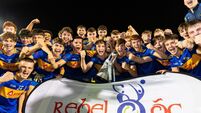
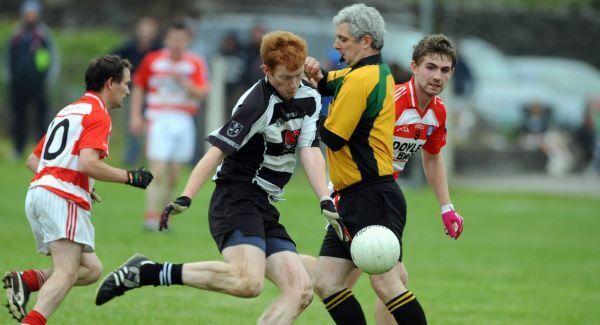
Their footballers didn’t manage any short cuts. Last Sunday they overcame Éire Óg in the Cork intermediate football championship final, but that’s the final chapter. You have to start on page one to get the full effect.
Twenty-two years ago[, Castletownbere lost to Macroom in the intermediate county final, but they got back to the decider seven years later. And in 1999. And in 2006. And last year. Two of those games went to replays.
Every time they headed west afterwards without the cup. “From our point of view, last Sunday it was a case of ‘how do we face back down the road home if we lose?’” says Seamus Harrington, the club vice-chairman.
“Certainly if we’d lost it would have been very hard to pick ourselves up come next January or February. The way the lads picked themselves up this year again was fantastic, and reaching the final was a great achievement, but if we’d lost it would have been very hard to go again.”
They never considered regrading to junior, though. They’d been senior in the 80s, but more important than that, they knew the challenges of the lower grade.
“The feeling would have been that the junior county is probably the hardest to win, anyway,” says Ollie O’Sullivan, the club chairman. “We won the intermediate in the 80s and I honestly felt we had a great chance of winning it again. Going back junior would have been defeating the purpose. It probably entered a few heads but for most of us there was no way we were going to go down.”
Enda Wiseman didn’t look like he’d be part of the journey this year, though. Work with GlaxoSmithKline was taking the experienced defender to Raleigh, North Carolina.
“I came over to the US in April with my wife, Vicky,” he says. “We had the opportunity to travel and part of the reason we hadn’t done so before was that I was playing football, even though we’d talked about it for years. But we couldn’t pass up this chance.”
Fate intervened. A Gaelic football club was set up by an American, Steve Shannon, in Raleigh just two days after Wiseman arrived. He trained with the 13 lads at the inaugural meeting through the summer, and when the American season ended, a couple of the lads — a Liverpudlian and an American — kept going with him, and kept him sharp.
Eventually he flew back seven times to play for Castletown.
“I look after myself and I’d trained hard up to April, but I hadn’t planned on coming back for so many games. Vicky wasn’t on her own for the seven weekends, she came back a couple of times, but there were a few testing conversations about it.
“I thought each would be the last: one trip was for a wedding, and there was a game the same time. I wasn’t coming back for Grenagh, but we realised how good they’d be so I came back; my brother got sent off against them, so I came back for the next game, and so on.
“Then I came back for the semi-final, and I wasn’t going to miss the final once we got there.”
That looked unlikely early in the year. Castletown lost two championship games, to Kanturk and Adrigole, before turning the season around with a win over Glanmire.
Then the team and the community took a blow when Pearse Lyne, who’d been principal of the national school, drowned on the weekend they were to play Grenagh in the championship.
“He would have been a tutor to us all,” says Harrington. “A stalwart of the club, and things were in turmoil after that. We went out to play Grenagh and Donagh Wiseman was put off after five minutes. Tough.”
They survived and were able to store the lesson of playing with 14 men for later.
The games then started to come “every week or fortnight”, says O’Sullivan, who saw encouraging signs when they reached the final. Encouraging absences, to be precise.
“We learned a lot from last year in particular, Small things that would distract you. Players wanted a gearbag with their name on it, that kind of thing, while this year there was nothing at all like that. The attitude was right.
“Being underdogs was the best thing that ever happened to us. Last year against Kinsale, we probably thought we just had to turn up, and we got a lesson. The shoe was on the other foot this year.”
On the day of the final against Éire Óg, 20 minutes before the game O’Sullivan saw bookies quoting Castletown at 7/2: “In a two-horse race? I thought that was unbelievable. We wanted it more. The likes of the two Wisemans, Sean Ban O’Sullivan, Alan O’Regan — they’ve been stalwarts, but the end of the road can’t be that far away. How many county finals are there going to be? They knew it was this year or nothing.”
They lost Shane McCarthy on 42 minutes, but that meant it was their third game of the season playing with 14 men. Familiar territory.
“We were able to click into it,” says O’Sullivan. “We’d been there before when we lost a man in the county final, so it wasn’t a shock. We got on with it. The panel is like that. They’re very tight.”
So was the game. Castletownbere closed it out, though. Afterwards they were in no great rush home, says Harrington; they even watched a bit of the hurling game that followed their match.
“We went out to The Viaduct for food,” he adds. “On the way home that evening we stopped in Glengarriff for half an hour, but we got together then, everyone, and we headed down to Castletownbere in a line of cars.
“It’s tough keeping the thing going. You’ve a lot of lads who live away from the town, the likes of Alan O’Regan is years living above in Cork, but he still plays for us. We’ve got a lot of players like that. They stay with us, lads who would have no problem getting transfers to other clubs. There’s an affiliation, there’s the history — there’s a sense that we’re a small club and need everyone, while with a bigger club you might have people who think ‘well there’s plenty others to fall in there instead of me’.
“But the lads do it. They put in the travel, they get back here — or we train somewhere else. We’d have trained a lot up in Cloughduv, and we had lads came from Dublin to train there and then they headed back.”
The reception in the town was massive, says Harrington: “A great night, bonfires, a reception in the square. The goodwill from the people of the area was fantastic.”
O’Sullivan chips in with concrete evidence: “I asked people to put their hands in their pockets to support the club and they were fantastic. Naturally things are tight, but people would give you €50 or €100 just to keep it going. A few people from Adrigole, even, chipped in to help support us.”
The acknowledgement is telling. Adrigole and Castletownbere are neighbours, but the rivalry isn’t dipped in bitterness. When Castletown beat them in the county semi-final it was heartbreaking for Adrigole, and not just because they missed out on a county final.
The intermediate football cup commemorates one of their clubmen, John Lock O’Sullivan, who died tragically young in 2002. The Castletownbere players knew him well as a neighbour. As an opponent. As a friend.
“We won’t forget the man the cup is named after,” says Ollie O’Sullivan.
That’s why the journey didn’t end in Castletownbere this week. On Tuesday, they took the cup out to John Lock’s grave. Afterwards they carried on to his parents’ house.
“There were 15 of us, and they welcomed us with open arms,” says O’Sullivan. “We had a lovely evening, a couple of drinks and that. We’re a tight division in Beara. It meant a lot to us to visit his parents. It was emotional. We were glad to head out to them.”
Not all of them were able to make that trip. Enda Wiseman’s return flight last Monday was 7.30am. He left Castletown at 3.30am to make it to the airport and he was catching up with emails in the office by Tuesday.
“I showed the boss the match report in the Examiner — ‘look, there’s proof of what I was doing’. He found it funny, and kind of mad, but the Americans love sport. And they like the bit of madness.”
His Raleigh teammates acknowledged the win: Wicklow county player Dara Ó hAnnaidh sent congratulations from his wedding, while Graham, the Liverpudlian who trained with Wiseman into September, tuned in to the radio commentary on C103 on the internet.
“You don’t play for medals or cups,” says Wiseman. “At the final whistle on Sunday I looked around for Donagh, my brother, and Alan O’Regan. Alan is playing since 1993, Donagh since 1995. They were down on their hands and knees about two steps away from each other, unaware of each other. Lost in the moment. Just giving thanks.
“That’s what it meant. That moment will always stay with me.”
Selector Paul McCarthy had been collecting Wiseman on arrival at various airports all summer. On one trip he said it would be some story if they went on to win the championship — after Wiseman’s trips, after the defeats, after everything.
McCarthy was right. It was some story. Some journey.

CONNECT WITH US TODAY



Be the first to know the latest news and updates