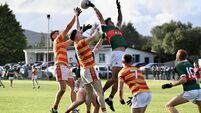
Why Galway need to think outside the box
Should Galway forget about tactics this Sunday and just take Kilkenny on man-to-man, 15 on 15? Judging from most people I’ve talked to in the last few weeks who have an opinion on this, the answer is yes. Just front up, no fancy stuff, take them on front-on full-on.
I wonder though. Go through this Kilkenny team and find the weakness? Go through that attack especially. Colin Fennelly, Richie Power and Aidan Fogarty started in the half-forward line in the semi-final blitz of Tipperary. TJ Reid, Eoin Larkin and Henry started inside. You want to go man-to-man on those? And remember, Richie Hogan is waiting in the wings, might even start.
Is that really such a good idea? They are Leinster champions and All-Ireland finalists but Galway are still only bedding in Kevin Hynes as a full-back and Johnny Coen as a corner-back. Niall Donoghue is a novice at this level out on the wing. Does anyone seriously consider that all on their own, those lads could hold that Kilkenny sextet?
Galway will need to be tactical, very tactical.
Let’s get one thing out of the way early here. Tactics have always been an integral part of hurling at all levels. As so succinctly pointed out by Michael Moynihan of this parish in his column on Monday, if you have a 5’6” wing-back on a 6’ 5” wing-forward, any goalie worth his salt will pump the puckout down that wing. That’s a tactic that’s been employed in hurling since the days when the headgear of choice was your auld cloth cap.
Even at club level, and again going back as far you like, team managers would try to isolate their fast forward on the opposition’s slow back or their hard man on the other’s windy winger.
What those who now object to hurling tactics are actually talking about is any departure from the norm. Puckouts were always just belted down the field as far as the goalkeeper could hit them, which meant when the ball landed it was usually in the other half of the field.
That was seen as the safest and best option.
Well, first things first; the ball wasn’t just belted. If the keeper had a brain in his head at all it was aimed at what he felt was his best ball-winner. That’s tactical. There would usually have been an agreed signal from the keeper to his midfield and half-forward line to let them know which area of the pitch he was aiming.
But what if the ball is not being won by your half-forwards. What if the ball is coming back up the field as fast as it’s being pumped down?
Further questions and who better than this Kilkenny half-back line to win the opposition long-ball puckout. Who better than this Kilkenny midfield to clean up breaking ball. At the very least Galway must have a good puckout strategy.
Then we come to positions. The traditionalist bemoans any departure from the old 3-3-2-3-3. They’re blind. Needs don’t just change from game to game, they can change within a game.
Playing against a big wind? Get yourself a sweeper or two from what’s probably going to be a redundant attack and leave yourself with a few fast guys up front.
Playing against a dominant attack? Same thing. You need a sweeper. Playing against a team who has one dominant player? Put an extra guy on him to cut off that early ball.
Now, think Kilkenny again. Do you know of a more dangerous attacking sextet? Think then about the acreage in Croke Park. Do you really want to set what is still an inexperienced defence against that attack without help? If you do, you’re just not thinking.
For the most part Galway went 3-3-3-3-2 in the Leinster final. They also switched their attackers around and kept switching the point of attack. It wasn’t just the tactics that caught Kilkenny off guard, it was the intensity of Galway’s play. Those tactics made a difference.
To have any chance of winning, Galway need to the same again this Sunday. Not the same tactic, but the same very tactical approach.
Tradition? Thinking outside the box, that is GAA tradition.