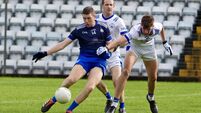
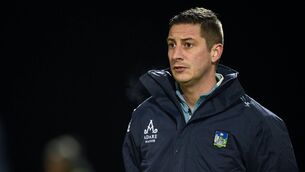
Ó hAilpín a casualty of a culture he helped create
Players have assets that might fall under headings such as: skill, athleticism, youth, and commitment.
They also have liabilities. They could be injury-prone, a disruptive voice in the changing room, or too fond of the nightlife. The number of liabilities permitted is generally in direct proportion to a player’s list of abilities.
The history of sport tells us that old pros need to be model pros. The same applies to anyone who wants to enjoy a prolonged inter-county career.
On the surface, Tyrone’s Brian Dooher and Cork’s Seán Og Ó hAilpín would appear to tick all the boxes required of the individual who wants to keep playing well into their 30s. They have much in common.
Having made their debuts in 1996, they stayed in peak condition due to their supreme dedication. Both have recovered from serious injuries. Both captained their counties to All-Ireland titles in 2005. During the past 14 years, they have won three All-Ireland medals and three All Stars apiece.
But that’s where the similarities end. Whereas Tyrone boss Mickey Harte has indicated his 35-year-old captain will be remaining for another season, Cork hurling manager Denis Walsh has informed the 33-year-old Ó hAilpín that he will not be part of his squad in 2011.
If an independent observer watched the last displays given by Dooher and Ó hAilpín in this year’s football and hurling championships, they might struggle to comprehend why it is the Corkman’s career that has been terminated.
Brian Dooher is worshipped in Tyrone, and rightly so. But even Dooher’s most ardent admirer could see that he was really struggling against Dublin.
In contrast, Sean Óg had a decent game against Kilkenny. While many of his team-mates were outfought and over-powered, Ó hAilpín more than held his own.
Yet, it is Dooher who has survived for another season, and it is Ó hAilpín who is considered surplus to requirements.
To understand why these parallel careers have suddenly diverged, we need to examine the backgrounds of both.
The most cursory inspection throws up some glaring contrasts. The key difference lies in the relationship that both players share with their respective managers. The intimate bond between Dooher and Harte was brilliantly captured in the photograph taken in the immediate aftermath of the 2005 All-Ireland final.
A few years ago when Dooher was recovering from an injury, Harte made all the others in rehab train alongside him. It led Harte to quip that his injured personnel couldn’t wait to resume full training so they could get a break.
Keeping Dooher in the squad presents zero risk to Harte. They trust each other implicitly — so much so, that it was Dooher who was given the job of telling Dermot Carlin that he had lost his place for this year’s Ulster final.
There is no doubt that Harte considers Dooher to be his right-hand man.
Now consider Ó hAilpín’s situation where he was front and centre in battles with the board for the betterment of Cork hurling. While many GAA supporters have come to look upon the Cork hurlers as crazed zealots, there was nothing extraordinary about the list of demands they sought from the board ahead of the first strike in 2002.
They wanted to be allocated the training gear to which they were entitled, gym membership, their own doctor at all matches, proper meals after training, and, strange as it may seem, selectors who actually attended training sessions.
In contrast, Dooher has been able to put his entire focus into winning games with Tyrone.
Although forced to be a militant, Seán Óg never looked comfortable in the role. He’s not a natural agitator. Yet, through no great fault of his own, Ó hAilpín was always going to be treated with some trepidation by a manager such as Walsh. If there was to be another revolt then Ó hAilpín would have been among Walsh’s list of ‘usual suspects’.
Furthermore, Walsh probably wasn’t a fan of Ó hAilpín’s column on the website, www.joe.ie. Writing a weekly column while still playing is a tightrope walk.
And Walsh may not have been entirely pleased that his left half-back used his column to announce that he was going to miss the Munster hurling final replay due to injury.
Walsh would have been further irritated when Ó hAilpín went public over his annoyance about his brother Aisake’s substitution against Kilkenny.
Again, a few years ago, any Cork manager would have been willing to overlook a couple of loose statements made by Ó hAilpín in an online column. But a player who will be celebrating his 34th birthday during next year’s championship is not going to be afforded the same leeway.
In the end, it was probably a pretty easy decision for the Cork manager. And no doubt it was made in the same calculated manner. The irony, of course, is that this is precisely the type of bold, independent, professional management that Ó hAilpín and the Cork hurlers have routinely campaigned for.
He is simply the biggest casualty of a culture that he helped to create.