Red Hands: The Next Generation
IF you want to see the future of Tyrone GAA you need to take a right turn off the A5 Ballygawley-to-Omagh road at Kelly’s Restaurant and keep your eyes peeled for a narrow laneway in between two houses about 100 yards further up.
Edge your car through the mud and take care to avoid any stray branches that tend to whip the windscreen before the road widens slightly. On your right is a gate with a disused barrel lying nearby.
All you will see is hill after undulating hill but, in four years’ time, that same view will be dominated by the county’s Centre of Excellence, a state-of-the-art training facility and possibly the most ambitious investment project ever undertaken by any county in Ireland.
This, in a place called Garvaghy, is where the nerve centre of all future operations will take place and it will incorporate seven floodlit pitches, changing rooms, showers, plunge baths, medical rooms, fitness centre, administrative office space, catering facilities and the latest in pitch and media technology.
The overall cost has been estimated at £5-6m (€6.3-7.3m), a dizzying figure for a volunteer organisation but one that appears even more daunting considering the county has just finished spending £4m (€5m)on the redevelopment of Healy Park.
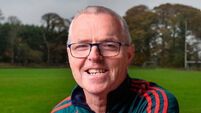
Pat Darcy has become accustomed to dealing in sums of such magnitude but the Tyrone county chairman understands that some people find it difficult to get their heads around the changing face of economics in the modern-day GAA.
“Paul Dorris, a former chairman, was saying to me one time that if you talked about spending £10,000 (€12,600) or £30,000 (€38,000) back in his time you would have been panicking. He can’t believe that we are talking about millions.
“If someone was to say five years ago that you would spend £4m (€5.07m) on Healy Park people would be asking where you would get the money but we spent it and it is all paid for and now we have moved onto another project.”
Like any county, grants have been central to their ambitions but, as the old saying goes, God helps those who help themselves and Tyrone have not been found wanting in that regard.
Central to everything the county has achieved since the mid-90s has been Club Tyrone, an organisation held up as a shining light throughout the country but one which very few people are familiar with.
First of all, what it is not is a supporters’ club. Club Tyrone is actually the Tyrone county board’s PR and marketing committee and Darcy is its chairman. Club Tyrone is merely its brand name, albeit a very successful one.
People and businesses are asked to contribute £500/€750 per year to Club Tyrone. Last year, members’ donations amounted to £252,851, (€321,000) while a gala banquet raised another £42,500 (€54,000) after expenses. Some have estimated that Club Tyrone has raised in the region of £2.5m (€3.14m) for the county since its inception and the funds have been poured into far more than just bricks and mortar.
“It started in the mid-90s and the idea was to create something for the millennium,” says Darcy. It changed after that into Club Tyrone. The millennium fund was initially earmarked for a new stand at Healy Park. It then morphed into something that was not just about providing facilities. It became something that would look at the whole GAA in Tyrone.
“There would be a three-pronged approach to resource coaching, resource the development of Irish culture and resource the development of Gaelic games. The money raised from Club Tyrone was designated for those areas.”
Darcy talks passionately about how Club Tyrone allows people to be stakeholders in the county’s GAA. For him, it is more than just a money-making machine, it is a means of unifying the strands that make up the association within the county.
Contributors get nothing concrete in return for their donations, not even an All-Ireland ticket. They are expected to buy in for their love of the GAA but what they are guaranteed is accountability.
Club Tyrone meets once a month and a copy of the minutes goes to the county committee. Members are updated regularly and every one gets a copy of the annual report detailing how their money has been spent, what successes the county has had and what the intentions are for the future.
‘Transparency’ is a word Darcy uses frequently and, while Croke Park has often been criticised for its lack of marketing nous in recent times, no-one can say the same about Tyrone.
“You have to develop it as a good, quality brand. Feedback to the members and seeing the members as stakeholders in the GAA is vital. They own that little bit and are making that contribution.”
Their success has come up on the radar of others. Officials from various counties eager to learn some pointers are regular visitors and Tyrone administrators have made many a trip outside their borders to impart what they have learned.
Success on the field wasn’t priority number one when Club Tyrone was founded, claims Darcy, but it was a natural progression once the right foundations were laid off the park.
The extent to which the bar has been raised was evident last year when the consensus was that Tyrone had had a bad season. Darcy can only laugh at that and take it as compliment.
Tyrone’s senior team actually won the Ulster championship and Dr McKenna Cup in 2007. Their minors were also provincial champions while Tyrone schools won another eleven competitions at provincial and national levels.
Key among them was Omagh CBS who claimed the Hogan Cup while the county were also All-Ireland Vocational Schools champions. Oh, and let’s not forget that four Tyrone players won Sigerson Cup medals with UUJ as well.
Not bad going for what was called a ‘quiet’ year and that pattern has been repeated for the last five years. The presence of the county seniors and minors in Croke Park yesterday is evidence of what all that underage success can lead to.
The system has clearly been good for Mickey Harte but Mickey Harte has been good for the system too and the fact that everyone seems to know where their own portfolio begins and ends has helped too.
“From the point of view of the county board and Club Tyrone, it is up to us to have the structures in place to facilitate our managers at all levels, so that they can get on with the job of coaching county teams.
“People find it surprising, for example, that I would never go into the dressing room, that I would never travel on the team bus and that I never go near the line during a match. I just keep out of the way because I would just be a distraction.
“What would I have to offer? My job is to make sure that those managers have the resources and the belief that the county board is behind them one hundred per cent.
“A lot of counties are hesitant about their manager, saying ‘this is their last year’, but how can you expect a manager to work under conditions like that? Look at poor Pillar Caffrey.
“This was his last year and the players knew it. It makes it difficult for him and there is no need for it. It is an amateur sport. We don’t pay managers. Mickey Harte gets nothing apart from the satisfaction of managing Tyrone.”
The most impressive aspect to Tyrone’s successes on and off the field has been the length of time they have managed to keep it going. After all, peaks and troughs are facts of life in every sport.
Times are tough out there right now. Multinational companies are as exposed to the economic downturn as the average Joe Soap and county boards are struggling to cope with rising costs.
Tyrone are already busy preparing for the future, whatever it may bring. Aside from the Centre of Excellence, the county has also published an ambitious five-year strategy called ‘Raising the Red Hand’ which incorporates everything from infrastructure to volunteers, culture and, of course, funding.
“The only certain thing about the future if you look at the past is that the costs will continue to increase,” says Darcy. “What people need to do is put a lot more work and emphasis into budget planning and control.
“If you don’t have control over the budget you could very easily get into a debt situation because managers are asking and asking for more and more. It’s not a bottomless pit.
“We do our best to give them all the resources they need, the very best. Nothing is second-hand, that is our philosophy with all our county teams and they know and appreciate that.
“I suppose, if we did hit hard times, you would have to go to them and say there will have to be some cutbacks. That is part of business and life when times are hard. Touch wood we are not in that situation.”
CONNECT WITH US TODAY



Be the first to know the latest news and updates