Bordering on sweetest win for those best of enemies
Beyond the boundaries of the south-south west, that’s probably how people view the Cork-Kerry relationship. A presumption that while there’s enmity to some extent, but with a leavening of humour, a certain amount of warmth because of the proximity and presence, in either county, of people from just over the county bounds.
And for a long time, that was fairly true. From around the mid-70s on, certainly, Kerry had the upper hand in football between the two counties, and in the era before the qualifier system being the second-best team in Ireland carried no cachet for Cork.
What only served to rub Rebel noses in it, of course, was that Mick O’Dwyer made an annual ritual of visiting the Cork dressing room to tell the players there that they were the second-best team in the country. Having been told by all and sundry that they were only turning up to keep the ball kicked out to Kerry, it didn’t help Cork to have someone come in right after the final whistle and tell them to keep it going.
Of course, there was a damned-if-you-do quality to the Cork resentment. If O’Dwyer didn’t visit the dressing room, he’d have been condemned as arrogant; once he visited, however, he was open to accusations of patronising defeated opponents...
That example isn’t an accidental one. We tend to think of the cult of the manager as a relatively recent development, but for decades now the perception of Kerry and Cork teams — and their relationship with each other — has been personified in their managers.
O’Dwyer dominated for well over a decade and saw off a succession of Cork managers, and his team were seen on Leeside as an expression of their manager’s expansive personality: skilled and fluent, but with a hard edge when required.
Though Kerry fans roll their eyes even now when Jimmy Barry-Murphy’s travails with Jimmy Deenihan are mentioned, that’s to miss the point. All-Ireland titles aren’t won by saints, and the Kerry Golden Years team came out on the right side of too many hard games for it to be a coincidence. There’s nothing wrong with that: at every World Cup in football Brazil are expected to play la juego bonito, but even the samba boys know you have to win the battle before you’re allowed to play.
WHEN Billy Morgan took over the Cork footballers in the 80s the revolving door policy for managers began to operate west of Ballyvourney as Morgan’s side became top dogs.
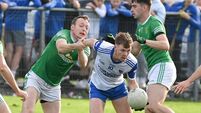
To do so they had to win a couple of dogfights of their own, and while people may recall the turbulent encounters with Meath from 1987-90, there were a couple of warm-up bouts in Cork and Killarney — a melee in Páirc Uí Chaoimh during the 1988 Munster final springs to mind.
Whether you could say that this indicates a deep-seated distrust which needs little enough to spark off violence, it’s hard to say. Certainly, your columnist remembers being in a Cork hostelry one evening during the early 90s, when a Cork footballer walked in sporting a magnificent black eye, with accompanying divot taken out of the cheek on the same side of the face.
Asked what had happened, he explained that in that afternoon’s NFL game against Kerry, one of the Kingdom’s finest had “taken his chance” and that he, the Cork footballer, would be “taking his chance” when the time arose. (The above is paraphrased furiously, you understand).
What sticks with your correspondent was the matter-of-fact tone used by the Cork players. It had happened, it was over, it would be revisited when the opportunity arose: until then there was no seething or steaming.
Kerry people will always needle their neighbours about the lack of football All-Irelands; Cork people will stab back by asking the Kingdom to become members of the GAA, not the Gaelic Football Association. This weekend the sweet enmity becomes national, not provincial.
“Nice one,” says the sports editor, “I thought you’d get pretentious, being over in Paris.”
“I could get pretentious yet,” I reply.
Paris is not quite agog with the impending All-Ireland football final, but it allows me to deploy one of my favourite pretentious stories.
The yarn goes that a friend called to Samuel Beckett one fine summer’s day when the great man was living in Paris — but the friend had two priests in tow. Ever gracious, Beckett broke off from whatever masterpiece of austerity in the human condition he was writing to accompany them on a stroll.
As they took the air, the younger priest asked Beckett if he got back to Ireland much. No, murmured Beckett, though he was thinking of going to Dublin in September for a brief visit.
“When in September?” asked the priest.
“The ninth,” murmured Beckett.
“Ah well,” said the priest, patting him on the shoulder. “Too late for the hurling but you should be grand for the football.”
* Contact Michael.moynihan@examiner.ie

CONNECT WITH US TODAY



Be the first to know the latest news and updates