The Pitch: How summer sports camps mushroomed into €25m industry
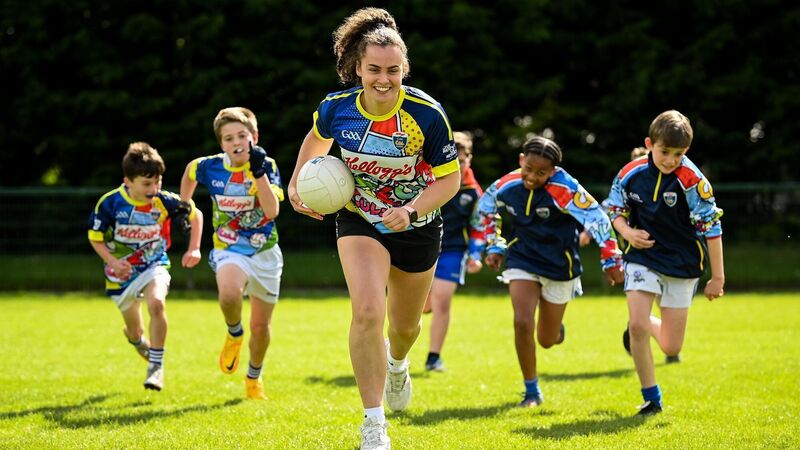
Meath footballer Emma Duggan with Skyrne GFC underage stars at the launch of the Kelloggs GAA Cúl Camps on-pack competition. Photo by Stephen McCarthy/Sportsfile
In the coming weeks more than 300,000 students will take part in the sports industry’s most lucrative ‘non-spectate’ activation – the summer camp.
210,000 students will take part in official National Governing Body camps, established by the GAA, FAI and Rugby Provinces, while another 100,000 will join summer schools established by leagues, clubs and independent operators.
The Pitch has valued the sector at approximately €25m (income) - through registration fees and commercial activations – allowing names like Kellogg’s Cúl Camps and Intersport Elverys Summer Soccer Schools to grow into the biggest associate brands in sport.
Perhaps the most extraordinary aspect is the growth across the area, where record numbers of children will this year participate in some form of sports academy.
160,000 children are set to participate in the GAA’s Cúl Camps, while the FAI is expecting an increase of 5,000 participants for its summer offering.
Entry fees to the biggest summer camps packages - organised by the largest National Governing Bodies (and provincial organising structures) – can be valued at €17m.
Schools organised by non-NGBs, local leagues, clubs and independent operators, add another €4m to the sector with millions more coming from sponsors including Bank of Ireland and Allianz, all paying top dime to be part of the seasonal movement.
Summer sports academies are key revenue drivers for the biggest NGBs – the GAA will take in more than €12m, with the FAI set to generate up to €2.5m, while rugby will add €1.2m to its income.
Clearly the biggest winner is the GAA, thanks largely to its more cohesive camp structure where it doesn’t compete against internal or third-party forces and has the buy-in of 1,250 clubs across the country.
While the FAI fully endorses non-Association summer camps, run by leagues and clubs, it will be aware that these schools are likely to generate even greater revenues than the €2.45m that it will appreciate this summer through its 400 camps.
The IRFU has left the summer camp sector exclusively to its Provinces, with Leinster, Munster and Connacht hosting up to 7,500 participants in the coming weeks.
Rugby also provides the most diverse summer camps with a mix of residential and day attendance with prices ranging from €75 to approximately €500.
Outside of the ‘Big Three’ sports the next most participated summer school will be provided by Sports Campus Ireland which will welcome 3,500 campers onto their world standard facilities to participate in multi and single sports programmes.
For sponsors ‘Camp’ is a highly valuable activation for partners, as the GAA’s Commercial Director Peter McKenna outlined to The Pitch.
“The Cúl Camp’s numbers are staggering – 160k children - when you think of the population of Ireland, it’s extraordinary and is something not lost on our commercial partner,” explained McKenna.
“Kellogg’s, who are our sponsor, are so pleased with that success - particularly as this is their only non-corporate activity outside of the US.”
While sports camps are a highly successful activation for NGBs and independent organisers, hosting such events also present great challenges, where issues can present in the most unlikely way.
Kits, which are an integral aspect of the camp culture – the take-home goodies for participants, including jerseys, balls, bottle and other souvenirs — also present major supply and quality stresses.
In the FAI a number of years ago a potential disaster was encountered when calls came into the association after day one of Summer Soccer Schools, as parents reported that dye had run from the jerseys in the wash, causing colouring issues.
The problem was limited to one small batch of tops, but the potential financial and PR potential impacts were significant.
Other high-participation sports including basketball and athletics continue to grow in this space, with cricket, hockey and sailing providing significant activations for their audiences.
Local Sports Partnership progammes in County and City Councils offer a wide range of programmes, particularly in the area of inclusivity.
Importantly, the summer school also provides a multiple strategic catch-all for organisations, where significant pillar goals are reached across Participation, Education, Club Development, Business, Coaching, Engagement, Commercial, Sponsorship, PR, Financial Planning and a host of other strategies.
Camps done well are politically priceless and can elevate the reputation of an organisation, which in the political world of the NGB is almost as valuable as the cash intake.
RTÉ Head of Sport Declan McBennett has moved to clarify his position on its GAA highlights offering, which received stinging criticism in the past week.
The senior executive was name-checked in two separate discussions about the quantity and quality of the station’s Sunday Game programme, in what amounted to a bruising few days for the former news executive.
Last week in The Pitch, Virgin Media Managing Director Paul Farrell hit out at RTÉ’s lack of output of GAA footage, which he said impacted GAA supporters and “lesser covered counties”.
Separately, Sunday Game presenter Des Cahill, in a weekend interview, spoke of “utter frustration” by him and his Sunday Game colleagues at having to fit up to “15 games into 106 or 108 minutes” of a single highlights show.
The crux of both complaints is that RTÉ has so much GAA content, it is not making the best use of its platforms to show it adequately – although Cahill also bemoaned the Sunday Game’s rigid style and lack of humour.
In an interview with The Pitch this week, Declan McBennett said RTÉ was limited by the amount of highlights programmes that the channel could show, and unapologetically declared that, in his view, viewers were most interested in live coverage.
Even if he wanted to, however, McBennett said that RTÉ was not contracted to broadcast subsequent highlights shows – as Paul Farrell and Des Cahill had suggested it should – as those rights are taken by Sky and TG4.
“Under the existing rights agreements, which have been in place for the past five or six years, the rights to a Monday highlights show are held by TG4, with Sky having Tuesday to Friday,” said McBennett.
“I would also question whether the audience wants additional highlights of GAA (outside of The Sunday Game), because my experience and my view is that live is better - and that’s what the GAA fan wants.
“When I came into the role (Group Head of Sport) in 2018, RTÉ was showing 31 live championships matches - now we’re covering up to 60 (live) matches throughout the year with more highlights than ever before.
“From the last Saturday in January (when RTÉ televises Allianz National League games) right through to the end of the year (Club Championship) we are broadcasting (live) GAA games – so does the audience want additional highlights or live games? Live is better, I believe.”
Paul Farrell said RTÉ’s lack of highlights was “extraordinary”: “They are struggling to get sport away they cannot physically get it away on their linear schedule.
“With the Sunday Game – is that enough coverage that fulfils a public service remit, say for lesser covered counties through one highlights show every Sunday night?”
Des Cahill’s interview with the Irish Independent echoed Farrell’s comments: “I think we have to break it up and have separate programmes, and maybe the notion that hurling and football must be together needs to be looked at.”
Paul Farrell had also criticised RTÉ for effectively controlling a monopoly on sports rights, by deliberately inflating the market and pricing ‘free-to-air’ broadcasters out – which McBennett said was “simply not true”.
Whatever about criticism from a rival broadcaster, Declan McBennett now has a job to deal with internal insurrection, which has suddenly turned sports broadcasting into high drama.
THE lure of the JP McManus Pro-Am is expected to dial up an extra notch with US audiences set to experience the event from Adare Manor live across the ‘States from the 4th of July.
NBC Sports – owners of the Golf Channel and GolfPass (co-owned by Rory McIlroy) – are in negotiations to broadcast the two-day event.
Tiger Woods’ formal withdrawal from the US Open on Tuesday will certainly have organisers at Adare’ in a sweat, with the 15-times Major winner set to be the star attraction for the post-Irish Open event.
It’s likely that by pulling out of the Brookline (The Country Club) event Woods is allowing greater opportunity to take part in The Open at St Andrews in July, where he has stated a number of times is his favourite Major championships of all.
Part of that prep at Adare Manor will allow Woods to play competitive golf in the more leisurely environment of the McManus Pro Am.
Throughout his career Woods has prepped for The Open by visiting Irish parkland courses — for years he was an annual visitor at the K Club.