Irish Squash CEO hopeful Olympic inclusion will sustain revival in game’s fortunes
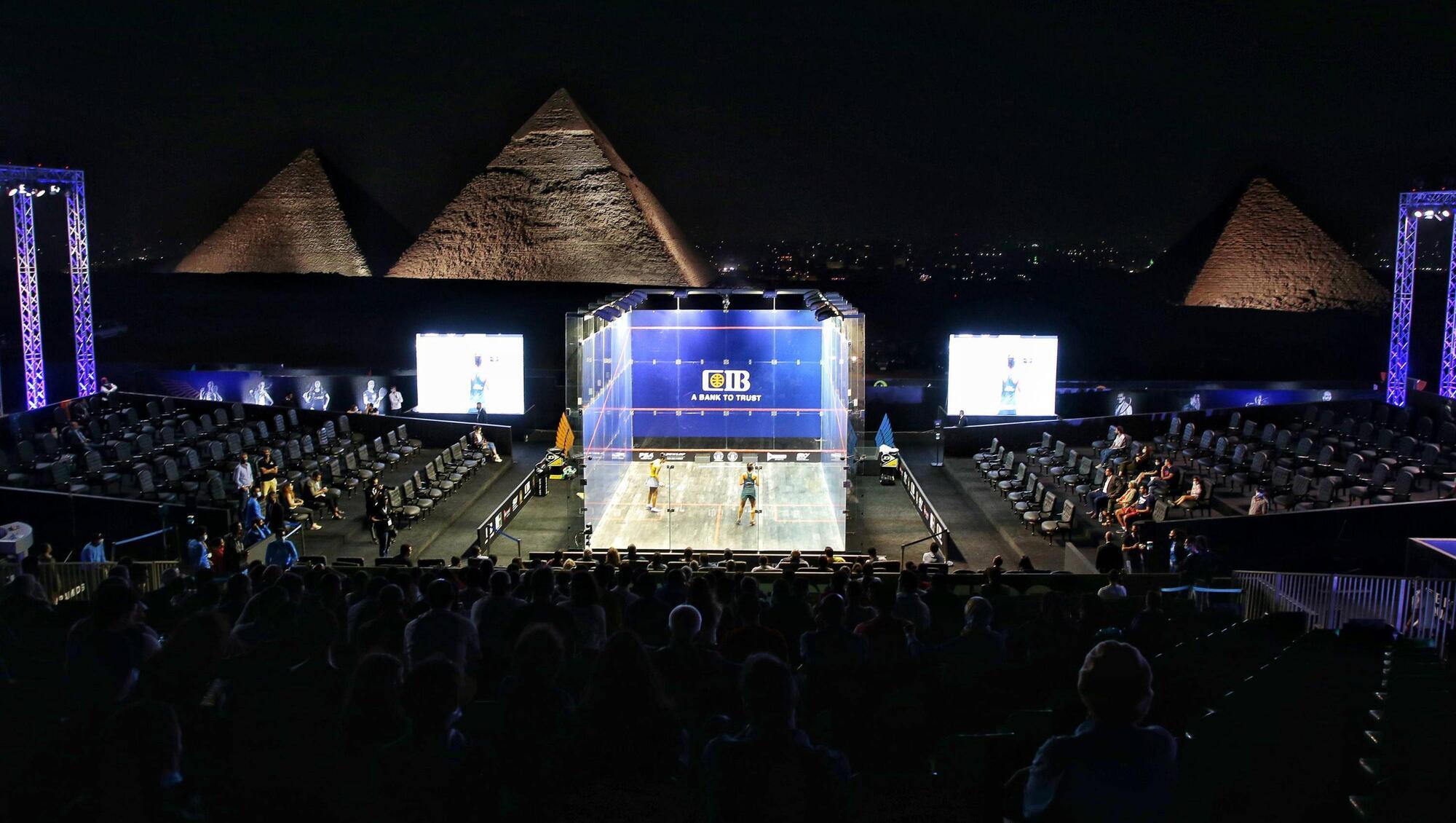
The Egypt International Squash Championship held in the pyramids area in Giza, Egypt, on 14 October 2020. (Photo by Ziad Ahmed/NurPhoto via Getty Images)
Peter Molony, the driving force behind the historic Rathmore Stud in Limerick has family connections with the thoroughbred industry that reach back over three centuries. So, it’s safe to say he knows a thing or two about horses in general and more specifically, the importance of seeing them regularly on television.
Last August, in a comment outlining his concerns over the possible negative impact of proposed new gambling legislation on the presence of Irish racing on UK satellite channels, he observed that; "When I was growing up, showjumping was huge in this country, the likes of Eddie Macken, Paul Darragh, Captain Con Power; all these guys were national heroes.
"Showjumping was taken off the television screens and now the average person in the street in Ireland couldn't tell you who was on Ireland's Aga Khan team in Dublin last week."
Molony’s point is simple but fundamental. The prosperity of a modern sport correlates directly to its capacity to attract eyes to screens. For instance, it wasn’t all that long ago since Frank Bough or Dickie Davies were shepherding large Saturday afternoon TV audiences through the exotic complexities of speedway in Sheffield, bowling from Blackpool, karate from Kyoto or motor-cross from Mexico City. Niche stuff, but a strange familiarity was cultivated between viewer and player.
Squash attracted plenty of airtime back then too and this was one of the main drivers of an explosion in participation in the sport, domestically and internationally, through the 1970’s, 1980’s and nineties.
The game was embraced by people with all shapes and sizes, seeking the tangible physical benefits offered such as cardiac health, strength and flexibility as well as wellbeing benefits such as stress relief and social interactions.
Hopefully, those ‘sunny uplands’ are again in sight as squash has recently received a massive shot in the arm with the announcement of its inclusion as an Olympic sport for the first time at the Los Angeles games in 2028.
Scott Graham, newly appointed as CEO of Irish Squash, couldn’t have asked for better news in the first months of his tenure and nurses high hopes that Olympic inclusion will help sustain a current revival in the game’s fortunes, both in the public appreciation of its art and the presence of feet on courts.
“The Olympics offers a huge platform for the sport to raise its profile and it also offers players young players going through a great opportunity to become an Olympian and to make a professional career out of squash,” he says.
“Obviously, we need to understand what the qualification criteria is and what the qualification process will be and we don't expect to hear that from the International Federation until early 2025. But at the elite level, it will raise the standards and will also help from a participation point of view.
"By having that global stage, we think that it will inspire a lot more players to pick up a racket because people will see how exciting it is, how fast it is, how diverse a game it is.”
Despite the black and white coverage and the ropey production values of squash on TV back in the day, players still became known beyond the narrow confines of club changing rooms. Players like our own Jonah Barrington, a combative competitor who once described squash as ‘boxing with a racket.’
Or Geoff Hunt, who glided to four world titles with the grace of a Federer and the inspirational Heather McKay, arguably Australia’s greatest ever sportsperson who went unbeaten for eighteen years. And that was before the Messi and Ronaldo of squash, Jahangir and Jansher Khan (no relation), came along and won fourteen world titles between them from 1981 to 1996.
This is the kind of recognition opportunity that Scott Graham feels Olympic participation offers to his sport.
“I think what we'd like to see is looking back after the Olympics, whether we qualify an athlete or not, is to see the profile of squash in Ireland raised, that the status of the sport is elevated. I think that's one of the most important things is to have more people playing, more young kids involved in the game at schools’ level and in our cities, right through the different ages.”
The wind seems to be turning in his favour. Squash is now played in over 180 different countries by over twenty-million people on fifty-thousand courts. In Ireland the indications are that participation in the sport in 2023 was up by 10% on the preceding twelve months and that competition entry increased by twice that amount.
There are currently four-thousand affiliated players on the Island playing out of fifty-eight clubs although the common consensus holds that if casual non-aligned players were included that the number of active players would significantly increase.
“The sport is making great progress and membership numbers are up, more people are entering competitions,” confirms Graham. “We're setting up a lot of different programs within schools, within cities. We've been very fortunate to be well supported by Sport Ireland and Sport Northern Ireland, and we're looking to appoint some development officers to roll out more programs at a grassroots level.”
While the Khan’s achieved global recognition thirty years ago, the current world number one ranked players Ali Faraq and Nour El Sherbini, wouldn’t be generally recognised as household names outside their native Egypt.
But squash has improved the presentation of its marquee events considerably in recent years and now hosts premier tournaments under lights on glass courts at spectacular locations such as the Pyramids at Giza, Grand Central Station in Manhattan, the waterfront in Hong Kong and a gigantic shopping mall in Kuala Lumpur.
Given its cultural and artistic history it won’t be a too much of a stretch to believe that the Los Angeles organisers will find an equally stunning backdrops to make the tournament look beautiful in 2028.
The problem Irish squash now needs to solve is how to get as many players as possible on that plane to LAX in July 2028. Scott Graham believes that our most prominent players will need to raise their ranking well into the top 100 in the global rankings to guarantee a seat on the flight.
Four years to go and the spotlight currently shines brightest on Hannah Craig from Lisburn and Sam Buckley who plays out of Sutton Squash Club in North Dublin. Craig (24) has careered up the world rankings in 2023 and is now nudging a top 100 spot having began the year almost three hundred places lower.
Buckley is on an equally strong trajectory and solidified his development with some outstanding performances in the recent world team championships in New Zealand. Still only twenty-two the Dubliner should be reaching his prime in 2028. Does he feel he can become a future Olympian?
“I always prefer to move in small steps and with small goals rather than having one massive one,” he explains, allowing himself a small dream while keeping his perspective firmly in reality.
“But It would be an honour. Although squash obviously is an individual sport, since I was a kid, my favourite moments have always come when I’ve stuck on the Irish shirt and played in a team.
"To pull on the green jersey in LA would be a dream come true.”
CONNECT WITH US TODAY



Be the first to know the latest news and updates