Ali Donnelly: How women's rugby eventually made its mark in Ireland
As Ireland seek to rebuild and qualify for the next World Cup in England in 2025, the dedication and commitment of their early pioneers and their most recent heroes, should never be forgotten.
As the Ireland women’s rugby team prepare to fly to Japan for a historic first ever summer tour, it’s worth reflecting on the obstacles faced by the pioneers of the Irish game and the commitment made by players who went on to enjoy success in the Irish shirt.
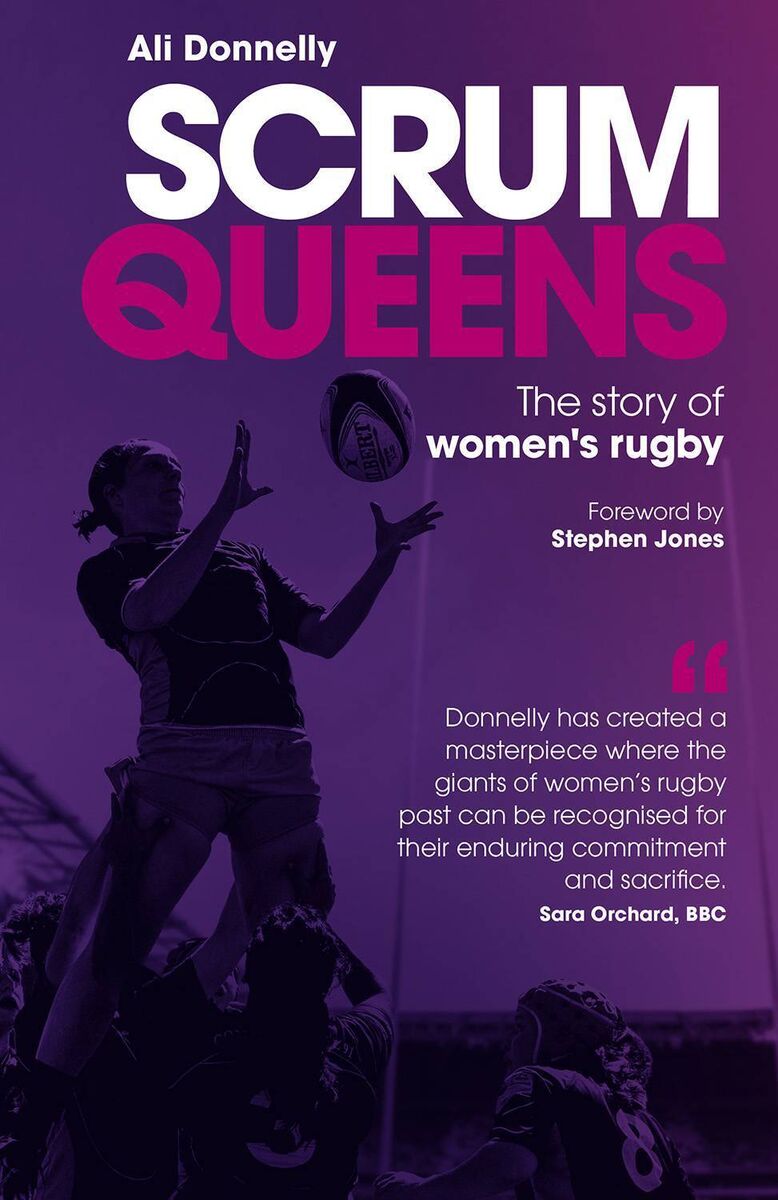
In my book, , I reflect on the establishment of the game across the world, my own involvement in the fledgling Irish game in the early years and look ahead to seismic changes facing our sport, including professionalism and increased interest and profile.
Ireland, having disappointingly failed to qualify for this year’s World Cup, are currently in a transitional phase, finding themselves somewhat left behind as investment increases among rivals England, France, Wales and Italy, who are all now contracting their top players and restructuring their sport around stronger performance pathways and increased resources.
Though change is coming in Ireland, the sport’s tumultuous journey to establish itself, explains some of its current challenges.
Rugby of course has a rich history in Ireland.
The first men’s Test game was as far back as 1875, but women were largely shut out from the sport as a formal proposition till the 1990s and even then, the game was run by volunteers, until the IRFU took it on in 2007.
This is despite the fact that current research tells us that women were playing rugby in Ireland before anyone else.
It’s in Ireland that we know of the earliest documented record of any woman playing rugby at any level.
The story began in the 1880s at the Portora Royal School in Enniskillen.
The school had a wealth of famous alumni with former students going on to have high-profile careers in football, cricket, athletics and the arts. Playwrights Oscar Wilde and Samuel Beckett both attended the school.
But it’s the tale of a ten-year-old girl that entered women’s rugby folklore.
The school was going through a particularly difficult period in the 1880s after the departure of a headteacher who took many pupils with him to a new school and a decision to stop taking on boarders.
The arrival of new assistant headteacher William Valentine in 1883 brought three new pupils who all loved the game of rugby – his children William, John and Emily. They played among themselves and with friends. Although the school didn’t have an official team, intraschool matches were played every Saturday and matches against Enniskillen RFC were recorded.
The discovery of Emily’s journals revealed that one day in 1887, the boys were playing a match and they were short of players, summoning their sister to come and join them on the field. Her memoirs vividly recall the moment.
"At last, my chance came. I got the ball. I can still feel the damp leather and the smell of it and see the tag of lacing at the opening. I grasped it and ran dodging, darting, but I was so keen to score that try that I did not pass it, perhaps when I should. I still raced on, I could see the boy coming towards me; I dodged, yes I could and breathless, with my heart thumping, my knees shaking a bit, I ran. Yes, I had done it; one last spurt and I touched down, right on the line. I had scored my try. I lay flat on my face, for a moment everything went black. I scrambled up, gave a hasty rub down to my knees. A ragged cheer went up from the spectators. I grinned at my brothers. It was all I had hoped for."
Her story is remarkable, not just because its history has been preserved and was told so many years later for the first time, but also because it would be almost 100 years before Ireland’s first women’s rugby clubs were formed.
Like many women’s sports, women’s rugby started to grow slowly from the 1980s on in Ireland. By the time of the first Women’s Rugby World Cup in 1991, there were about ten teams up and running.
In 1992, the players were determined to get a national side off the ground. Led by Blackrock player Mary O’Beirne, the Irish Women’s Rugby Football Union (IWRFU) was established with a significant focus put on establishing a domestic league structure.
With a number of Irish-qualified players playing a good standard of club rugby in England, the first Irish team who played Scotland on Valentine’s Day in 1993 was made up of a combination of ex-pat and home-based players.
The side was captained by Jill Henderson, who was playing for Waterloo in the north-west of England. Henderson had been one of the driving forces behind getting the national team set up in the first place and had got involved in every aspect – playing, helping to organise trials and finding coaches.
The match against Scotland was played at Raeburn Place – the world’s second-oldest rugby ground where the first ever men’s rugby international took place in 1871, a clash between Scotland and England.
Ireland were coached by Alain Rolland, who would go on to become a renowned international referee and they faced a brand-new Scotland side, captained by scrum-half Sandra Colamartino, who scored both tries in a 10-0 win for the hosts.
The game continued to grow despite the significant limitations it had around finance and resourcing as the IRFU concentrated all its efforts on the men and boy’s game.
Ireland went on to become one of the first four teams to play in the women’s Home Nations competition in 1996 where they would play England for the first time. They lost to Scotland 0-21 in the opener but impressively beat Wales 22-6 at Old Belvedere before going on to only narrowly lose to England 12-8.
Given the team had only played eight Tests going into the competition and had only won one – against Japan at the 1994 World Cup – these were decent results for a new team, though it would hardly be the catalyst for success.
The Irish would have to wait another eight years before a win in the competition, although they did not take part in 2000 and 2001, choosing to focus on growing participation.
Fast forward almost 20 years and Ireland went into the Women’s World Cup in France on the back of a Grand Slam winning Six Nations run in 2013 – the culmination of a heroic journey of an especially talented group of players led by Philip Doyle.
One of those players was Lynne Cantwell, still Ireland’s most capped player, whose story going into a World Cup where Ireland would sensationally beat New Zealand, is told for the first time in the book.
Ireland were going into the competition with confidence, despite having to face the raging favourite Black Ferns team.
They’d had warm-up games for the first time and had some hands-on involvement from Irish men’s coaches Joe Schmidt and Les Kiss.
Massive analysis work had been done, particularly on both the USA and New Zealand, by their backroom team in advance, so the team knew exactly how they’d approach both of their crucial pool matches.
But they also had to deal with some quiet setbacks, including what could have been a serious injury to Cantwell - one of their best players.
Three weeks before the World Cup, Cantwell had broken two bones in her back in training, landing awkwardly after a tackle by a team-mate.
Nobody was made aware of the injury bar Fiona Coghlan – the team’s captain and Cantwell’s close friend – and the Irish coaching and medical team. She even had to keep the news quiet from her work colleagues, who happened to include the England lock Jo McGilchrist, also playing at the World Cup. Cantwell, who with 82 caps going into the tournament was a vital player, didn’t want to panic anyone or make the story about her.
She was medically cleared to play in the tournament after three weeks of rest and recovery which involved sending pictures to Coghlan every day charting her improving mobility.
When Ireland led 20-10 at half-time against the USA in the opener, Cantwell was in the bathroom vomiting thanks to the combination of the painkillers she was taking and the force of the first half against a hugely physical American team.
Remarkably she went back out and played every remaining minute of the game and her inclusion in the team who would beat New Zealand was crucial.
As Ireland seek to rebuild and qualify for the next World Cup in England in 2025, the dedication and commitment of their early pioneers and their most recent heroes, should never be forgotten.

CONNECT WITH US TODAY



Be the first to know the latest news and updates