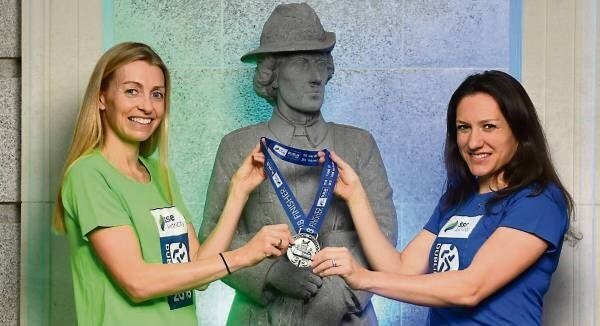
Caitriona Jennings already in bonus territory for Dublin Marathon
It’s a strange place, the autumn of a sporting career. Burdened with the knowledge that the best days are most likely behind you, there is sometimes scant reason to stay going, not when the clock tells a ruthlessly objective tale of inevitable physical decline.
In a trade like marathon running, which requires such an extortionate toll to be paid each day, the temptation to slip away into a more comfortable life is all the greater.
Caitriona Jennings knows she doesn’t need to do this anymore. The 38-year-old Donegal athlete knows no one will bat an eyelid if she doesn’t rock up on the Dublin Marathon start line tomorrow morning, chasing her first national title at the race.
But the thing is, she wants to be there — unshackled by the burden of expectation, revelling in the ability to do this for as long as she can, as well she can.
She’ll readily admit it: she’s not in her best shape. There were times in the past when Jennings turned her back on her working life, poured her entire vat of energy into the marathon and smiled — and sometimes cried — as the gamble either came off or came apart on race day.
But this isn’t one of those.
These days, Jennings has a lot more plates to keep spinning, what with being the head of tax at Goshawk, a Dublin-based aviation company. “It’s pretty demanding alright but I love my job,” she says.
“At this stage, I train because I enjoy it.”
She always loved running. In her college days at the University of Limerick she had been a triathlete but it was always on the final leg of that race where Jennings’ talent shined brightest.
Running gave her the best days, like in April 2012 when she recorded her marathon PB of 2:36:17 in Rotterdam in what was only her second try at the distance, her first coming six months before in Dublin, where she debuted in 2:43:08 after an injury-riddled preparation.
But her breakthrough performance in Rotterdam also brought Jennings to her most brutal day in a pair of running shoes: August 5, 2012 — the London Olympics.
Of all the fallacies weaved into the fabric of the Games, perhaps the greatest is that competing there is a dream come true for all who make it, an experience to be forever savoured. Jennings lined up for the women’s marathon with two injuries: plantar fasciitis in her heel and a stress fracture in the fifth metatarsal bone on the outside of her foot. Weeks before, she had trained herself into the shape of her life, and though the problems in those final days had sown a field full of doubt, Jennings got to the line convinced that she could still do her talent justice.
She was last to finish, clocking 3:22:11 – almost an hour behind race winner Tiki Gelana of Ethiopia.
That’s not to say, however, that Jennings finished last, given she limped her way to the finish to at least beat the 11 athletes who dropped out.
Did she ever think of doing the same? “No, not really,” she says bluntly.
There’s an understandable reticence in Jennings when the conversation turns to London, an unwillingness to go there, which begs the question whether she feels those injuries, that performance, ruined her Olympic experience.
“Yeah,” she concedes. “It probably would have spoiled it.
“But you know what?” she adds, her tone becoming optimistic. “I’m trying to focus on the future and not dwell on it — you have to move on and think about the positives you can take. I’m excited about Dublin and that’s where I’m focused at the moment.”
After London there was the inevitable crossroads, the what-now twilight zone all Olympians must encounter, and her answer to that conundrum was to switch sports.
In spring 2013 she took up rowing, hoping she had similar ability to her sister Sinéad, who had won world championship medals and at that point was beginning the build-up to the Rio Olympics in the lightweight double sculls.
In 2014 Jennings went all-in on her new project, moving to the National Rowing Centre in Cork but while she certainly had the engine for the job, her technical inexperience limited her ability.
“It’s a very technical sport, which many underestimate, and you can be really fit and at the top of your game but unless you have that technique and can make the boat move, you’re not going to get the results.”
As much as she enjoyed the team environment, a welcome antidote to the isolation of distance-running, after nine months Jennings knew her heart wasn’t in it the way it was with running, at which point she moved back to Dublin and resumed her working life.
In 2016, she returned to the Rotterdam Marathon but was well off her best, clocking 2:44:33 which was not fast enough to challenge for a spot at the Rio Olympics. Later that year she was back on the line at the Dublin Marathon, finishing 11th in 2:44:59 and as the second Irishwoman home.
Last year she again hit the crossbar in her quest for the national marathon title, her second-place finish in 2:42:36 leaving her three minutes adrift of Belfast’s Laura Graham and netting her fifth in the overall women’s race.
Earlier this year, Jennings solidified the hypothesis that marathoners are masochists when she competed in an indoor marathon at the Armory in New York: 26.2 miles on a 200m track, round and round and round, 211 laps in total.
She had already booked a trip to New York for Paddy’s weekend when she was told about the race, and she figured it’d be a good way to test her limits and earn some spending money for her trip.
Jennings finished second in 2:53:12, just under three hours of running that felt like three days.
“It was awfully tough mentally, the repetitiveness of it,” she says.
“Even the last 10 laps — 2K sounds like nothing but there was nothing to take your mind off it and it dragged on so much, but it was an interesting experience and it was good to have done it.”
Since March she has been coached by fellow Donegal woman Teresa McDaid and on the build-up to Dublin, she had to pick and choose her battles in training, using what limited time she had on the most important sessions, not sweating the small stuff the way she once would.
It leaves her here, excited if a little unknowing about what’s ahead in tomorrow’s race.
“I absolutely love the Dublin Marathon,” she says. “It’s a brilliant atmosphere and such a nice marathon to run. The support is phenomenal.”
With defending Irish champion Laura Graham out through injury, Jennings’ task is no easier given the presence of Lizzie Lee, a 2016 Olympian from Cork who is also 38 but has run almost four minutes faster than her.
All the same, Jennings knows how fickle a beast the marathon can be, a distance that always allows for an upset, for an underdog to get on top long before the golden light of autumn fades to black.
As she says: “It would be nice to tick off the list.”