Serena Williams: I’m here fighting for women’s rights and equality
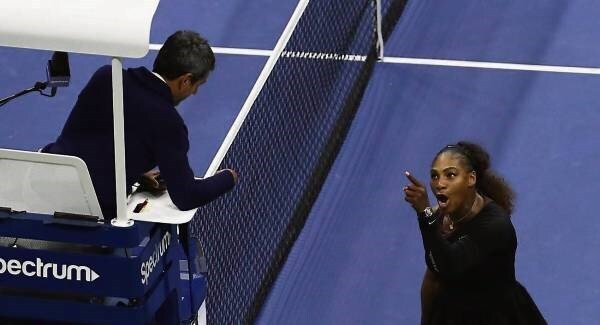
The events and the arguing and the booing that would make this a US Open final unlike any other began when Serena Williams’ coach made what she insisted was an innocent thumbs-up, but the chair umpire interpreted as a helpful signal.
It was the second game of the second set Saturday, in a packed Arthur Ashe Stadium, and Williams’ bid for a record-tying 24th Grand Slam title already was in real trouble because she was being outplayed by first-time major finalist Naomi Osaka.
Chair umpire Carlos Ramos warned Williams for getting coaching during a match, which isn’t allowed. She briefly disputed that ruling, saying cheating “is the one thing I’ve never done, ever.”
Serena Williams fought back after being penalized at the U.S. Open Final. Would a male tennis player be treated the same way? pic.twitter.com/qURaAnsJsw
— AJ+ (@ajplus) September 9, 2018
A few games later, Williams received another warning, this time for smashing her racket, and that second violation cost her a point, leading to more arguing. Eventually, Willams called Ramos “a thief,” drawing a third violation — and costing her a game.
“I have never cheated in my life!” Williams told Ramos. “You owe me an apology.”
Soon, Osaka was finishing off a 6-2, 6-4 victory that made her the first player from Japan to win a Grand Slam singles title.
That is not, however, what will be remembered about this chaotic evening.
With jeers bouncing off the arena’s closed roof, both players — the champion, Osaka, and the runner-up, Williams — wiped away tears during a trophy ceremony that was awkward for everyone involved.
“I just feel like I had a lot of emotions,” Osaka said, “so I had to kind of categorise what was which emotion.”
Williams whispered something to Osaka and wrapped an arm around her shoulders.
From boos to cheers. An emotional and powerful moment for Naomi Osaka and Serena Williams at the US Open podium. (🔊⬆️) pic.twitter.com/oTg6SORjXe
— ESPN (@espn) September 8, 2018
“I felt, at one point, bad, because I’m crying and she’s crying. You know, she just won. I’m not sure if they were happy tears or they were just sad tears, because of the moment. I felt like, ‘Wow, this isn’t how I felt when I won my first Grand Slam.’ I was like, ’ Wow, I definitely don’t want her to feel like that,’” said Williams, who missed last year’s US Open because her daughter, Olympia, was born during the tournament.
“Maybe it was the mom in me that was like, ‘Listen, we’ve got to pull ourselves together here.’”
Williams was last night fined $17,000 for receiving three code violations in Saturday’s final, the United States Tennis Association has announced. But in the post-final press conference, Williams issued a stout defence of her actions — especially her verbals with the officials.
“I’ve seen other men call other umpires several things. I’m here fighting for women’s rights and for women’s equality and for all kinds of stuff. For me to say ‘thief,’ and for him to take a game, it made me feel like it was a sexist remark.”
He’s never taken a game from a man because they said ‘thief,’” Williams said.
“For me, it blows my mind,” Williams said.
“But I’m going to continue to fight for women.”
Sometimes things don’t work out for you, but in your effort to fight for change, you’ve made it better for those coming up behind you. That’s what selfless leadership looks like. Thank you @serenawilliams. #UsOpenFinal #USOpen https://t.co/lMfQd6XPbV
— Khary Penebaker (@kharyp) September 9, 2018
Earlier, as Williams pleaded her case on the court with tournament referee Brian Earley, calling the penalties unfair, she said: “Because you’re a woman, you’re going to take this away from me?” This was the only the latest in a series of high-profile conflicts with match officials for Williams at Flushing Meadows. It all dates back to 2004, when an incorrect call during a quarter-final loss to Jennifer Capriati was cited as the main reason for the introduction of replay technology in tennis.
Then came Williams’ infamous tirade after a foot fault in the 2009 semi-finals against Kim Clijsters, and a to-do over a hindrance call in the 2011 final against Sam Stosur.
“It’s always something,” Williams said.
Osaka is just 20, 16 years younger than Williams — and grew up idolising the American, even asking her to pose for a selfie together at a tournament just a handful of years ago. Their age difference was the second-widest gap between women’s finalists at a Slam in the professional era.
“I know that everyone was cheering for her,” Osaka told the crowd, “and I’m sorry it had to end like this.”
What was most problematic for Williams on the scoreboard was that she was unable to keep up with a version of herself.
Osaka, who happens to be coached by Williams’ former hitting partner, hit more aces, 6-3. Osaka hit the match’s fastest serve, 119 mph. She had fewer errors, 21-14. She saved five of six break points. And she covered the court better than Williams did.
“She made a lot of shots,” Williams said. “She was so focused.”
Indeed, that was what might have been most impressive. Osaka never let Williams’ back-and-forth with Ramos distract her, never wavered from playing terrific tennis. The one time Osaka did get broken, to trail 3-1 in the second set, she broke back immediately, prompting Williams to smash her racket.
That cost her a point, because of the earlier warning for coaching. While Williams was adamant that she never receives coaching, her coach, Patrick Mouratoglou, acknowledged afterward that he did try to signal Williams, but didn’t think she had seen him.
It’s true that it is something of an open secret in professional tennis that plenty of coaches do get away with offering help without any sort of sanction.
“I never had any warning in my career for coaching. Strange to do that in a Grand Slam final,” Mouratoglou said. “Second, we all know that all the coaches coach at every match, all year long, from the first of January all the way to the 31st of December. We all know it.”
When Ramos called both players over to explain the game penalty, which put Osaka ahead 5-3, Williams began laughing, saying: “Are you kidding me?” Then she asked to speak to tournament referee Brian Earley, who walked onto the court along with a Grand Slam supervisor. Williams told them the whole episode “is not fair,” and said: “This has happened to me too many times.”
Billie Jean King, who won 12 Grand Slam singles titles and helped found the women’s tennis tour tweeted her support for Williams.
“Several things went very wrong during” the match, King wrote. “Coaching on every point should be allowed in tennis. It isn’t, and as a result, a player was penalised for the actions of her coach. This should not happen.”
In a second tweet, King said:
“When a woman is emotional, she’s ‘hysterical’ and she’s penalised for it. When a man does the same, he’s ‘outspoken’ & and there are no repercussions. Thank you (Serena Williams) for calling out this double standard. More voices are needed to do the same.”
Consistency the biggest problem in rules row
Williams was unhappy to be given a code violation for coaching early in the second set. Players are not allowed to receive coaching from anyone in the stands and Ramos saw Williams’ coach Patrick Mouratoglou making a gesture.
Yes, Mouratoglou admitted to ESPN that he was coaching, but claimed all coaches do it, something that is widely accepted but inconsistently penalised. Williams told Ramos she would rather lose than cheat. The American is one of the few players never to call their coaches on court, which is allowed on the WTA Tour, and said they had never discussed hand signals.
Williams smashed her racket after dropping serve in the fifth game. A second violation, even though not for the same offence, results in a point penalty. There was no dispute about this warning, a broken racket is an instant violation.
Having not initially realised she would be penalised a point, Williams continued to protest to Ramos at the next change of ends. When she called Ramos a liar and a thief for taking a point off her, the Portuguese official decided to issue another violation, which resulted in a game penalty.
Technically, yes. The Grand Slam rule book states: “Verbal abuse is defined as a statement about an official, opponent, sponsor, spectator or other person that implies dishonesty or is derogatory, insulting or otherwise abusive.”
Not well. She demanded to see tournament referee Brian Earley, who came onto court with Grand Slam supervisor Donna Kelso.
Williams became tearful as she argued that male players say worse things to umpires and are not given code violations and later accused Ramos of sexism.
Perhaps. The issue once again is one of consistency.
On the scale of verbal abuse, this was fairly minor, but it was still a breach. Umpires can give so-called soft warnings, and Ramos applied the letter of the law where maybe a different approach could have been taken. Whether it was sexist or not is much harder to determine.
Williams was last night fined $17,000 (€14,600) for receiving three code violations during Saturday’s US Open final.
Earlier the United States Tennis Association, which runs the tournament and issued the fine, posted a statement from president Katrina Adams praising Williams’ “class and sportsmanship”.
CONNECT WITH US TODAY



Be the first to know the latest news and updates