The Irishman leading US Olympic gold rush
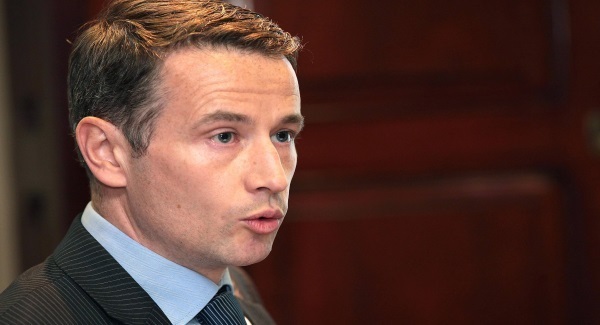
The story begins with a fruit — or, as Finbarr Kirwan puts it, the fruit is the story. The Cork native was in Colorado, beginning a new job with the US Olympic team, when he met one of the most famous athletes on the planet.
“We’re all human. You walk into a room with Michael Phelps for the first time, you know there’s an expectation, that you’re in the room for a reason. You’ve earned the right to be in the room but you definitely feel that pressure to be able to offer something of value to him.
“When I got to Colorado I met his coach, Bob Bowman, one of the best swim coaches — best coaches, full stop — I’ve ever met. A brilliant man. Michael was coming up to the training centre in Colorado Springs for a couple of weeks’ training and when he came into the dining hall, Bob said, ‘let’s do the intro now’.”
Phelps came over. Nice to meet you, he said to Kirwan, before adding: “I’ve got something I need you to help me with.” Kirwan thought: “OK, this is the test.
“He wanted an avocado. They didn’t have them in the dining hall, so I said to myself, ‘I’m going to have to get this man an avocado’.
“The avocado’s become the story for me. It doesn’t matter what it is, if the guy says, ‘I need this’ — there’s always a point when you’ll be tested. It may come at the beginning of the conversation or the end, but it’ll come.
“And the point is you’re there to serve these people, to serve the right athletes, the medal-potential athlete.
“It goes back to the point of feeling the pressure to respond, and the answer is yes. At the time it happened Bob started talking about some other things, some strength and conditioning or medical supports, and before you know it we were off talking about something else entirely.”
Kirwan is senior director of performance with the US Olympic Committee.
“The job is to help put US athletes onto the podium — how we do that is we use the available resources we have. Money, science, medicine, training centres, technology — we bring those together, we work with the sport and the athlete to maximise performance.
“I was doing a similar job in Ireland, and what I learned here is what we’re applying in the States but on a broader scale.”
Is scale the difference?
“Yes, in numbers and yes, definitely, in expectation. I started after the London Olympics and I run Team 4, which covered six sports going into Rio — swimming, athletics, equestrian, weight-lifting, golf, and shooting.
“We’ve had sports climbing added since, so I’m trying to catch up on that.
“Those sports won 65 medals at London, so the pressure I felt was different to what you’d feel in Ireland, where it was more a case of ‘help Katie Taylor over the line, to get the medal, get the funding and get Billy (Walsh) what he needs’.
“This was at a larger scale but using the available resources we bumped that number from 65 to 73 in Rio. There’s no softness. It’s black and white, it’s either happening or it’s not, and the currency is medals.
“Our job is directed towards helping the team win at the Olympic games, that’s basically it.”
There are other key differences. Take the revenue sources.
“There’s no government funding — and it’s written into legislation that it’s a privately funded entity — so we’re able to leverage the rings and all that goes with those.
“There’s a marketing component to the work, and there are private donations. High net worth people who are committed to the Games and who are big supporters.
“The absence of government money is interesting, it’s the opposite to Ireland, and I’ve enjoyed that transition. It’s meant there’s very much a business focus, and that the dollars we get belong to somebody.
“You meet the donor. It’s not like Ireland where ‘the taxpayer’ is a nebulous term. We meet the donor and the donor asks how his or her million dollars are going... the point is that there’s a more commercially driven environment where medals are the bottom line.
“I also oversee a USOC Technology and Innovation fund which has helped support a number of our Winter Olympics governing bodies, including Bobsled/Skeleton and Ski and Snowboard.”
Is there potential for a conflict, however, if the donor wants to see his or her money used in a specific way?
“We don’t see it as a conflict,” says Kirwan.
“That happens quite a lot and in sports like rowing and sailing, where the demographic can be wealthy, a donor may well have an idea of where they’d want their dollars to go.
“As much as we can we try to have a conversation where we say, ‘yeah, there’s real value there, 100%, but have you thought about this?’ So there are options.
“But we must also be absolutely respectful of the fact that the money belongs to this person, so if they choose to direct in a certain way, we’ll make sure they get the best return on wherever that goes.”
Within the team, Kirwan’s primary relationship always is with the coach: “I’d never want to be out in front of the coach, I’m there to work at his shoulder, and in that case it was with Bob (Bowman), but yes, there’s a pressure in stepping up to the expectations they have.
"And you have to be able to recognise the moments, too.
“In fairness, with Michael it was clear that his commitment to performing at his very best in Rio was exceptional.
“His workouts in Colorado were phenomenal, he was a leader within that national group, and they had a record performance in Rio — a lot of that had to do with the leadership, which was there early on.”
So even within an Olympic-level team, an individual can drive standards?
“Looking at the swim team, 48 go to the Olympics, and you have to be in the top two at the trials. It’s so brutal, and to see the stress they were under at the tryouts, and then to see how the team forms after those trials… it’s like they’ve been through the battle, because the trials are almost harder than the Games so it’s almost a relief for them to make the team.
“Some of them have the means to stay wherever they want — Michael could stay in the Four Seasons and fly down in a private jet, but he chose to be in the team environment.
“He did that because he got value from being around his teammates — he got energy from them and vice versa. There was one night, the men’s 4 x 100 and Michael’s turn at the 50 was brilliant. There were a couple of questions going in — could he replicate his form and so on — but you saw the turn and knew: we’re on.
“And the energy in the group seeing that... they knew it was on, too. That’s what he brings.”
But what does a Bob Bowman bring? What makes him special as a coach?
“My observation is that whatever the discipline, these guys evolve with the athlete. Their personalities can shift.
“The technical stuff… you’re coaching a 1500 metre runner, you can do 8x400 metres and so on, fine, but it’s the ability to change and evolve with the athlete.
“Bob talks about that, his evolution as a coach from starting with Michael, as a boy, and now he’s grown up and married — so Bob’s style had to evolve. His coaching when Michael was 14 is different to what it is when Michael was 28.
“I see that with Billy Walsh. He’s thriving in the States, we hang out together, but when you see him with the boxers…
obviously he’s great technically, but his skill is in communicating, making people believe.
“It was interesting hearing Joe (Schmidt) recently about the suppression of the ego and leaving players do their work. Billy is similar.”
Interestingly, Kirwan says the US is “trying to catch up” in terms of science and tech in sport.
“In comparison with nations like Japan and Britain, we’d raise our hands and admit we’re a little behind, but we’re trying to catch up.
“A couple of things, though. We were looking for technology to help us take the athlete out of the laboratory — bringing the science to the training pitch.
“We’re interested in wearables, a unit giving you physiological feedback, heart rate variability, body changes as the athlete trains.
“Sensors on sleds to assess forces going into curves and overlaying video on that… we’re also looking at motion capture, the biomechanical movement of the athlete and getting better appreciation for that movement.
“Right now the technology means putting sensors on the athlete and representing the movement on a screen or display. What you really want is no markers on the athlete, and the tech coming from the display unit.
“Watching golf on TV, that technology tracking the drive, the white streak across the screen and the radar technology company which does that — we’ve adapted that so the line you see is a radar unit with a graphic and data overlayed on it. We use that with the shot put and hammer throw.
“Is it a panacea? What it’s become is a very important coaching tool. You’ve got the video of the throw and the data on top if it — angle of release, velocity and so on.
“Those data points on the throw made it a new way of coaching — rather than the coach saying, as used to be the case, ‘I think you were a little flat on that throw’ and the athlete thinking, ‘ah, I think I got it’, now you have the coach able to say ‘you need the release to be at 58 degrees, and this is what 58 degrees looks like — the last throw was 53 degrees.’
“So it changes that dialogue between the coach and the athlete.”
Kirwan says it “would not be outlandish” to see other Irish coaches, like rowing’s Dominic Casey, take up positions in the US: “It would be in line with what they (the US) have done in the past.
“When you start they want you fully committed to Team USA, but there’s a genuine lack of ego in the system.
“Like life, there are pockets of it but the self-reflection that goes on in Olympic sport in the US is genuine, and that self-reflection leads to the question, ‘how can we do this better?’
“And that leads to ‘if we can’t find the person here, then where’ll we find them?’ and they go and find that person.
“That kind of self-reflection is very important.”
The recruitment of Billy Walsh is a case in point, added Cork native Kirwan.
“The first question I was asked when I joined (US Olympic team) was about boxing.
“They (the Irish boxers) were the big story, so when I joined I was asked for my thoughts on boxing as the US had an underperforming boxing programme, and we know the answer to that.
“Billy was recruited because he’s genuinely the best in the world at what he does. World Coach of the Year this year, and World Coach of the Year last year after the Olympics, he’s seen as the pre-eminent guy in that sport.
“When good people are out there, then there’s no lack of ambition when it comes to the US Olympic programme getting those people.
“Arthur Lydiard was the man who coached the great New Zealand distance runner Peter Snell — and a lot of other runners — and Lydiard used to say there was an Olympian in every village, but his idea was that there wasn’t a coach in every village.
“There’s often been brilliant talent in Ireland which didn’t find the right way because the person didn’t get the right coaching — or perhaps get any coaching at all. Skibbereen is no different.
“I don’t know Dominic but I know his reputation.
“What they have achieved is tremendous, and it’s reflective of not looking for absolute perfection, but looking to get really good people together and succeeding.
“In terms of how Ireland is perceived internationally, there’s a recognition of the value.
“Ireland can be very hard on itself.”