Stephen Duffy Q&A: ‘If your goggles were to come off, it’s instant blindness’
My mother was raising money for the Irish Wheelchair Association back in the early 2000s and myself and my brother David did a tandem parachute jump to raise money for the charity. David loved it and a few years later he found the Irish Parachute Club and got trained up. I followed him in about two years later. That’s where we initially met Marc (Daly) and Des (Reardon, the other team members).
Since then we’ve become tandem masters so we’re now the guys you’d be strapped to when you’re doing a charity jump. We’ve taken our mother and both of our sisters. Our father hasn’t stepped up to the plate yet...
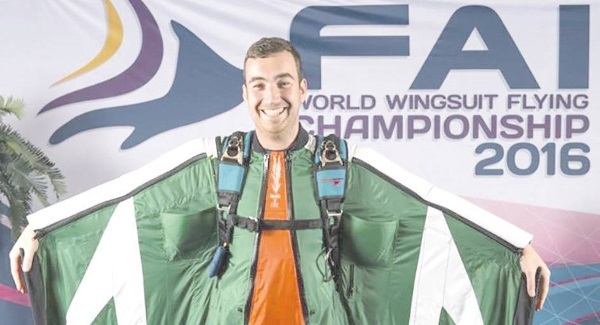
The wingsuit itself is basically an inflatable suit. It works on ram air, so when you jump out of the aircraft and the air starts to flow over your body, it inflates the suit. It turns your body into an actual wing. Just like an airplane, it’ll be flat on the bottom and curved on the top to create that low pressure to give you lift. Gravity is always going to be dragging you down but we can overcome gravity and achieve glide ratios over a whole jump nearly up to 4km forward per kilometre of distance downwards. At peak times during a jump, say during a high-speed flare, we’d actually be climbing. It’s possible to go back up but you use so much energy when you start to climb that you get to a certain point and start to fall again.
On average, we’ve all had in excess of 1,000 jumps each since 2010 and 2011. Basically, all of the jumps we’ve done since then are wingsuit jumps, apart from tandems for charity. We record all the GPS data from every jump we do and go through it with a fine-tooth comb to pick out where we could’ve done better. When we’re doing the competitions, like the World Championships or the World Cup, you’re only measured from 3,000m down to 2,000m, so you want to get your optimum in there. What we do at the top gate is that high-performance flare to get the optimum glide ratio through that window.
Because the light guys are going to be really good at time and the heavy guys are going to be really good at speed, to find the best true pilot they do three tasks: time, speed, and distance over the ground. Just to put it in perspective, our nominal distance is usually around 3.5km for every kilometre in descent, our time in that 1,000m is 70 to 80 seconds in freefall and our speed can reach in excess of 300kph ground speed. Our vector speeds can be up to 400kph.
The records we’re looking to break are overall distance and time, as individuals and as a team. The current record for overall distance as a team is 11km so we’re absolutely going to smash that out of it. For an individual, it’s 30km. We’re hoping to go over 25km but because we have to stay as a team, 30km is not really going to happen — although we will be able to get the European records for individuals. For time, as a team, the aim is seven minutes. We’d expect to be able to get between eight and nine, and hopefully in excess of the individual time record which is nine minutes and six seconds.
The aircraft will be flying along and all three of us get out the door one after the other. We all fly together in a straight line, possibly towards Sacramento City. Hopefully we won’t be landing in the middle of it! Which direction we’ll actually be flying all depends on the weather conditions on the day.
No, we have our pre-planning grid broken up into eight segments, and in each segment we know our optimum landing area. That’s what we’ll be aiming for but, to be honest, we’re not going to be worrying about where we’re actually going to land until after we finish our record run. We’ll have approx five minutes once our parachutes open to plan and reach a safe area to land.

It’s looking like the average temperatures at 33,000 to 35,000 feet are -55 degrees Celsius. When we put that through the formula at an average plane-speed of over 250kph, it’s coming out at -97, factoring in wind chill. Our primary sponsor is Aer Lingus and we have other sponsors GoXtreme Action Cams and FlexiTog, who have built us custom-made thermal suits and bodysuits. We’ll be wearing thermal and heated gloves as well to keep us warm.
There’s no fear at the moment but there’s definitely anxious nerves. I’ve only had two nightmares so far! We’ve assembled a fantastic and elite team around us, but there’s still the risk involved. Any open skin is frostbite. If your goggles were to come off, it’s instant blindness. If your oxygen system fails, you’re four minutes away from any breathable oxygen source. If you’re in a reduced-oxygen state, you can suffer from hypoxia. The first stage of hypoxia is like drunkenness, so you’ll notice there’s something wrong but you won’t react to it. The second stage is you’ll black-out. We’ll be getting out of the aircraft at much higher speeds than we’re used to and, unfortunately, you can’t simulate that on the ground. Even if we do very well, we only have a 12 to 15-minute oxygen supply. So, if we were to absolutely smash the world record of nine minutes, we could end up running out of oxygen. But the calculations say the best we can do at our current level is ten-and-a-half minutes. Those are our biggest concerns but we’ve life-support systems and plans in place for everything.
Personal achievement, number one. And number two, this is actually a proof of concept for a much, much bigger project we’re planning on doing in Ireland for September 2018. Our intention is to fly as a team of three, or possibly four, from the North of Ireland across the Irish Sea to Scotland. That’s a 22 to 24km mass of water, which would be another world record.
It’s only been in the planning for three years so it’s all coming together slowly but surely! We’re also trying to increase our numbers and the knowledge that people have of the sport. A lot of people don’t think you can parachute in Ireland, so it’s trying to get our message out that we’re here…
And breaking records! We’re not just here in spirit, we’re giving the best in the world a run for their money.