Anna Lee Q&A: ‘Every attack has to start really slowly, so they don’t know they’re being attacked’
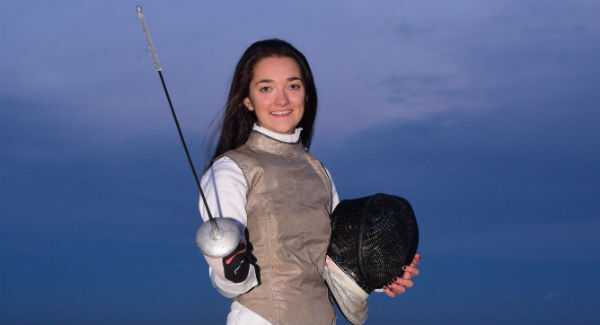
Anna Lee won the women’s foil at the Irish Open, the flagship fencing event in Ireland, adding to her National and East of Ireland titles. Aged 18, she is also studying for her Leaving Cert this year.
Anna Lee Q&A: ‘Every attack has to start really slowly, so they don’t know they’re being attacked’

Philip Lee, Anna’s father, is chairman of the recently renamed Fencing Ireland, which oversees the running of the sport. There are 19 fencing clubs in the Republic, including eight college-based clubs. They have a good relationship with the Northern Ireland federation, which holds its Open event in January, while the Irish National Championships are set for April.

Q: First of all, congratulations on your Irish Open win.

A: Thanks, it was great to win my first one!

Q: Your dad was competing at the event too, so I’m guessing he had a role in introducing you to fencing?

A: Yes he did. They did it in my primary school for a while, so I did it for three or four years there from the age of seven. Then I moved into a club, in Conleth’s (school) in Dublin. I really started competing properly in internationals when I was 15, because there aren’t that many competitions for me to compete here in Ireland — maybe four or five a year. That was eye-opening because you feel like you’re really good when you’re in Ireland, but there’s not that many people to compete against. Then you see the standard of the countries who actually take it seriously as a sport.

Q: Where have you travelled to for international competitions?

A: They’re mostly all over Europe. This year I’ve been to Budapest and Romania, and a few in the UK. I’ve been to Slovakia, Slovenia, Croatia, France, Germany, Italy… The European Championships last year were in Serbia and the Worlds were in France, but the year before the World Championships were in Uzbekistan. That was the first time I’ve been out of Europe for competition. It was very different.

Q: How different is your preparation for events abroad when it’s such a step up in class?

A: Sometimes I might spend a month training really hard for a competition and get knocked out in the first round, and I’d have to fly home the next day. That can be hard. But I prepare the same even if it’s a really tough competition. I have to hope for the best and prepare as if I’ll be fighting all day. In the Irish competitions I’d know I’d be in for a long time, but it’s harder to judge when I’m going to the internationals. But a lot of preparation would go into them either way.

Q: How does the sport work?

A: There are three weapons so there are different rules for each of the weapons. My one is foil, which is the one you might recognise… It’s the smallest weapon and the simplest. You can only hit on the torso, which is why we wear an electric vest. When the foil, or the sword, touches your torso, it sends an electrical current down the sword and it registers a hit with a light.

You can hit at the same time but you can get priority by making an attack. So if you’re lunging forward and they’re moving backwards you’ll get the hit if you’re making the attack. The same happens with a parry riposte, which is when they make an attack and you hit the blade away. If you both hit then, it’s your point then because of the riposte.

Q: Your movement needs to be quite explosive so… What do you work on in training to improve?

A: My dad coaches me but I’m also coached by a woman in the club as well. A lot of the stuff I’m doing wrong I wouldn’t notice myself, so they’d tell me a lot of that. So maybe your lunge isn’t long enough, so you’re trying to do a longer lunge, or working on your parry ripostes, to make a smaller movement so you can get to the target faster.

Q: Are there much tactics involved?

A: Yeah, it’s not just about what you’re good at, you have to tailor it to every single fight that you do. The trick is to do things to make them think you’re going to do one thing and then surprise them with another. It’s really important to have a change of speed. Every attack has to start really slowly, so they don’t know they’re being attacked, and then you finish really quickly and hit them when they’re at the right distance.

Q: Do you tend to be the aggressor or attack off the back-foot?

A: There are different ways you can play it. There’s also a time limit, which can put you under pressure. You’ve three minutes in the pool matches to get your five hits done, and then you’ve nine minutes in the direct elimination matches to get your 15 hits to win. But very often it goes to time, so you don’t get up to 15 and the winner is whoever has the most points at that time. In that case, if you’re ahead you’d be trying to let the time run out and keeping a long distance so they can’t get you with any attack. But if you’re behind, you’d be a lot more aggressive.

Q: Would you explain the difference between the foil, épée and sabre categories?

A: In foil you can hit on the torso and there’s always going to be a priority given if there are two on-target lights. Épée is the one modern pentathletes do. They don’t wear the electric vest because their whole body is a target and you can also get a double, which means you both hit at the same time and both are awarded a hit. Sabre has got a big guard on the weapon and it looks like a pirate’s sword. They can also hit with the side of the blade, whereas in foil and épée you only hit with the point, which has a small button on it.

Q: Are there many clubs around Ireland?

A: There’s a lot less clubs than we’d like but it’s definitely growing. There are a lot of kids doing it compared to when I was young. There’s still a huge gap and I’d really feel it because I’ve only one or two training partners, which makes it hard to compete with international fencers. But our club, Pembroke, are opening up more days to train the kids.

Q: What’s your favourite part of fencing?

A: I really enjoy working out your opponent mentally. The physical side of it is sort of fun but you get sick of it sometimes. But even if your muscles are sore, I enjoy working out what they’re doing. Even if you lose a match, you can come away feeling good because you enjoyed figuring out what they’ve done and trying your best to do something else to get around it. When you make a really good hit and everyone can see it, you forget about whatever the score is and think, ‘Yeah, that was really good’.

More in this section

Cookie Policy Privacy Policy Brand Safety FAQ Help Contact Us Terms and Conditions

© Examiner Echo Group Limited