Obituary: Miami Marlins pitcher Jose Fernandez
It is a stormy night on a stretch of the Caribbean Sea known locally as ‘Cuba’s largest cemetery’ and although the boat is not heavily laden the angry waves uncomfortably remind the passengers of how this water got its name.
Although just 15 years old Jose Fernandez is already on his fourth attempt to emigrate from his native land, hoping for a kinder life in North America. The boat had earlier run a gauntlet of Cuban coastguard gunshot and was heading towards the holiday resort of Cancun, Mexico.
There is no way to precisely know what reflections accompanied Fernandez on his journey that night, but it’s a short priced bet that baseball had fair prominence among the other prevailing anxieties.
And a fear of capture and subsequent jail was probably in there somewhere too. The last time he had tried to leave Cuba he was apprehended and sent to adult prison for several months where he mingled daily with murderers. This terrifying experience was slow to leave him.
Still, his stepfather Ramon Jimenez, who had nurtured and provided for him since he was a baby, had needed 14 tries before he succeeded to emigrate three years earlier and in those years Ramon had worked tirelessly to pave the way for his family to join him.
By the time he boarded the boat, Jose was already widely recognised as a baseball phenomenon. He had taken up the sport at five and by the age of 14 had already pitched in three age group national championships. He was destined for the elite programme at Cuba’s School for Sports Initiation and fame, if little fortune, as a future member of the national squad.
Wherever his thoughts had wandered that night they were rudely interrupted by a sudden splash and loud commotion on the boat. One of the passengers had fallen overboard and instinctively young Jose leapt into the water in a rescue effort.
Years later he described what happened next. “I have always been a good swimmer, since I was a kid,” he recalled, “which is why I am always alert. I dove to help a person not thinking who it was.”
When he had safely recovered and calmed the terrified emigrant he looked at her face. “Imagine when I realised it was my own mother, Maritza. If that does not leave a mark on you for the rest of your life, I don’t know what will.”
Several days later, Jose, Maritza and his younger sister Yedenis made it safely to Mexico. They then took a dangerous bus ride to the US border town of Hidalgo, Texas, which if things go as Donald Trump hopes in November, will soon be a brick in the wall of exclusion.

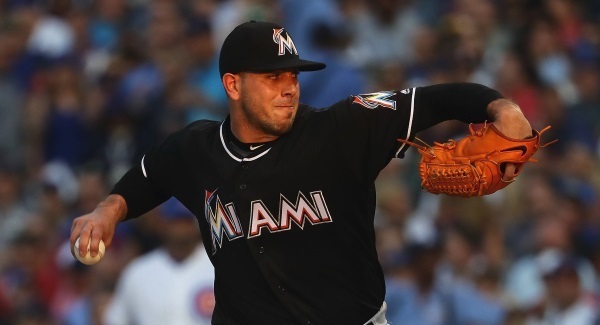
Young Jose is now 24, weighs in at 17 stone and stands six foot two. By now, he is a wealthy young man earning almost $3 million a year from the Miami Marlins baseball club, a salary thought of as an appetizer for the $200 million main course that awaits him when he becomes a free agent in 2018.
He lives a joyous and exuberant life. Widely loved in Miami and far beyond as a gregarious and lively character, he is enjoying all the trinkets wealth and celebrity brings you in Florida. Prominent among his bling is the 32- foot, 60mph powerboat he calls ‘Kaught Looking.’
On September 25th last, he took his boat on an early morning voyage somewhere between Port Miami and the open sea. It was to be his last ocean journey.
The day had been fraught for Fernandez, mainly because of a bad argument with his pregnant girlfriend. He took his boat out, picked up a couple of friends and punctuated the evening with stops at various late-night watering holes on the Miami quaysides. The last time he was seen alive was at 2.35am when he and his buddies left American Social, an upmarket beachside watering hole and headed back out to sea. At 3.15am, Kaught Looking crashed at high speed into a nearby pier.
The tragic Fernandez and his family had eventually crossed the border into Texas on April 5th, 2008. America operates a ‘wet foot, dry foot’ policy with Cuban emigrants. If you are caught at sea you’re returned to the island. If you make it onto land then you are welcomed right in.
So in they came and found their way to Tampa where they rejoined Jimenez, and like hundreds of thousands before them, got down to the hard work of making their Cuban dreams of Florida come true.
Jose enrolled at Braulio Alonso High School, readily made the baseball team and led them to two State titles, ending his senior year with a 13 win, one loss record, including two no-hitters and an exceptionally good earned run average (ERA) of 2.35. His high school career ended with two less obtuse statistics: he turned down a signing on bonus of $1.3 million from the Cincinnati Reds for the $2m offered by the Miami Marlins.
His rookie season at the Marlins was historic, the list of records broken long and detailed. In short: he was accelerated through the normal development schedule in the Minor Leagues, made his debut against the Mets on April 7th, 2013 almost five years to the day since he crossed the US border. He was one of only seven pitchers under 21 years old to throw eight ‘strike-outs’ on a first start in over 100 years.
He made the National League All-Star game in July of that year where he broke even more of baseball’s bottomless catalogue of records. He ended the season with the league’s Rookie of the Year award and was third in the Cy Young Award voting. In a European context, it’s like somebody who plays their first game in September at the age of 20 coming third in the Balloon D’Or voting to Messi and Ronaldo.
In the three short years that followed, Jose Fernandez consolidated his reputation and popularity. Prankster, philanthropist, but most of all, poised to be one of the greatest pitchers of his generation. When he died, the Marlins postponed their next game in tribute and for the next home game the Cuban-American city turned out to remember their favourite son.
The day after his boat had crashed into the jetty four baseballs washed up on Miami Beach. Jose had signed them all. It had ended as it had begun. At sea.