Colin Jackson Interview: Scaling hurdles with a smile
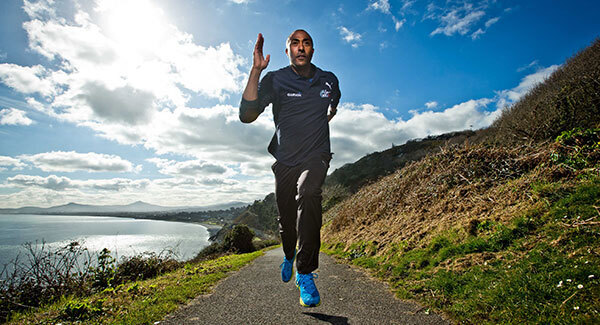
e looks like he could still run. Not just run, but sprint and hurdle and compete — even medal.
Colin Jackson’s birth cert may show he’s 49 but meeting him you’re struck by how he could easily pass for 29.
The most-medalled British athlete of his generation is over in Dun Laoghaire to promote a global charity run that he directs, and it’s obvious that an active lifestyle is something that he doesn’t just preach but lives. He still trains as much as he can, he says, be it going out on the bike or for a run or to the gym.
He giggles when you ask him what’s the secret to defying aging thus far – spend some time in the man’s company and you learn that Colin Jackson has a tendency to giggle, even when the subject matter is less flattering or more sombre.
“People always say to me I’m an eight-year-old with money,” he says with that disposition that is even sunnier than the weather he’s brought with him this day.
“I enjoy life. And I think that’s the most important thing. I try not to stress over things in any way and I think that keeps me sane. I work with good brands, I work with good people and have good people around me. I think if you have a sense of fulfilment, you have a sense of enjoyment.”
Which, in many ways, is a great approach to have. Except it could be said that when one of your jobs is to commentate on a sport that is constantly plagued with scandal, you should maybe stress over certain things a bit more.
“How sweet it would be to live like Colin Jackson, the BBC pundit. There has scarcely been an athletics story in the last three months without the word ‘doping’ included, but Jackson chooses to keep his head firmly in the sand. He blathers on about how good an athlete’s year has been, how fantastic it is for a 33-year-old man to be still at the top of his sport, with no mention whatsoever that he is referring to a twice-banned drug cheat... As [Justin Gatlin] coasted home with a 9.77 second semi-final race, Jackson gushed, ‘Even with all his problems, you cannot take away the fact he is at the top of his game.’” — Matt Butler, The Independent, August 2015: ‘Ignoring the drugs references makes dreamer Colin Jackson look a prize dope’.
he same week that Jackson is over to promote the Wings for Life race, it’s broken that Maria Sharapova was taking something other than Red Bull to give her wings. We’re also in an Olympic year in which it’s emerged that her native country’s athletic programme was essentially systematically doping. So how concerned is he for sport, especially his own?
“I’m happy that the badness is being exposed,” he says. “I think it’s really important that there’s no hiding place for anybody. Just because you’re a big name and a big country, you shouldn’t get away with stuff. So I’m happy in that sense that it’s being exposed.
“The only thing that is disappointing is that it happens. We’d all rather it didn’t happen. That’s the most frustrating thing for me. But I think what is good is that there is a very clear message to young people who want to do athletics as a sport — you know what, if you think you can just put your feet up and relax and reap the rewards from your cheating, [he wags his finger] it ain’t going to work that way. Because they will come for you. It might be in 20 years, but they will come for you.”
Jackson himself can vouch that he at least has that peace of mind. When he burst onto the senior international scene in his late teens he was so naively conscientious that he not alone abstained from drugs but almost from food as well — well, at least fat. At the time he was working under the belief that the more weight he lost, the quicker he’d get. Instead it left him vulnerable to injury and infection.
After that brush with a food disorder, he’d learn the value of eating fat and taking certain supplements to wade off colds. To this day, he can candidly list off all the substances he took throughout his career. Creatine. Glucosamine, Carnitine, and a supplement called ACE which contained calcium, zinc and Vitamin A. They were the only things he took. He knew what he was taking and why he was taking it. And he didn’t feel the need to take anything else.
It’s why he has an issue with sportspeople making up stories as to why they’re taking substances. His sympathy for a Sharapova is limited for another reason. “The athlete should know what is coming on the list,” he says, “and if you’re taking anything of pharmaceutical strength, you better be reading up every single thing. Athletes want to better themselves, but if you want to start taking risks, then you’ve got to be able to deal with the consequences.”
So, you ask him, could he understand why people were surprised and wondering why he was sympathetic to the case of Justin Gatlin, and so reluctant to remind BBC viewers of the sprinter’s past?
“I was probably the softest of everybody [on the BBC team],” he acknowledges. “But as I’ve already said to people, everyone knows clearly what my stance is on drugs in the world of sport. So I don’t really have to keep reiterating that to the general public.”
Sure enough, Jackson has been publicly critical of doping. In 2010, he said that Dwain Chambers would always be remembered for being a cheat and rightly so. In 2011, he said that the British Olympic Association should ban any suspended athlete from competing at any future Olympic Games. But the idea that “everyone” knows his stance is a stretch. Those who don’t know it could probably do with him reiterating it. And he won’t deny that he has a certain sympathy for dope offenders, such as Gatlin.
“The people you have to blame for Justin being in the position where Justin is in is our sport and our federation, not Justin,” he tells you.
Why, you ask? “Because he’s just doing what the rules are saying that he can do. Why should you persecute somebody because he’s just doing what the sport allows by leaving him back in? If they didn’t want him back, keep him out?”
So what does he think should be the ban for someone like Gatlin?
“Oh, he should have a life ban — in my opinion,” says Jackson. “The problem with a life ban and taking away someone’s chance to work at what is their job is that the test is not 100% foolproof accurate. Once you have a tiny margin for error, it’s hard to enforce life bans.”
So, he’d be for life bans. But since the sport doesn’t insist upon or enforce them, Jackson will be sympathetic to, even tolerant, of certain dopers.
Maybe it goes back to his own coach, Malcolm Arnold, under whose tutelage Jackson would win two world championships and set a world record that would last for over a decade. In 1992, a Canadian athlete called Mark McCoy returned to the sport after serving a two-year ban for doping. Jackson at the time was the favourite to win gold at Barcelona yet he and Arnold allowed a rival like McCoy join his training group that year. McCoy would end up winning gold while Jackson wouldn’t even medal but neither Arnold nor Jackson would regret their leniency.
“It’s very easy to condemn people,” Arnold would say upon McCoy’s victory. “Perhaps my ethics are a little more Christian. Forgiveness is an important aspect.”
Jackson shares a similar ability to forgive and not to condemn. You ask him about Seb Coe, who like him is part of a fabulous Great Britain athletics tradition and someone he must have got to know well from London’s Olympic bid for the 2012 Games. From knowing the man and now knowing what’s going on in his sport, is Coe the man to solve it?
The question triggers another curious little fit of giggles from Jackson.
“I have to laugh at this, and not in a bad way, and Seb would certainly agree with me in this circumstance. When he was doing all his canvassing, canvassing, canvassing out there, he would never have thought about what he was going to have to deal with if he got voted in as president!”
He stops laughing. “And it shocked us all, if I’m honest. He has some great ideas on where the sport can go and what angle we can take but unfortunately with all the other stuff that is going on, he needs to clear up this mess first.”
But given Coe was vice-president of the IAAF, did he not contribute to that mess?
“No-no-no-no,” he insists. “It’s a very closed shop in that circumstance. So when he was looking after London 2012, he’d have had no chance of looking on what was going on in the IAAF. Vice-president or not, he’d have absolutely zero opportunity to get into the nitty-gritty of athletics as a sport.”
So what can Coe offer the sport?
“Well, what I’m hoping that he can do is really shine some clarity on it and get the support of people again. One thing with Seb is he will always be as fair as he possibly can be. There’s no doubt about that. And he won’t take any messing about. He won’t take any prisoners in that circumstance. So if someone has done wrong, he will say ‘You have to go, it’s as simple as that.’”
So do you think Russia will be allowed back in?
“If they produce what they’re supposed to produce, and get in line, then will they come back in.
“Well, if they clean up their act, yes. I see no reason why not. But they’ve first got to clean up their act and prove that they’ve cleaned up their act.”
So just the individual athletes who have been proven to have doped should be suspended from the Olympics, not others even though there was such widespread doping throughout the system?
“Yes”, he says. “If the federation have proven they’ve cleaned up their act.”
So he’s against doping. Thinks anyone caught should have life bans. But in the absence of such severe sanctions he has a certain sympathy and tolerance for athletes like Gatlin who he simply refers to as “Justin” and is confident that “Seb” will finally clean the sport, though he should allow the Russians in for Rio under certain conditions.
Matt Butler might be right in thinking he’s been dreamily naive. Or else his old coach is right and he’s just more Christian and forgiving than some of us.
ou bring him back to his first Olympics. Seoul, 1988. The men’s 100m sprint has since been dubbed The Dirtiest Race In History.
He anticipates where you’re going with another giggle. “Only Calvin Smith was clean!” Correct. Jackson ran in a similar event except there were hurdles out there and an extra 10 metres. Was it a moral dilemma for him to join the dirty race or was there any anguish that he was possibly cheated, given he never won an Olympic gold and it would be naive to think his event was unaffected by doping?
“You have a choice,” he says, this time without the trace of a smile. “And you can get it in your mind that these people are cheating around you, or you can concentrate on what you’re doing and just train hard and do the best that you can do. Otherwise it could become an excuse for not performing.”
He gives you an example. Those 1992 Games, in which Mark McCoy would win gold. Jackson would limp home in seventh. No one — McCoy or anyone else – was at fault for such an underperformance.
“It was my fault – why I pulled a muscle. I didn’t do a warm-up for the second round – because it was only the second round. I didn’t think it was necessary for me to do that to qualify.”
How did he allow himself to take such a short cut?
“Because you’re 25, ranked number one in the world and think you’re untouchable,” he smiles with that appealing self-candour and accountability that crops up several times through the sitdown.
At the following year’s world championships he would set a world record 12.91. “I wasn’t going to make the same mistake. But that’s what sport is about. Tough lessons. And you have to learn from those tough lessons. You’re a fool if you don’t.”
Jackson would never add another Olympic medal to the silver he won in Seoul, finishing fourth in Atlanta and fifth in Sydney, but he’d go out on a high, winning a fourth consecutive European championships in 2002. Retirement was something that was made easier by the fact that his final year was followed and recorded for a documentary, which he would edit. That opened up a world in television.
Jackson wanted to enter new terrain, looking at history and how people interact with one another, not just sport.
But those challenges were the appeal of it as well. “As an athlete your creative side gets crushed because there’s nothing for you to do but deliver this [performances]. But I had friends who were producers and I really loved what they were doing.”
His production company — called Red Shoes after the spikes he wore in the ’90s — continues to grow. He mentors several athletes, from those in his own event like Lawrence Clarke who finished fourth in the 2012 Olympics, to those in other sports, like the GB men’s basketball team who also participated at those Games. Ten years on from being a finalist on Strictly Come Dancing, he’s still a member of that family, touring with them every few years.
Then there’s his work as an event director. He runs his own charity run for prostate cancer, while the Wings for Life event on May 8 will have him based in Red Bull’s Salzburg headquarters for the day, watching 34 screens as the run starts off in Dun Laoghaire and 33 venues worldwide.
As an event and an ambassador to promote a clean active lifestyle and a good cause, it’s a good match.
As for making athletes clean, his friend “Seb” has a way to go.
Visit www.wingsforlifeworldrun.com for more details

CONNECT WITH US TODAY



Be the first to know the latest news and updates