Rally star Nagle calling the shots
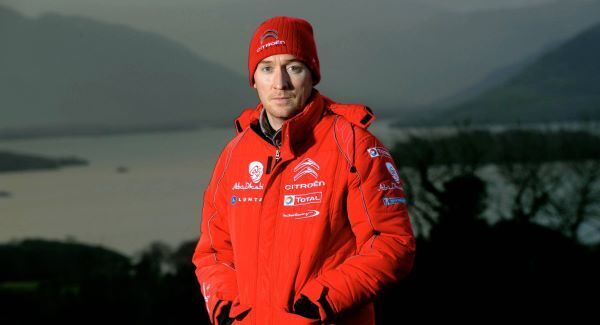
The Paul referred to above is Paul Nagle, who sits in a Killarney coffee-shop, trim and friendly, a successful professional sportsman virtually unknown in his own country, discussing what should be an exciting 2014.
He, and Tyrone native Meek, will drive for Citroen for this year’s World Rally Championships (WRC), a hugely prestigious car, and for Nagle it’s another rung in a long ladder.
He’s steeped in rallying, to put it mildly.
In his own words, he was one of the little lads in the high-vis jackets giving directions at rallies around the country. His father was heavily involved in the Rally of the Lakes, so motorsport was in the DNA.
“A lot of the lads in school were big into cars and so on, and my dad was a co-driver at national level. As he was involved in rallies from the organisational level I was brought marshalling the length and breadth of the country from a young age. That gave me contacts, being involved so early.
“When I got to 17, a couple of mates and I decided we’d have a go and we took up rallying ourselves for the craic. It all progressed from there.”
Co-driving, though? The appeal of sitting behind the wheel is obvious enough, but shouting directions from the passenger seat?
“My dad was a co-driver, so I had the interest. When my mate bought a car I offered to do the co-driving rather than the driving. It didn’t really appeal to me.
“I’ve done the odd bit of driving for charity and so forth, but you need more money for driving, for the car and everything that goes with it. I wouldn’t be where I am today if I’d been a driver.
“It didn’t appeal to me in the sense that I’d know I wouldn’t have the driving skills for it; I drive my own car on the road, but if I’m in a car with anyone I’d rather be a passenger, to be honest.”
So he wouldn’t be a nervous passenger, then? “I wouldn’t be much good in my job if I were a nervous passenger! I wouldn’t get much of a buzz from driving, I’d enjoy being driven around far more.”
It’s a tough gig, though. Nagle says that what you see on television, filmed by the on-board camera, is only the tip of the iceberg.
“There’s a mountain of work, a lot more than you’ll see.
“At this level a lot is done for you in the sense that your flights, accommodation and all of that is sorted for you, your schedule’s made out but as a co-driver you’ve to drive the entire route twice and make your pace notes.
“The driver calls those out the first time you drive it, you write them down and call them back to him on the second turn around.
“That’s the most important job I have – to write down those notes properly and call them back to him properly when the time comes.
“You have to relay information to the engineers if there’s something wrong with the car: there can be 30 people back waiting on your every word about the engine, so there’s pressure there.
“When all that’s done . . . well, if we’re going to Monte Carlo, for instance, we leave on the Saturday, practice Sunday, Monday and Tuesday and take a day off Wednesday.
“Along with all of that, then, there’s the relationship you have with the driver himself.”
That’s the point Meek makes above. The chemistry, the atmosphere created by the partnership is also significant for the team’s chances of success. Nagle agrees.
“It’s interesting. You’ve got to get on with your driver, because you’re with him maybe 15, 16 hours-a-day. The two of you have breakfast, lunch and dinner together. You fly out together to an event. You fly home together.
“If you’ve an argument with your wife or your girlfriend you can walk away for a while and let things cool down, but with the driver if there’s an argument you have to get into a car with him again half an hour later.
“As a co-driver you have to keep them calm, keep them focused. Kris is very fast but these guys can be highly strung – they’re under huge pressure, there’s a lot of hype, and it’s important to help them in any way you can.”
Which isn’t to say there are never disagreements.
Being thrown together for so long, in such a pressurised context, can lead to tensions.
“It’s like a job. You’re there to work, and if necessary after the race you can let the driver off, you can go your way and he can go his. It’s business.
“I’ve a very good relationship with Kris, though, and I’d prefer it that way, to get on well with your driver. We’d chat away between events, while other drivers and co-drivers would go their separate ways between races.
“Obviously if you’re away together a lot there can be tensions, you might have a blow-out, a clear-the-air the odd time: people are different and if you can see the driver needs to be on his own for a while, then you leave him off. That’s only natural, you’re in each other’s company so much.”
Nagle and Meek are on a global circuit with the WRC, and there are 13 events to cover. Ten European – Sweden, Finland, Italy and so on – as well as races in Argentina, Mexico and Australia, the three long-hauls. The schedule doesn’t generally allow sight-seeing, but there are exceptions to that rule. Nagle has been on rallies in the Canaries, for instance, but they’re up in the mountains, not the tourist traps.
“Some view up there. Some landscape. Same in Sardinia, you’re driving in and around mountains and forests, little villages out of nowhere.
“In Mexico, say, the race is run out of Leon, an industrial city about an hour from Mexico City. That’s nothing special, but the rally goes into the country – guys lying on the roadside with the sombrero over the head and guns in the hand, cactuses — all of that.
“There’s poverty, as well, unbelievable poverty. In Mexico we had a puncture a couple of years ago and a guy on the roadside helped us change it, and all he wanted was a couple of peso. We gave him five and it was like all his Christmases had come together. You wouldn’t be long realising how lucky you are.”
Operating with Citroen, Nagle says there’s a lot to take in.
Standards are high.
“You’d learn every day. You’d want to. With Citroen you’ll learn a lot because they’ll tell you. The engineers and mechanics are passing on the tricks of the trade that Sebastian Loeb learned, for instance.
“What have I learned? Going back six or seven years, I’d have been good in the car, but outside the car I had to tighten up. Be more professional, get the homework done, realise that you’re representing a brand.
“The minute you open the car door you’re an ambassador for the brand: you’ve got to be as professional outside the car as you are inside it, that you’re representing the manufacturer.”
In the case of Citroen, they had a pretty special representative before Nagle and Meek came along. Sébastien Loeb set the bar very high.
“What he achieved stands out. Unbelievable. What made him different? Hard to say. He came out of the blue and brought the whole thing to another level . . . he just didn’t make mistakes, I suppose. That made the difference. He probably made a handful of mistakes in his career. Now there are a lot of new drivers on the scene, but I don’t think the benchmark Loeb set will be beaten.”
Nagle can offer a very obvious example of what it takes to reach that level.
“The required weight in the car – it’s not compulsory, but required – is 150kg. So for balance in the car you’ve to keep to 75 kg each: I’m hovering around 73, 75 kg all the time, and the driver the same.
“You have to be fit. When you’re fit you’re sharp and you’re alert.
Early starts, long days in the car, quick reactions – that’s demanding, so you have to stay fit. Running and cycling, not weight-lifting. That would mean muscle, and muscle means weight in the car.
“Now I’ve a mad sweet tooth, but I keep it in check. Chicken, veg, nuts when the energy levels go down. The healthy stuff.”
The events vary. Not just from country-to-country, but from year-to-year.
“Every rally has its own characteristics. You go to Finland and it’s flat-out, big jumps; Sweden, all snow; Monte Carlo is tricky and damp; Spain and Germany, tarmacadam, much like it is here.
“They’re all different, and every year you go back they’ve changed again and they’re a little different to what they were the previous year. It’s not like Formula One where all the corners stay the same.”
The Finns have an impressive tradition in rallying. Why? “There’s a tradition there, but one thing is what they grow up with. We grow up with narrow tarmac roads here, but there it’s gravel roads going through forests, and from 15, 16 years of age they’re used to the cars moving around on the gravel. The grandmothers the same, they’re sliding all over the place and it doesn’t bother them that the car slides around: they’re completely comfortable in that environment.”
Given Nagle’s wide-ranging experience, one obvious question based on this observer’s non-scientific research.
Are Irish people terrible drivers? Nagle laughs.
“Based on my experience I’d say most Irish drivers on the public roads are good enough. It’s hard to generalise, and you’ll find idiots on the roads everywhere, though road structures in Europe tend to be better – the motorways are obviously very good in places like Germany.
“It’d help if people got the basics in school – in a controlled environment they could learn how to stop, go, change gears and brake, all before they get on the road. Doing a written exam won’t make you a safer driver.”
He’s mentioned safety, and people see rallying as a risky pastime . . .
“Safety is huge in rallying now,” he says. “There are helmets, cages, stress tests, safety tests . . . thankfully I’ve had no serious injuries. You’d get the odd tumble but it’s no different to other sports – to a footballer breaking a leg in a tackle, or a hurler getting a ball in the face.
“There is a risk factor, but that exists in all sports, particularly professional sports. I’m involved in road safety as well, so I’d understand that end of things.”
The Kerryman would like the sport to have a higher profile, naturally enough.
“It’s lacking exposure. I’m probably at the highest level an Irishman has been at the world championship level and the coverage is minimal, but we take it as we see it.
“We’d like more coverage. If you were a footballer you’d be on the back pages, but sure as a co-driver you wouldn’t be getting the glory anyway. We’re the poor relations!”
They’ve had glory days. In 2009 he and Meek went to Italy and had to win that rally to win the European Championship.
“They weren’t in a position to do so at the start of the event, but then their main rival crashed out in stage two. “We were fourth, and whatever clicked the following morning, it was our day. We won. It was the biggest moment of our careers: you don’t beat the Italians in their back yard, but we did..”
Did the celebrations suit the win? “We saw the dawn a couple of times.”
Be nice to see the dawn a couple of times this year, too.