The superhumans are in old London town
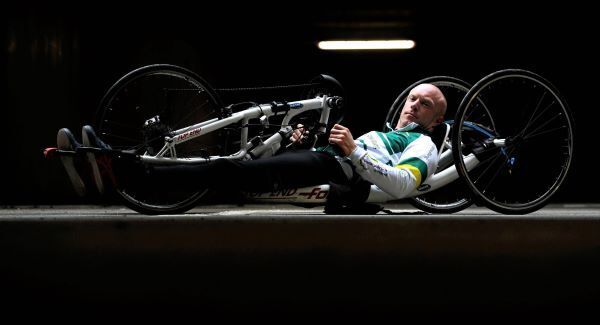
- Channel Four’s promo for the London Paralympic Games
There’s always a day, a place, the journey begins, always someone, somewhere, who gave that helping hand starting out.
Ten years before he became world handcycling champion, Mark Rohan was an inter-county footballer with Westmeath on his Honda motorbike to play a game of soccer. Minutes later an eagle-eyed passerby spotted his bike on the side of the road, went over and found him crashed into a ditch, complaining about chest pains. Turned out he was paralysed from the chest down. Yet when he looks back on that day, that accident, in a weird, warped, almost wonderful way it was nearly good for him. “I have seen parts of the world I might not otherwise have visited,” he’s said. “I have competed at a level of sport way beyond my wildest dreams.”
Today he is in London, favoured to win a medal at the Paralympic Games, but long before getting the chance to wheel himself into the Olympic Stadium, first Rohan had to wheel himself into the Irish Wheelchair Centre in Clontarf. He hardly knew anyone there, didn’t know the game, didn’t know how to play it.
John Fulham could spot him a mile off. Today he’s the media officer with Paralympics Ireland having competed at four Paralympics himself, but the former European bike sprint champion is still a keen wheelchair basketball player and remembers well when Rohan started out playing it. Right away he could empathise with Rohan’s initial tentativeness because he too had experienced that whole first day at school thing.
Unlike Mark, he’d never been an athlete, because he’d been born with Spina Bifida and when he was growing up PE teachers didn’t know what to do with someone like him, only to let him sit and watch from the side. But when he was 15, a couple of locals stopped him pm the street, inviting him to try out sport for kids with some kind of disability.
“The first time I went along I saw nothing but a load of people in wheelchairs roaming around an athletics field. It didn’t float my boat. But they kept at me and I went back a second night and tried out everything. I soon discovered I was terrible at table tennis — I could barely see over the table and my hand-eye co-ordination was crap — but I really liked the athletics and the basketball. Pretty soon I was hooked.”
So as Rohan wheeled though the door that first night, Fulham had a good idea of what experiences sport could offer him, but also what Rohan was experiencing right there.
“You see it all the time, someone new coming in. They might be full of enthusiasm but they’re full of nerves and doubt because they don’t know how to go about it. The most important thing there is to come over and talk to them. How’s it going? Where are you from? What sports do you think might tickle your fancy?
“Mark was always a competitor, but he was starting out from scratch all over again and that was a bit frustrating for him, to build up his strength again. But we treated him just like any one of the lads — we got him in there, knocked him hard, and taught him the skills of the game, like how to spin the chair, pick the ball off the ground using your wheel, how to lay the ball into the basket. He’d become a very skilful basketball player, playing for Ireland but then Mark’s one of those feckers who’d be good at any sport he’d try at.”
For Fulham and Paralympics Ireland, London is about producing more Mark Rohans. That all over Ireland there’ll be people with some form of disability watching it on television and will be moved to at least go to a nearby sports club or sports centre and just try out a sport, whether they go on to be a Paralympian like Rohan or not.
They also want medal winners like Rohan on the podium. In Beijing Ireland managed to win five medals and pretty soon after those Games they outlined to the Sports Council they’d be looking to match that if not beat it in London. They also intend to have at least 15 finalists. If they fall short of that, they’ll have underachieved. And if they underachieve, spare them nothing, especially your sympathy. The Sports Council has delivered over €1 million a year to them during this Olympic cycle and the payback is supposed to be in medals. Just like Billy Walsh’s boxers, this is a high performance unit operating in a high performance environment.
Jason Smyth regularly trains with Tyson Gay in the States. Half an hour after he’s expected to win Saturday night’s visually-impaired 100 final in front of a packed Olympic Stadium, Michael McKillop from Antrim defends his 800m title. Ireland could well have the kind of Saturday night a Jessica Ennis-Mo Farah-inspired Team GB had at the same venue only four weeks earlier. That’s the dream. That’s the plan.
Very little has been left to chance in the team’s preparations. How detailed have their preparations been? Twelve months ago the team held their training camp in precisely the same Portuguese camp that they spent the past fortnight in so they’d have no glitches, only familiarity in the runup to London. For the past two years Paralympics Ireland have been particularly conscious of what athletes to pair and not to pair as roommates on camp and in the Olympic village.
“We’ve asked all the athletes this. Who don’t you like rooming with? Who do you not want to room with? Like, if someone snores, you don’t want them in a room with someone who’s competing. It’s down to that level of detail, even if it’s simple stuff. It’s our job to do everything we can to cater for the athlete so they can perform.
“This is elite sport. The Special Olympics focuses more on recreational sport and participation, which is tremendous, whereas the Paralympics is elite sport for people with physical disabilities. A lot of our athletes have been training religiously for eight years or more to get into this position to excel. At this stage for all of them the disability is inconsequential. It’s just a factor they’ve had to adapt to in their training.
“Let’s be honest, people who’ll watch on will first of all see people with disabilities doing things they didn’t know they could do. The disability factor is there. But pretty soon they’ll see it for what it is which is elite sport. So it won’t so much be a case of ‘Oh, aren’t they marvellous for even trying to do this?’ which used to be the traditional approach to our sport, but rather ‘Wow, what they’re doing is fantastic; this is really serious, high-class sport’.”
A few weeks ago we all suffered some kind of post-Olympic depression. Don’t worry. You’re about to get your fix again.
And be amazed again. It’s more elite sport, just not quite as you’d have known it. The superhumans are in old London town.