Christy O'Connor: This year's football league Division 1 was the craziest in three decades
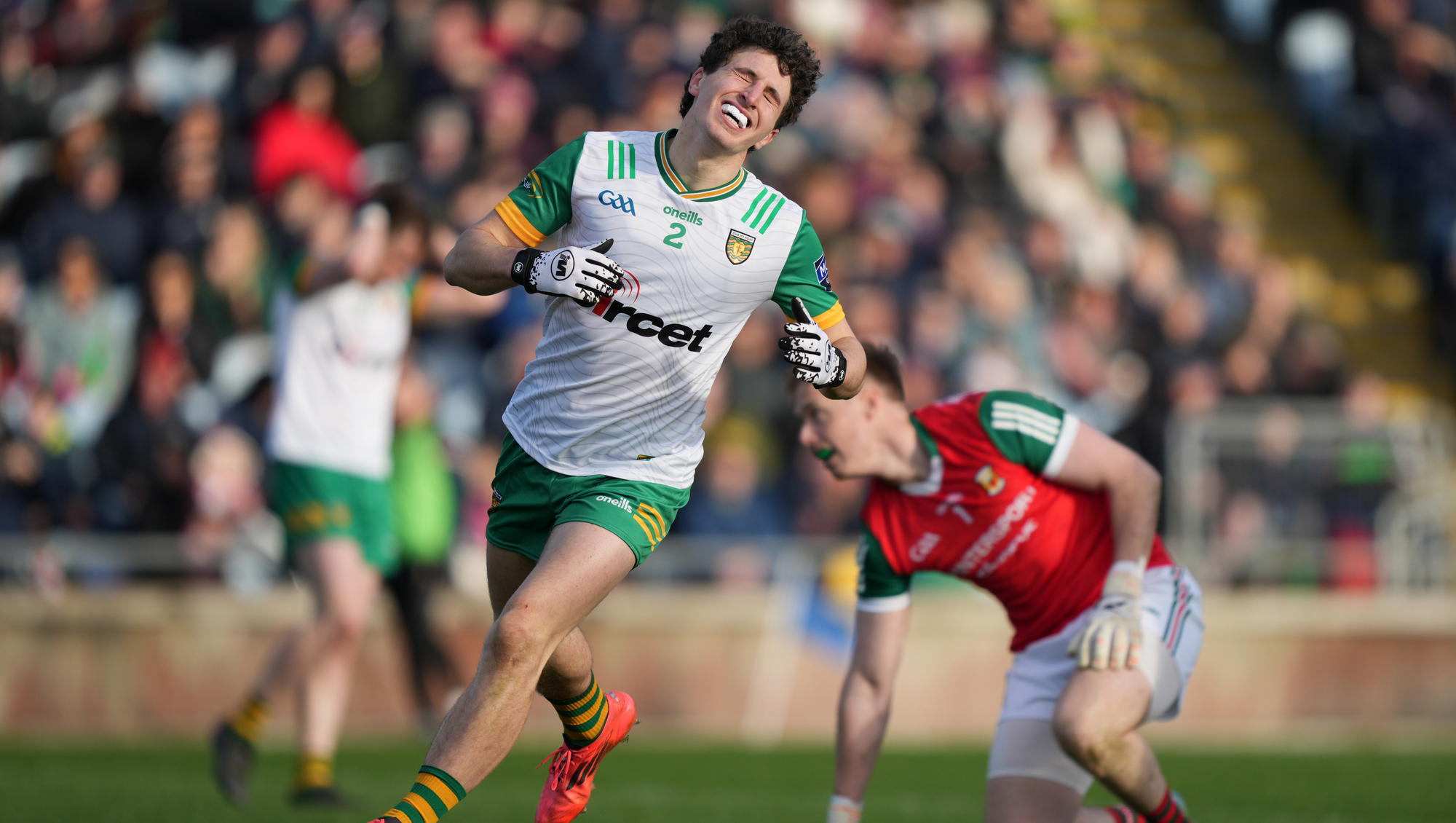
Mayo defeated Donegal on Sunday to reach nine points and top Division 1. It's the lowest number of points which the top team in the division has accumulated in 29 years. Pic: ©INPHO/James Lawlor

As soon as the hooter sounded at the end of the Tyrone-Dublin game in Omagh yesterday, Cormac Costello was standing over a free when he looked over his left shoulder to see what all the noise and commotion was about behind him.
A huge number of young kids had invaded the pitch thinking the match was over before quickly rushing back over the sideline once realising their error. After Costello kicked the ball wide, an even greater number of kids rushed onto the pitch again, before being hunted off a second time as referee David Coldrick ordered the kick to be retaken.
The match was over as soon as Costello’s 2-point effort cleared the crossbar but the chaos at the final whistle mirrored the confusion and mayhem of the day as an impressive seven-point victory added up to nothing for Tyrone. As Costello squared up to the kick a second time, delaying the inevitability of relegation was only prolonging the pain for Tyrone.
It was that kind of a day as Mayo were in that relegation spot of seventh at one stage, later escaping a Donegal missed penalty and a shot that crashed off the crossbar, before leapfrogging everyone in front of them and ending the afternoon in first.
The nine points Mayo accumulated was the lowest number any team that topped Division 1 had collected in 29 years. In the intervening years, the average points total accumulated from the team at the top of Division 1 was 11.3 points.
There were just seven occasions when ten points was enough to finish top. The craziness of it all this time around is that there were just eight occasions in the last three decades when the team that finished second bagged fewer than ten points.
This is also the first time in the last 29 years that a team was relegated on seven points. There were just three occasions in the last 29 years when a team slipped through the trapdoor with six points.
The last time it was this chaotic was in the 1995-’96 campaign when Donegal finished top of Division 1 on nine points. Meath (2nd) and Derry (3rd) also completed their campaign on nine points, while Kerry were fourth on eight, with all four teams advancing to the quarter-finals.
Laois were relegated that year on six points, having finished level on the same total as Kildare. Back then, just three points separated first from seventh, whereas there was a distance of just two points between first and seventh at the end of yesterday afternoon.
Crazy.
Patrick Horgan was expected to break the record two weeks ago against Clare when he only needed at least five points to become the all-time leading scorer in hurling league history. When he didn’t, hitting just 0-3 that afternoon in Ennis, the coronation was inevitable on Saturday. It was complete as early as the 10th minute when Horgan overtook Eddie Keher.
According to GAA statistician Padraig Ferguson, Horgan has now accumulated a staggering 26-673 (751 points), which finally surpassed Keher’s long-standing total of 72-524.
Horgan ended the match with 1-9 when giving his best league display in a long time; from just seven possessions, Horgan scored 1-3 from play while he had assists for another 0-3. He also created another scoring chance, along with being fouled for a converted free (when he didn’t have possession).
It's only when all the numbers are added up that the extent of Horgan’s scoring achievements are really laid bare. In league and championship now, Horgan has accumulated a colossal 55-1302 (1,467 points).
And he isn’t finished yet. Who knows where and when the counting will stop, and how high Horgan’s numbers will eventually reach?
At the outset of the league, there was genuine optimism around Meath’s promotion chances from Division 2, for a number of reasons; a new and impressive looking management ticket under Robbie Brennan; the new rules appeared set to suit them, especially with so many big physical players around the middle; and a raft of quality players had returned to the squad.
So instead of dicing with relegation, which Meath had been over the last two years when finishing fifth and sixth, there was genuine optimism that Meath could go the other way and secure just a second promotion to Division 1 in 20 years.
Four successive wins had put them joint-top and in a good position to kick on and secure promotion. And then the wheels came off.
Monaghan whacked them in Navan last Sunday but Meath were still well in the promotion hunt after Roscommon lost to Cavan. A huge local derby with Louth, who were scrapping for points to stay alive, seemed like the perfect match for Meath to get back on track. But they couldn’t.
The manner of the five-point defeat was more agonising again because a draw would have been enough to send Meath up as they would have had Roscommon on a head-to-head. On the other hand, the last two weekends hinted at why Meath didn’t go up.
How desperate were Meath to get promoted to Division One? The performances against Monaghan and Louth seemed to trigger the nagging questions in Meath’s heads as to whether they were good enough to be in Division One. The way in which Meath’s form collapsed when the pressure came on underlined where Meath are really at.
They are not good enough to play in Division 1. Not yet anyway.
Before Clare and Tipperary met in Thurles on Saturday evening, nobody knew what to expect. Everything was dependent on how committed both teams were to being as full-blooded as they needed to be in what was a dead-rubber. In the circumstances, a hectic ending when the blood was finally up was as much as anyone could have hoped for.
With eight starters from last year’s All-Ireland final, numbers and names were irrelevant for Clare in their search to eradicate their inconsistency. Tipperary were much closer to full strength with probably as many as 13 championship starters in their line-up, but it took them, and the match, an age to get going.
There were just seven scores in the first quarter. The half-time scoreline, when Clare led by 0-10 to 0-8, was an accurate reflection of an open match that was almost incapable of really breaking out because of its straitjacketed circumstances.
When Mark Rodgers had the ball in the Tipp net just 35 seconds into the second half there was a sense that Clare were finally about to break free. They kept the scoreboard moving early in the second quarter and had stretched ahead by eight when Liam Cahill took out the scalpel and made four changes in four minutes. It worked because Tipp finally found some energy and momentum, hitting six unanswered points before levelling up the match in the 63rd minute.
When Aron Shanagher took some wind from their sails with two unanswered points, it looked like Clare had stemmed the tide. But Tipp rowed it back. They sail into the league final now feeling good about themselves.
Scoring just 0-4 across the last 28 minutes, even against the breeze, is a concern for Clare. The All-Ireland champions won’t panic, but the next four weeks will still be a manic search for Clare to find what they’ve been missing.