Duncan Casey: Debate over 7/1 split will continue to rumble on
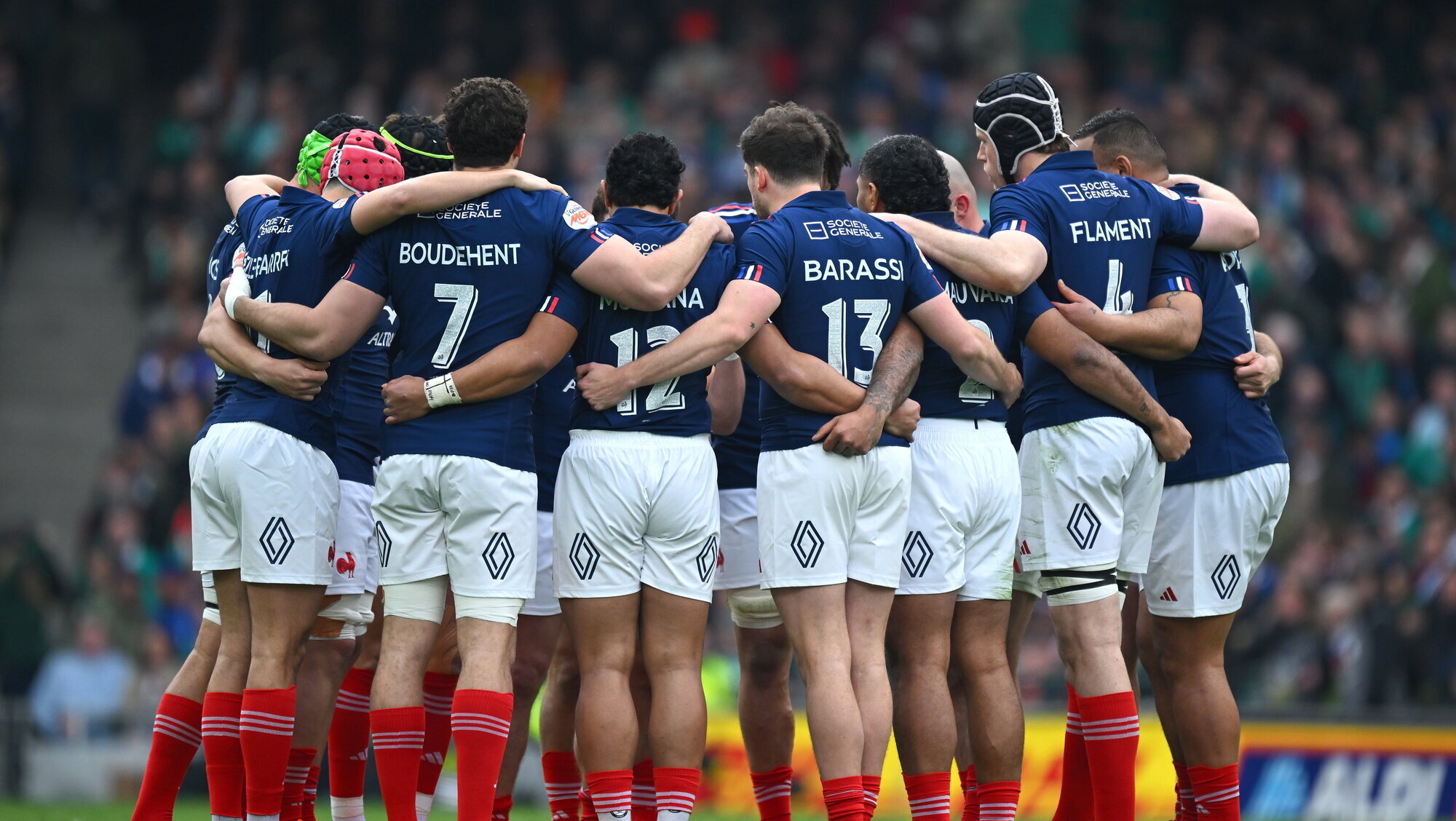
BENCH DEBATE: France’s decision to risk a 7/1 split on the bench on Saturday showed us the good and the bad that comes from such a call. Pic: Brendan Moran/Sportsfile

It’s rare you see a selection gamble prove both costly and rewarding in the same match. France’s decision to risk a 7/1 split on the bench on Saturday showed us the good and the bad that comes from such a call. Ahead of the game, there was plenty of chat about the worst-case scenarios. A back getting an early injury. Dupont having to go off. Heaven forbid, the double whammy of Dupont going off with an early knock.
When he was helped to the touchline after 25 minutes and Maxime Lucu entered the fray, France had already played a full hand with their backs and the Irish players must have been licking their lips. The cleanout from Tadgh Beirne that caused Dupont’s knee to buckle inward was innocuous and despite France attempting to have both him and Andrew Porter cited, there was nothing in it and the citing commissioner has thankfully decided as much.
In fact, this was a great lesson for any coach who opts for a forward-heavy bench split. If you’re relying on most of your backs staying on the field for 80 minutes, your nine should not be reloading into defensive rucks and looking to poach the ball. This is particularly true if that nine happens to be the talismanic focal point of your entire attack.
Just as Fabien Galthié had not planned to be without Dupont for the majority of the game, Simon Easterby had not anticipated being down to 14 men on two separate occasions. These periods proved incredibly costly, with Ireland conceding 15 points over the 20 minutes. Damage to the scoreboard aside, the momentum shifts that accompanied both yellow cards were significant, in different ways.
While Calvin Nash’s head clash with Pierre-Louis Barassi could be put down to clumsiness and wrong-footedness, Joe McCarthy’s decision to yank at Thomas Ramos’ collar with two hands and put him on his back showed a staggering level of foolishness you simply can’t get away with in international rugby. McCarthy has made a huge impression since breaking into the Ireland set up but if there is one flaw in his game, it’s his capacity to give away soft penalties.
They don’t get much softer than that. Though France only scored five points while he was off, his departure and Bielle-Biarrey’s ensuing try dealt Ireland the psychological blow of having nothing to show for their relentless dominance in the opening quarter. France had weathered the Irish onslaught and now had a foothold in the game. That kind of off the ball clumsiness is a relic of a bygone era and ironically, France is probably the only place you can still expect to see that kind of thing domestically from time to time.
It's beneath a player of McCarthy’s stature – both literal and figurative – and is the kind of thing that can see you play your way out of selection. Despite the setback, Ireland stuck to the plan and found a way into the lead early in the second half. For all the talk of how France’s power dismantled the Irish pack and proved the difference – which is largely true – Dan Sheehan’s try in the 43rd minute showed Ireland are more than capable of overpowering any pack themselves.
France stayed on the ground and did not compete, and made it clear this was what they were doing. I always find it interesting when teams make it so obvious. If you’re a lineout caller and want to maul from five metres out, the ideal spot to win the ball is in the middle. This leaves the shortest distance for supporting players to cover and means they arrive in a natural arrowhead formation. This keeps equal pressure going through the head of the maul from either side, giving you the best chance of keeping your shape intact.
If you win the ball at the front, the defence has the advantage as they can just pile in and drive laterally towards the touchline. It’s hard to get enough pressure on the short side to straighten the angle and get upfield. In addition to a riskier throw, trying to maul at the tail means your teammates have a lot of ground to cover before they can join and the lifting pod will be isolated for a split-second longer than is ideal. It’s difficult to weather a sack at the back of the lineout and as options five metres out go, it’s not a great one.
While flanker Paul Boudehent at least looks like he might compete, Tadgh Beirne looks across and sees both second rows – Flament and Guillard, turned laterally with no interest in going up. I used to always make the point to my second rows that if you at least shape up as if you’re going to compete, it makes the lineout caller think. They might feel the need to call a more complicated move. The hooker can also see whether a pod is likely to compete or not and if they are, it puts more pressure on the throw.
Just handing your opponents free ball in the perfect part of the lineout never sat well with me and that’s what France did here. Beirne moves in front of O’Mahony and calls it on himself. Sheehan sees there is no risk so can just toss it in with no worry. Ireland get the shove and Sheehan finishes well from one metre out. It was exactly the kind of big moment we all wanted to kick start the second half but unfortunately, Ireland’s time in the ascendancy was short-lived.
Three minutes later, they were under the sticks, Nash was shown a yellow card and the French train had started to rumble along. There was something very French about the phase leading to Boudehent’s try featuring two impressive, one-handed, out-the-back offloads in the tackle – one from a loosehead prop and one from a scrum-half. The score was a beautiful blend of power and skill and if the scales had been teetering one way or another, this was like an anvil being dropped on the French side.
It was all one-way traffic from there. There were six new French forwards on the field by the 49th minute and the impact was immediate – a counter ruck on the touchline leading to a Penaud linebreak and Bielle-Biarrey’s second try. France continued to turn up the dial on their power game, sending wave after wave of explosive ball carry at the Irish defensive line.
When you have ball-handling front rows like Cyril Baille and Julian Marchand coming on at the same time as 145kg behemoths like Emmanuel Meafou, it gives you an enviable injection of dynamic physicality. Add high-octane back rows like Oscar Jegou and Anthony Jelonch into the mix and it proved a lethal cocktail.
Meafou was the standout performer off the French bench. It’s not often you see one of the best number eights in the world being put on his arse but Meafou managed to do it to Caelan Doris a couple of times on Saturday. You could make the argument that he is more effective coming on with 30 to go rather than starting, particularly if he arrives as part of what is essentially a brand new pack.
Being able to inject that level of size and athleticism into your attack when your opponents are starting to tire is a luxury very few coaches have and while that was Meafou’s first time starting on the bench for France, I wouldn’t be surprised if that’s the direction Galthié takes to get the most out of him. It's not true to say Ireland had no answers, given they scored two converted tries in the last five minutes, but they had no answers when it really mattered.
Ultimately, Saturday’s game showed a lot of similarities to Ireland’s defeat of England in round one. There was nothing between the sides in the first half of either encounter. Just as Ireland found another gear and surged ahead of England as the game wore on, so France did the same on this occasion. They were head and shoulders above their opponents on the day and it’s difficult to see Scotland spoiling the party for them next week.
The dilemma and debate around the safety, fairness and ethics of a 7/1 split will continue to rumble on in the aftermath of this result but the Irish team won’t be concerned by that. They have plenty of food for thought to reflect on before consigning it to the archive and getting back to business in Rome. It is not a game without risk but one we should be expecting a convincing bonus point win from. If for no other reason, at least to ensure Murray, O’Mahony and Healy are given a sendoff befitting their remarkable careers.