Jack Anderson: AI technology's impact on sport continues to deepen
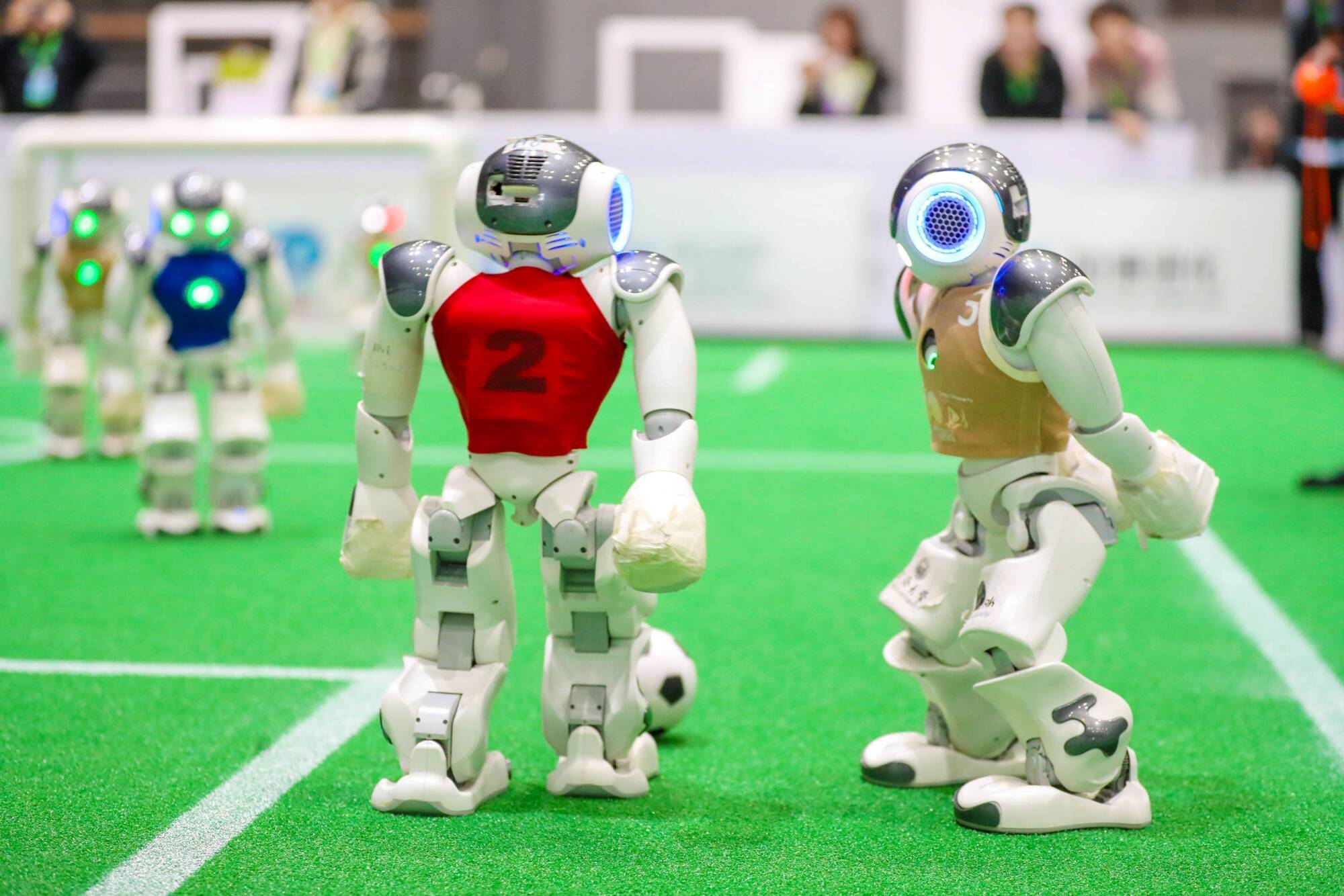
A robot plays in a soccer match at the Qingdao International Invitational Tournament of the 2024 Asia-Pacific RoboCup in Qingdao, China. Pic: Costfoto/NurPhoto via Getty Images)

Worldwide there is a lively market in sports memorabilia. In August, a jersey worn by Babe Ruth, when playing for the New York Yankees against the Chicago Cubs in the 1932 World Series, sold for US$24million, making it the most valuable sports jersey ever sold publicly.
The previous record had been US$10million paid for a jersey worn by Michael Jordan in game 1 of the 1998 NBA Finals. Prior to that, it was Diego Maradona’s “Hand of God” jersey from the 1986 World Cup game against England.
England’s Steve Hodge gave the back pass to Peter Shilton which Maradona “intercepted” in scoring that famous goal. It must be the most lucrative mistake in world sport as afterwards Hodge got Maradona’s jersey and, in 2022, sold it at auction for US$9.3 million.
The sporting memorabilia market is still quite robust: balls, bats, boxing belts and baseball trading cards; even original rule books, game programmes and autographs have all sold well. One set of sporting memorabilia that is slightly underpriced is old tickets (stubs, unused etc).
A ticket to see the Brooklyn Dodgers play in the opening game of the major league baseball season in April 1947 would have cost you US$1.75.
Two years ago, a ticket stub from that game sold for US$480,000 because on that date Jackie Robinson became the first Black player to take the field for a modern major league baseball team.
The Dodgers, who won this year’s World Series in baseball, are no longer in Brooklyn and ticket stubs are largely no more – hence their likely future increase in value. In most major sports today, the idea of a paper ticket is quaint, even the barcode has faded.
The equivalent of the ticket stub of yesterday is now another tab in your online phone wallet.
And even that is likely to become more infrequent in the future with the emergence of biometric ticketing where you will be able to “pay by palm” or via facial recognition technology.
Facial recognition is already in place in some stadia worldwide and was widely used by the French authorities at this year’s Olympics for crowd surveillance and security. Although it engenders privacy and human rights concerns, the use of facial recognition at sporting events, powered by AI, will inevitably be extended in years to come.
AI has also had a significant impact on sport more generally. AI technology allows monied sports organisations to identify and target its fan base with bespoke marketing and information. AI can scrape details and data on fans, from open sources, at bewildering speed.
Using that data, AI can then generate a biography of that fan and target them through social media postings with personalised content.
The modern marketing gurus in sport now constantly speak about this “personalised” or “immersive” fan experience, acknowledging that many modern sports consumers are not necessarily loyal to a club and often follow a particular player.
AI is also the driver of the remarkable rise in the use of data analytics in sport. Managers in professional soccer usually stand or fall by the quality of player transfers.
For most clubs in the professional football pyramid, their financial stability equally depends on buying well and selling even better. In the modern game, the identification of talent is now more likely to be left to a software engineer with a laptop than a scout in a flat cap.
At the top level of professional soccer, AI-led data analytics is also used to evaluate player skills and development; analyse opposition; generate game day data to inform tactical adjustments; and medically diagnose player fatigue, injury, recovery, and rehab needs.
The David Brailsford mantra of marginal gains – always a bit of marketing spoofery – has long been overtaken by data analytics. Big Dave has been replaced by Big Data.
Of course, AI is not papal-like is its infallibility. Generative AI is still relatively clunky and sometimes downright inaccurate.
Similarly, AI might well enhance VAR technology where, for example, at Euro 2024, UEFA utilised 10 cameras to look at 29 locations on each player’s body and, courtesy of AI, had the capacity, fifty times per second, to feed all of these data points into a computer.
And yet, in September, UEFA’s refereeing committee admitted that Germany should have been given an extra time penalty for handball in the quarter final against eventual champions Spain.
Nevertheless, AI technology’s impact on sport continues to deepen. Last month, Wimbledon announced that after 147 years, line judges would be no more, replaced by AI.
If John McEnroe were playing today, he could only shout “your algorithm is the pits, man.” It would be like as if McEnroe were an astronaut on Space Odyssey 2001 confronting HAL.
As for where the influence of AI on sport will likely go from here is, to quote a recent article from The Atlantic, a bit like the debate on AI’s impact on society generally: it veers from AI having the capacity to save humanity or end it; from utopia to dystopia.
As other writers on AI have pointed out, with any great technological leap there is an element of the unknown, the unintended consequence: when Guttenberg invented a primitive printing press, he just wanted more people to read the Bible; Nobel invented dynamite to assist with mining and construction projects; and when Oppenheimer invented, well, you’ve seen the movie.
Read More
The answer on AI in sport is equally that we just don’t know where it will end. When Steve Hodge swapped his jersey with Maradona in 1986 little did he realise that he was investing in a lucrative pension pot.
What the future of sports AI is, is also speculative though we do know that so much of our daily life has become automated and algorithmic in nature.
In contrast, sport’s elemental appeal is its unpredictability and spontaneity.
The reason Babe Ruth’s 1932 jersey sold for so much is that he wore it during the celebrated “called shot” game where allegedly Ruth pointed in advance to the spot he was going to hit a home run, and then did exactly that. No data analyst needed, just the muscle memory of a boy with a ball and a bat.
Finally, one of the unintended consequences of the rise of AI in sport is that it reminds us that sports bodies of various sizes hold a huge amount of sensitive data on their membership, including children – dates of birth, addresses, medical conditions etc.
Are we confident in Ireland that our sports bodies have the capacity to store that data confidentially and securely? AI can really only harvest data that we have already given on trust to others.