Naming and shaming America’s worst stadium rebrands
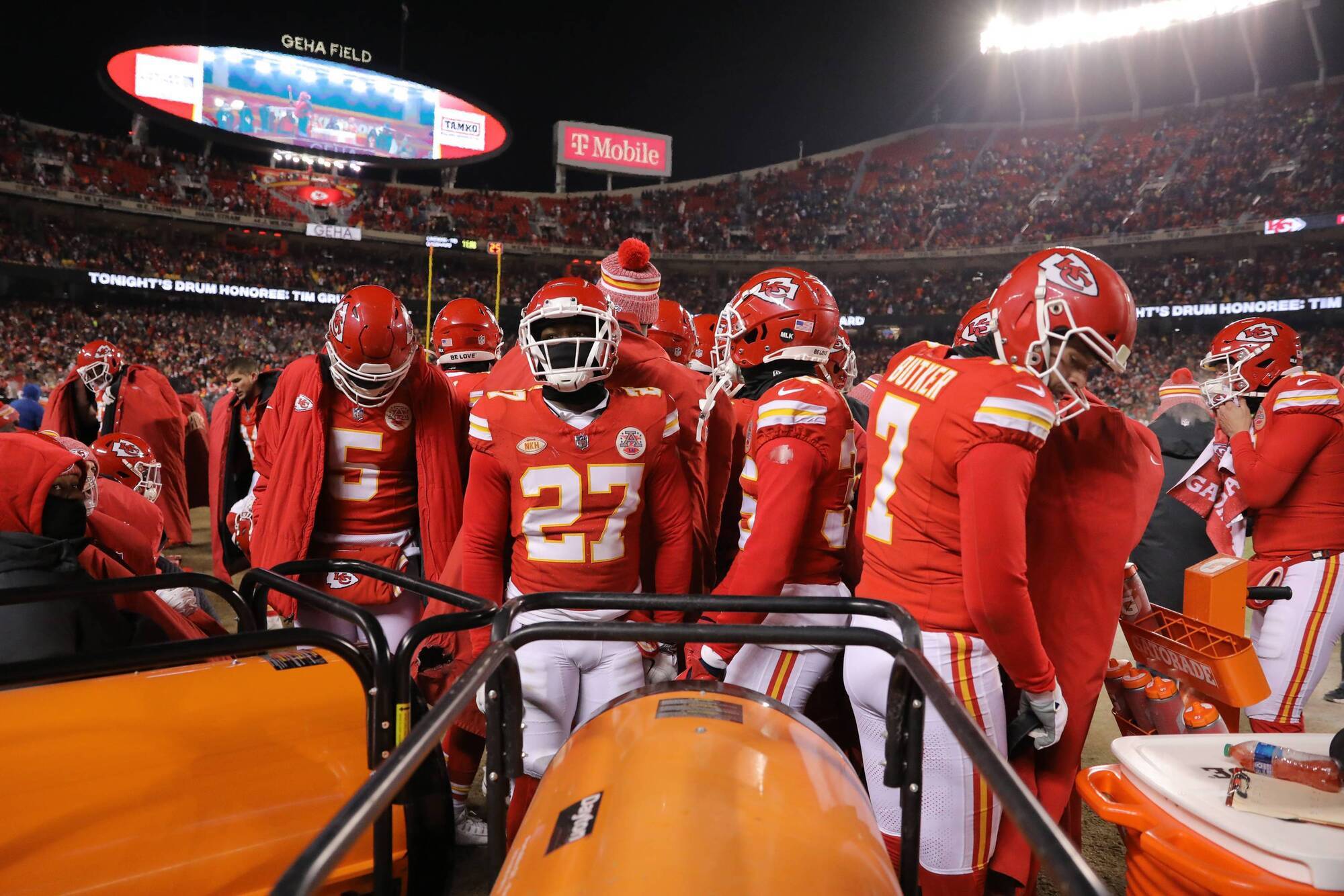
WHAT'S IN A NAME? Kansas City Chiefs players warm up in front of heaters in the AFC Wild Card Playoffs against the Miami Dolphins at GEHA Field at Arrowhead Stadium on January 13, 2024 in Kansas City, Missouri. (Photo by David Eulitt/Getty Images)

It’s a bad sign when the first time you see a fella from Longford in a few months, his prepared opening gambit is “SuperValu”. Count that as another marketing win for our favourite supermarket chain and another loss for Cork.
But you won’t be surprised to learn that you can count on one hand the number of stadiums and arenas across the US that haven’t sold history to the highest bidder.
Only the fewest well-known theatres have held firm: Fenway Park has been hosting Boston Red Sox games since the sinking of the Titanic. Dodger Stadium, Yankee Stadium and the home of the Chicago Bears, Soldier Field, are not broken and they have no need to fix it.
I’m not saying there would be riots if Madison Square Garden rebranded for extra revenue but it would be one more reason to run owner James Dolan out of New York City. And besides, he has enjoyed unparalleled profits through this brand in all manners of live entertainment so why replace it?
Of course, the dream scenario for a brand is to become part of the furniture as soon as possible. Like the United Center for the Chicago Bulls play or Wrigley Field for the Chicago Cubs. It’s ironic to think that there is no imaginable doomsday where fans of the Cubbies would be forced to protest against the replacement of the corporate name of their iconic ballfield.
Some of these precious theatres find a way around it and hopefully it will be heartening to the controllers of the Cork coffers that the Kansas City Chiefs have played at the “GEHA Field at Arrowhead Stadium” since 2021. That’s as unwieldy as it gets, the opposite of catchy and no I didn’t know it was called this or what GEHA was until I went through the entire list of branded stadiums in the US. And yes, I’ve already forgotten what GEHA does.
SuperValu is a relatively safe bet compared with some of the depths plumbed by thirsty sports outfits in America. You won’t be surprised to learn that a food-obsessed nation like this one has more than its fair share of foodie stadiums, the worst being the KFC Yum! Center which is home to the much more prestigious Louisville Cardinals college basketball team.
The American version of SuperValu, Albertsons, the country’s second-largest supermarket chain, has hitched its wagon to the football team at Boise State in Idaho, strategically ensconced in that vast heartland west of the midwest. Probably a good model to take some positive inspiration from.
Some major brands like Target and Toyota show up repeatedly in multiple sports, really going all-in on the concept.
But then there are the, as far as I am concerned, much less known companies who scrape around the minor leagues for something to stitch their name to, presumably more often than not a fan who made good and ploughed some dollars back into their team. If part of the purpose here is to develop new customers from the brand recognition of attending and enjoying a game, then the question becomes 'will I be inspired to do further research on Modern Woodmen Park, Peoples Natural Gas Field, Rent One Park, Ron Tonkin Field and TicketReturn.com Field'. But now I really want to travel and go watch the Quad Cities River Bandits, the Quinnipiac Bobcats, Southern Illinois Miners, the Hillsboro Hops and the Myrtle Beach Pelicans play baseball. Was that the desired effect?
If you have seen The Godfather Part Two, you’ll be well aware that Hyman Roth bragged to Michael Corleone how their growing operation was “bigger than US Steel”. This was a half century after JP Morgan formed the company but of course the film was shot later, during the beginning of the steel's decline.
And right there, close to the epicentre of the rust belt, are Gary, Indiana’s minor league baseball side, the SouthShore RailCats who proudly play at US Steel Yard. As if we need the reminder, a lot of American culture got bigger than US Steel.
Miami is not the most beloved city. Only the locals and the blow-ins are happy to speak up its very niche and shiny wares. The local sports teams lean OTT too, it’s only right. The garish ballpark which has been home to the Miami Marlins for about a decade has the very run-of-the-mill LoanDepot Park as its title. The match-up is as ill-fitting as the fashion choices of its local residents.
Sometimes you have to be careful to not be too snarky. Leo Messi’s Inter Miami play at DRV PNK Stadium which initially seems a little too cute. Until you learn the branding is a vowel free version of Drive Pink, a tie-in with used car dealer AutoNation's breast cancer awareness campaign. Congratulations to all involved.
The Miami Dolphins and Miami Hurricanes American football teams are happily ensconced at Hard Rock Stadium but things have been a little messier over at the NBA facility where the Heat play.
There was immense schadenfreude enjoyed after the messy collapse of FTX at the end of 2022. When the cryptocurrency exchange was dragged down by the crypto hedge fund illusion that its founder unleashed on his investors, the Miami Heat owners had to scramble to rip the FTX logo off of the roof of the FTX Arena.
When I have some time, I might investigate what the replacement brand, Kaseya, does to give it the budget to pay for the rights to be emblazoned across the Kaseya Center. It’s fairly certain that SuperValu will never find itself mired in a financial scandal for the ages.
You’d imagine the LA Lakers would have no need to jump on the creaky crypto bandwagon but the Crypto.com Arena is where they and the Clippers and hockey’s Kings charge exorbitant amounts of money for their prized seats.
Staples Center had been part of the lexicon as much as the aforementioned United Center and you’d be forgiven for still calling it that which must be the ultimate victory for a brand, their association continuing long after the final cheque is cashed.
I'm hard pressed to find a better-timed deal than the one inked by Gillette with the New England Patriots in the early 2000s. Five of the six Super Bowl victories were clinched after the new stadium was built, helping to make it one of the most successful pairings in sports marketing.
What I hadn’t known is that it was after the dot com boom went bust that a new sponsor was sought, opening out a void for Gillette to land into. CMGI Field, we hardly knew ye.
I won't take cheap shots at Cox Pavilion in Las Vegas and Dickies Arena in Texas (everyone needs to get paid) but I was delighted to discover that the NBA Champion Denver Nuggets (and their Stan Kroenke stable mates, the NHL’s Colorado Avalanche) have replaced Pepsi with the Ball Corporation. And now the greatest baller on the planet, Nikola Jokić. shoots ball at the Ball Arena.
While I wouldn’t expect any sympathy for the highly paid marketing executives whose job it is to seek out the partnerships that make the most sense for their brand, you have to wonder how they’re feeling at FedEx and MetLife. Neither FedEx Field nor MetLife Stadium are actually located in the cities in which they purport to do business.
The Washington Commanders, the New York Giants, and the New York Jets are all bye words for NFL ineptitude and their arenas are widely hated, not just because they can’t find a win to save their lives at either venue but also for the very understandable dread every fan feels when they need to commute there.
These are highly profitable companies which don’t need to worry about being weighed down by a sports deal gone wrong but I don’t imagine they’ll be rushing to extend the naming rights.
If America is any indicator of how a branding deal can go - and sadly it often is - then maybe better days and better deals are on the horizon. And it could always be worse; what if Cork had to play at the CarShield Field or Fifth Third Field or LoanMart Field?