John Riordan: how an unlikely Kentucky Derby win hit big for hundreds on sports investment app
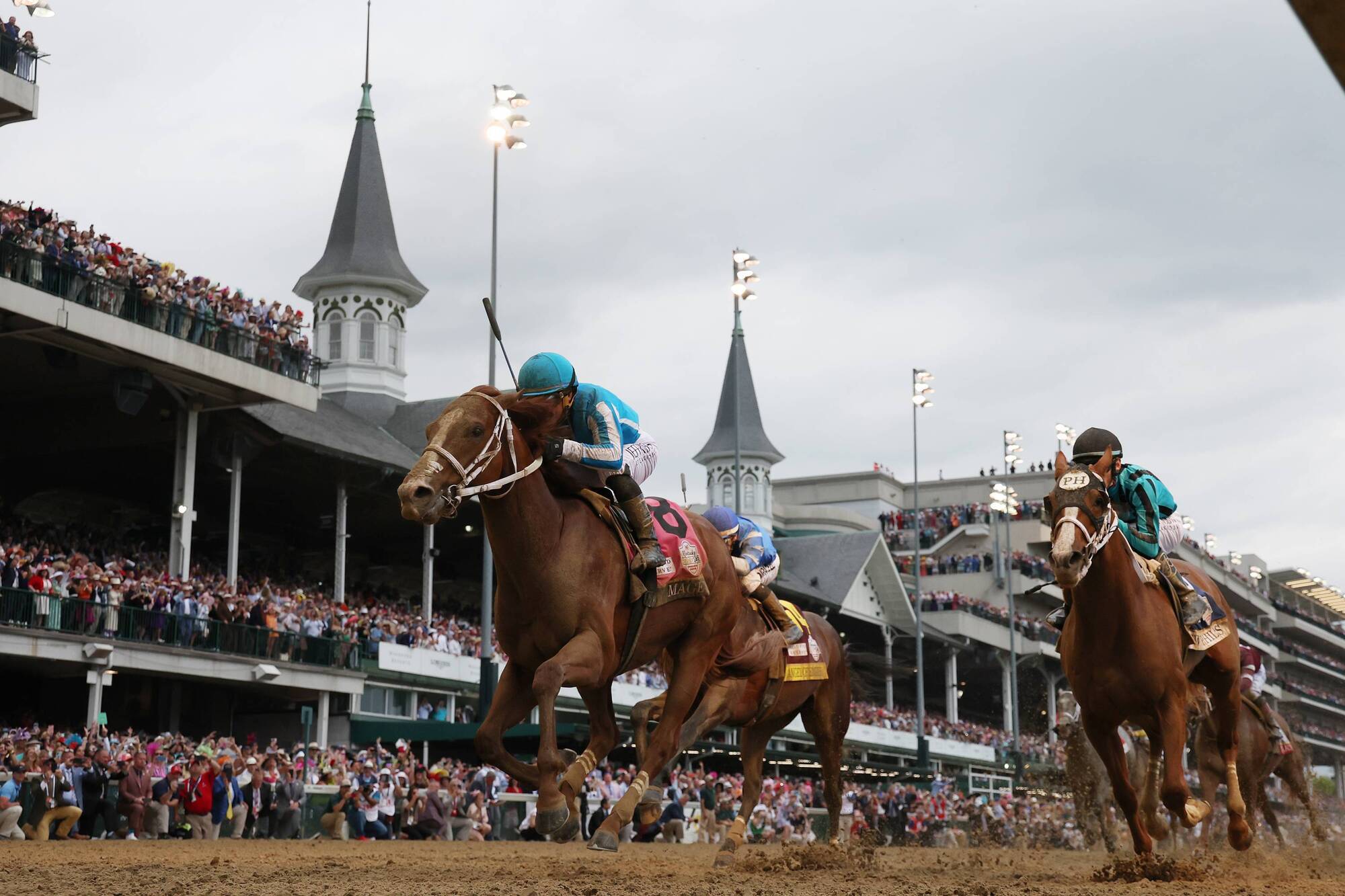
AMERICAN DREAM: Mage, ridden by jockey Javier Castellano, crosses the finish line to win the 149th running of the Kentucky Derby at Churchill Downs. Picture: Michael Reaves/Getty Images

When Mage made a late dash to win Saturday evening’s 149th Kentucky Derby, it was the most watched sports event in the US since February’s Super Bowl.
The main attraction at Churchill Downs is always a strong inspiration for a well-dressed party and its popularity edges upwards each year even if the rest of the horse racing calendar holds little or no appeal.
It’s not alone in its ability to attract revellers who wouldn’t know one end of a horse from the other and if you saw footage of some of the happy owners celebrating the longshot victory, you’d have been forgiven for jumping a little too quickly to the conclusion that the lunatics had taken over the asylum.
Decked out in trendy jacket / trouser combos, Nike high tops and “Mage” emblazoned baseball caps, the tech bro-looking lads dancing joyously on tabletops seemed very keen to announce themselves as the owners while the NBC producers and commentators scrambled to contextualise exactly who they were.
Fittingly, this extremely inexperienced horse was part of a complicated and somewhat inexperienced ownership network which seems to boast almost as many constituents as the TV viewership, thanks to a relatively innovative twist on the standard syndicate-style shareholding so familiar to the sport.
Mage was a 15/1 shot and was close to the rear for most of the two-minute race. We’re well used to the formbook not being worth its own paper across many sports these days but this one had layers of improbability.
The colt was starting just his fourth race and his jockey, Javier Castellano, had never won this most coveted prize in American horseracing in 15 attempts.
Then you have the wide array of characters laying claim to an ownership stake in the unfancied ride with almost 400 investors flummoxed and rapturous at the end of it and fully 25% of Mage being owned by people using a sports investing app.
The tedious tech tendency towards disruption is now firmly ensconced in horseracing where the founders and investors in a tellingly titled company called Commonwealth got to enjoy the winners’ circle at one of the grandest stages of all.
The last time multiple syndicates held relatively small shares in a Kentucky Derby winning horse, the race was run off in front of a sparse 2020 Churchill Downs crowd and four months behind the regularly scheduled first Saturday in May.
As local Louisvillian residents protested against police brutality throughout the rundown streets that surround the iconic venue, inside could be found the well-dressed and well-heeled fortunate few who had snagged a ticket for the surreal run-off, watching Authentic dominate the race and secure for trainer Bob Baffert his record-equalling sixth Derby.
The following year, just weeks before Medina Spirit was stripped of the 147th Derby and Baffert found himself facing into a two-year ban from the race, stemming from the colt’s positive test tracking a prohibited drug on race day, this obscure startup investor app signed a rights deal with Kentucky’s WinStar Farm.
WinStar was best known at that point for their Triple Crown Victory with Justify in 2018 and last year, the partnership enjoyed its first major breakthrough when their horse, Country Grammer, won the Dubai World Cup.
While the earnings in the Middle East far outweigh what the app founders were able to scramble together for their investors as part of the wider stakeholding group, the fact that Mage came from nowhere to win the $1.86m purse and did so in their old Kentucky home made it all the sweeter.
Kentucky is one of just four states that refers to itself as a “Commonwealth”; the other three are Massachusetts, Pennsylvania, and Virginia. It doesn’t set them apart in any practical way. The app founders clearly liked the ring of it and how the name gently promised a fair share of any winnings to their market, skewing youthful and fitting the same bill as the tech savvy Millennials who dress the same way every first Saturday in May.
On Saturday morning, Commonwealth was a mildly successful startup with no marketing budget. By Saturday evening, race commentator Mike Tirico was telling almost 17 million viewers on NBC about their unlikely climb to the top.
That sent about 6,000 people rushing to sign up for a slice of the Commonwealth pie in the 48 hours after the Kentucky Derby, with its total user base racing past 15,000 accounts. Commonwealth had initially made a $170,000 investment in Mage through the expertise and resources of WinStar and Saturday’s marquee win sent the value of that punt north of $5 million, a 30x return for its shareholders.
If Mage moves on to a rarely achieved Triple Crown at Preakness and Belmont over the next few weeks, their 25% stake in the horse could move as high as $25 million.
The question of stud fees hoves into view now but Commonwealth co-founders Brian Doxtator and Chase Chamberlin have been at pains to emphasise the community aspect of their venture with any profits simply sweetening the deal at whatever level is comfortable for their members.
The pair met at Western Michigan University where they were churned out into the real world as ambitious graduates with a particular interest in the business of sport. Doxtator, a serial entrepreneur and investor, tapped into Chamberlin’s lifelong interest in the horse racing industry right around the time that a relaxing of financial regulations around allowing phone apps to sell shares in assets gave the budding idea an additional spur.
“We had over 100 people at the Kentucky Derby with us. The winner’s circle was packed with people, tons of young people,” Doxtator told Front Office Sports. “You could have bet a million dollars on Mage in the Kentucky Derby, but you don’t go in that winner’s circle. You could have put $50 in with Commonwealth, and you’re in that winner’s circle.”
That baseline $50 investor, chipping in at a level similar to the occasional big-event punter, made a paltry $94 back out of Saturday’s win. The quick criticism was that a regular gambler backing Mage at 15-1 made quite a deal more. Hence the reason Doxtator is at pains to emphasise the overall experiential aspect of it all. Over 300 parties were hosted across the States for the Commonwealth investors unable to make it to Churchill Downs.
For the ones that did fly in, $50 shareholders gained access to the paddock before the race and some of the more higher rolling investors squeezed into the winner’s circle to douse themselves in champagne.
The fees that ride alongside the investments are transparent and explicable (of the $50 share price, 47% goes to acquire the horse, 17.5% goes to training, 14.3% working capital reserve, 10% on offering expenses, 6.7% on management fees and 2% after care donation) while also ultimately offering the co-founders a really lucrative bounty at the top end, especially if their stable of horses can command significant stud fees.
Outside of horses, Commonwealth also has investments in the early promise of a couple of young golfers graduating out of college while they are eyeing up the pro tennis circuit too.
This is a sports business model with echoes in football and, more familiarly to the founders, baseball. For example, Big League Advance has invested more than $150 million in young baseball players and their most famous payout thus far arrived off of the talents of San Diego Padres star Ferndando Tatis Jr who earned his backers $30 million when he signed a $340 million contract in 2021. Big League Advance had initially placed a bet on the young Dominican Republic native when he was just 18.
“Long-term, I want Commonwealth to be one of the de facto places where young athletes can tap into capital,” claims Doxtator. “I want to eradicate predatory deals. I am on a mission in individual sports to make it so no kid or young adult ever has to take a deal that is predatory.” In this era of high profile, Ponzi-style cons collapsing all across the the tech sphere, you have to imagine that the scrutiny of more qualified observers will snuff out the small print on behalf of the $50 believers. The proof could ultimately be in the stud fees commanded by Mage when he enters that phase of his life.
But the sugar high of Saturday’s victory was unmistakable and if the Commonwealth founders deliver on nothing else, they’ll always have that day in May.
@JohnWRiordan