Paul Rouse: 'This game of hurling, with the Celtic blood hot. What can equal it?'
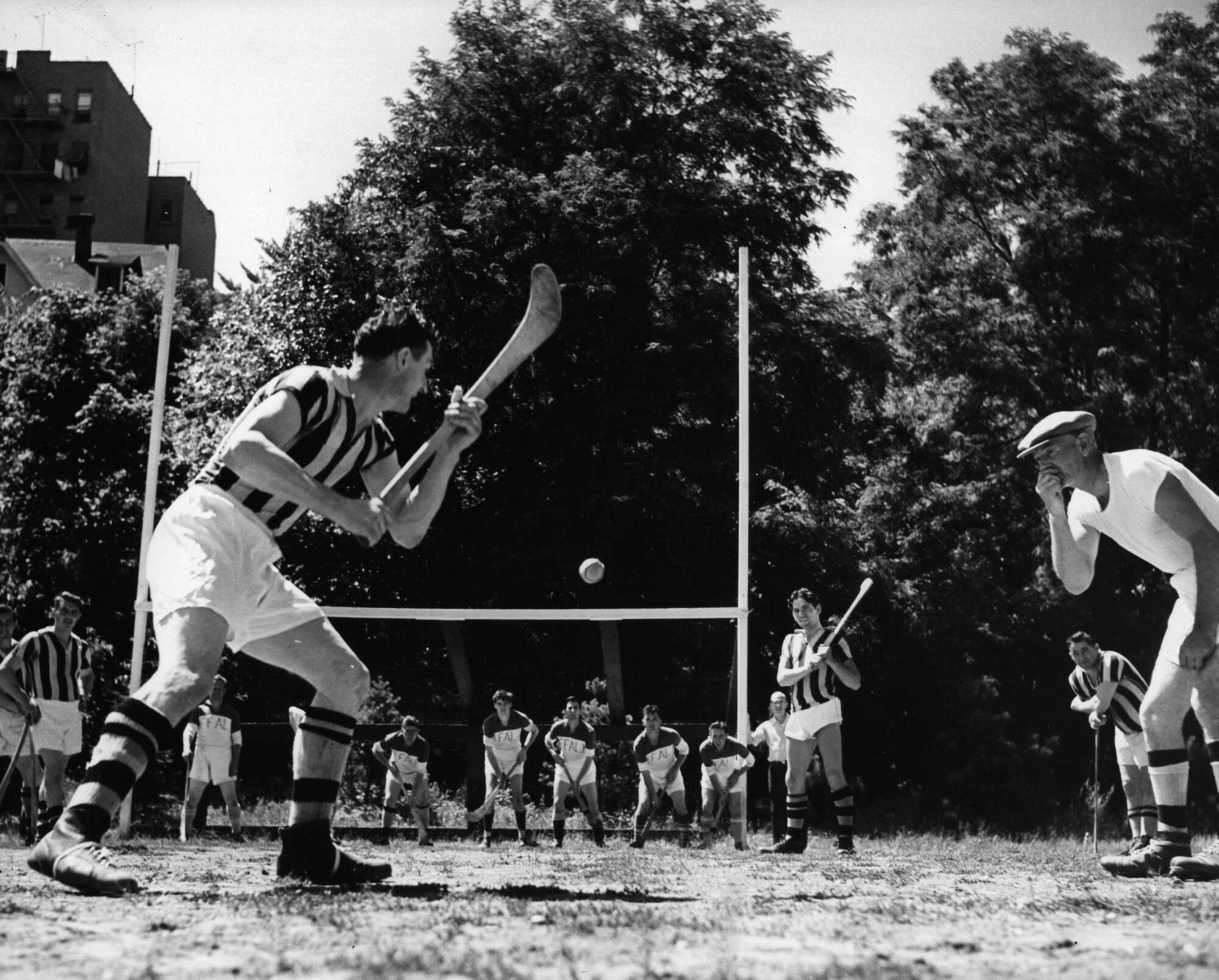
A player takes a free shot from the 21-yard line during a game of hurling at New York's Croke Park around 1955. Picture: Three Lions/Getty Images
All around the world today, Irish people are playing hurling. Some might just be hitting a ball against a wall on their own, while others will be playing in formally organised matches that are both part of everything that goes with a modern calendar of organised sport and also a celebration of Irish identity.
In the modern world, there is little enough that truly distinguishes Irish culture from the culture of whole swathes of the rest of the world. The triumph of the internet means an increasingly homogenised culture where across the world there is a shared global culture of music and fashion and film and much else.
Hurling clearly stands apart.
It is also the case that this is a tradition that pre-dates the founding of the GAA.
In America, for example, where the very idea of a St Patrick’s Day parade was invented, hurling was played to mark the occasion in cities as diverse as Philadelphia, Boston and San Francisco.
In New York, the paper recorded how the playing of the game was described in 1868 and comparisons were made to lacrosse:
“The same wild excitement characterises both hurling and lacrosse. This wildness increases the confusion and is itself augmented by the confusion which ever attends a spirited contest at either. Just such are the temperaments of both the Irish people and the Canadian Indians – soon aroused and brought up to the boiling point.”
During the 1870s and early 1880s, crowds of up to 6,000 people turned out to see hurling matches played by teams of Irishmen in Boston, as Paul Darby has written. The rules they played by had evolved sufficiently to include the use of referees and the game saw the players fill recognisable positions of play.
Among those who turned out to spectate were people drawn from the expansive working-class Irish enclaves of South Boston, but also families from the city’s expanding Irish middle classes. Indeed, the local press reported that “nearly all of the prominent Irish Americans in Boston and vicinity” attended to see a game that was so old that it “takes us back into the remotest antiquity.”
There were also hurling matches played in Toronto and New Zealand, but as Pat Bracken has shown, the most spectacular flowering of hurling overseas came in Melbourne and its surrounding towns in the Australian state of Victoria. During the late 1870s, Irish emigrants looked at the explosion of Australian Rules football, rugby, cricket clubs and adapted their traditional game of hurling to this new world. Through 1877 and 1878 clubs were formed, a league organised, and rules for the game laid down.
Between 1877 and 1884 at least 20 teams played hurling matches around Melbourne at one point or another – with some players using hurleys imported from Ireland – and the whole process included the founding of the Victorian Hurling Association in 1878, more than six years before the GAA was founded in Thurles.
Those Irish people who were playing hurling in American, Australian and Canadian cities were part of a post-famine generation who brought hurling with them and made it part of their connection to home that was expressed on St Patrick’s Day and on other occasions where they gathered together.
But, even before the Famine, Irish emigrants were playing hurling in foreign cities. There is a tradition that hurling was played in the public parks of Paris in 1750 and, later, in the 1780s, in New York, where it was advertised in the newspapers.
In the case of Paris, it was claimed to have “created a sensation among the Parisians”, and to have attracted “the whole city of Paris, the king and his court, nobility, gentry and artisans, all to see this specimen of the peasant games of Ireland.”
The game was even more prominent in London where it was played on a piece of land in called the Artillery Ground. This land – which was previously used for army manoeuvres – was by the 1740s owned by a man called George Smith who also was the landlord in a pub beside the ground called the Pyed Horse.
Smith was the first great cricketing entrepreneur. He encouraged teams from Kent and Surrey and Sussex to come to his ground – where a cricket club was also based – to play matches. It was a crucial moment in the making of modern cricket.
Smith advertised the matches, charged admission fees to the grounds and sold refreshments (lots of alcohol!).
The thing is that he did exactly the same for hurling: George Smith charged people in to watch hurling matches which he organised at his Artillery Ground.
For example, the in London reported in October 1747 that there would be a hurling match at the Artillery Ground between the hurlers of Munster and Leinster.
It was to be the last match of the season and admittance was to be cheaper than for cricket, standing at 3d.
As Eoin Kinsella and John Bergin have written, hurling matches in London continued through the remainder of the eighteenth century and into the nineteenth.
Sometimes the games were played between ‘gentlemen’ domiciled in England; on other occasions, they were played by Irish emigrants living in the London enclaves of St. Giles and Wapping.
Later, immediately after the GAA was founded, hurling again prospered in Irish emigrant communities. After the GAA’s rules for hurling were made, they were published in full in the Melbourne newspaper, , in March 1885. These rules were used to spread the game in Australia. For example, when Patrick Long from Tuam, Co. Galway, established a hurling club in Sydney in May 1885, Australian newspapers reported that he used the code of rules that had been prepared by the GAA. The new impetus coming from Ireland saw more Australian hurling clubs in Lismore, Coraki and Brisbane established in the remaining months of 1885.
This process was witnessed, also, in 1886 in Irish emigrant communities in Britain, in America (where a hurling match under GAA rules was played on Boston Common), and in the following years in Canada and Argentina.
And the game was viewed with wonder by those who attended it. As one Australian journalist wrote of a match in Melbourne: “The wild disarray, the tumultuous exciting onslaught, like Sioux Indians in full war cry; the hand to hand encounter, the hoarse shouts rising above the din of the fast and furious fray – this game of hurling, this war of clubs, with the Celtic blood hot with the dash and courage of the race. What can equal it? Football was feebly introduced, but it was insipid, tame, and effeminate beside the fascination of hurling.”
It is in this tradition that today hurling matches will be played around the world. There is, for example, the 4th Annual Butte St. Patrick’s Day Hurling Match will be held at Montana Tech at 2pm.
It is a game which extends across centuries of the intertwining of play and ideas of Irishness.

BLACK FRIDAY
Already a subscriber? Sign in