Paul Rouse: The enduring connection between Londoner Liam MacCarthy and Ireland
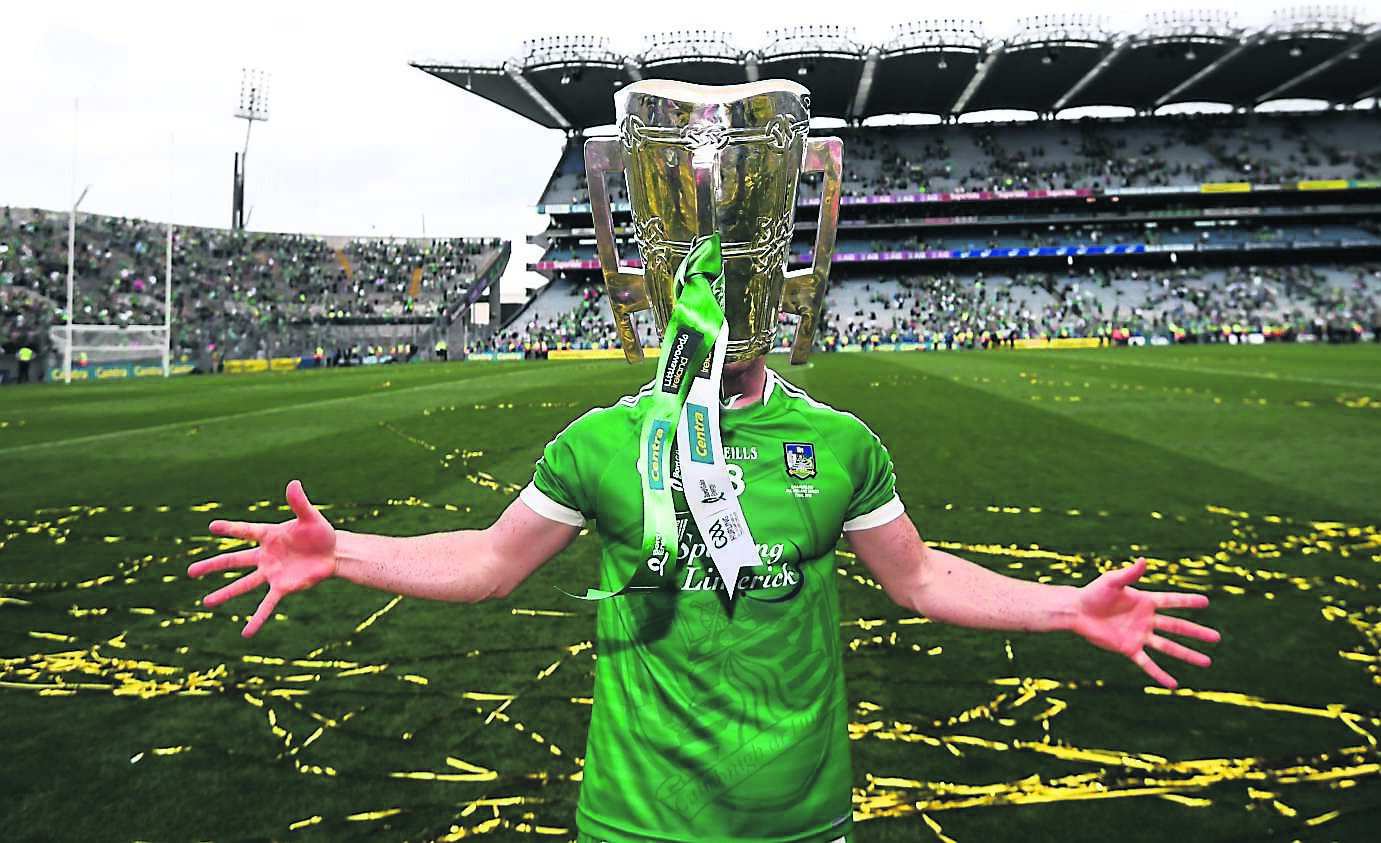
Darragh O'Donovan of Limerick celebrates with the Liam MacCarthy Cup following the GAA Hurling All-Ireland Senior Championship Final between Galway and Limerick at Croke Park in Dublin. Photo by Stephen McCarthy/Sportsfile
This week one hundred years ago, the Liam MacCarthy Cup was presented for the first time after Limerick defeated Dublin by 8-5 to 3-2 in the All-Ireland senior hurling final in Croke Park.
It was a match that was very much in keeping with the times.
Firstly, it was actually the final of the 1921 championship. The dislocations of the War of Independence and then the outbreak of Civil War had left the GAA’s local and national championships running some two years behind schedule. Indeed, the 1922 final was not played until late in 1923, the 1923 final itself was not played until September 1924, with the actual 1924 final being played in December that year as the playing calendar finally caught up with itself.
Secondly, these were years when hurling routinely saw many goals scored and matches – at all levels – often finished with more goals than points. There was for sure long striking and solo-running and the catching of the ball, but the game was primarily one where the ball was driven on the ground. It made for thrilling clashes and contests, especially as the pitches improved and allowed for faster play. Anyone who wishes to get some sort of insight into the way that hurling used to look should travel to the Scottish highlands and watch games of shinty.
Thirdly, the GAA was growing significantly as a spectator sport in these years. The development of Croke Park had allowed for much bigger crowds to attend. For the Limerick v Dublin final, some 19,000 people paid admission fees. The tumult of war had done nothing to diminish the passion for play – if anything it made it more urgent.
It was, in truth, a disappointing match. Dublin were very poor and were over-run by Limerick, for whom the brilliant Willie Hough from Newcastle West was a star. In their green-and-white horizontal striped jerseys, they did much as they pleased and scored four goals in each half.
In the team photo taken against the Railway Wall in Croke Park, the players sit and stand stoutly, not a helmet in sight, just long and narrow hurls with a heavy bas.
All around the players there are men wearing flat caps, some are smoking, all are dressed up. Mostly, the men are wearing ties, but one is wearing a dickie-bow. Even the boys are wearing collar-and-tie, though some are in short trousers. There is no woman present.
There is a fascinating line in the match report, down near the end: “A scene of enthusiasm was witnessed when Mr. D. McCarthy TD, as President of the GAA, in the unavoidable absence of the donor, Mr. Liam MacCarthy, London, presented the Limerick captain (Bob McConkey) with the perpetual challenge cup. Of rare and costly design, the trophy was an object of admiration during the day.”
Who was this Liam MacCarthy?
The answer to this question reveals a remarkable figure, whose life story is one of dedication to Irish culture and Irish independence. He was a Londoner, born in 1854 to Irish parents. His father Eoghan came from Ballygarvan in Cork and his mother Brigid Dineen came from Bruff in Limerick. They had emigrated to England in the immediate aftermath of the Great Famine and lived in North London where Eoghan worked on the railways.
Liam MacCarthy was raised bilingually and his love of Irish culture saw him join the Gaelic League in the city and attend the founding meeting of the London county board in the 1890s.
By then, he was a prosperous man, who had developed his own cardboard box factory in Peckham: William MacCarthy & Sons.
He used the money from this business to support a whole range of Irish initiatives in London. This brought him into friendship with Michael Collins and with Sam Maguire.
He also financially supported Patrick Pearse when he set up St Enda’s school in Dublin.
All the while, he was active in the GAA in London, serving as the association’s treasurer and chairman at various points in the years before the Easter Rising.
He particularly loved hurling and, although not a player, he was a regular referee of matches and he worked for decades to promote the game in London.
In 1922, he paid £50 to Edmond Johnson Ltd, a jewellers based at 94 Grafton Street in Dublin, to make a trophy for presentation to the All-Ireland senior hurling winners.
That trophy now sits on permanent exhibition at the GAA Museum in Croke Park, It was presented from 1923 until it was replaced in 1992 with a replica.
By the time, the Liam MacCarthy Cup was presented to Bob McConkey in 1923, MacCarthy had mourned the loss of his friend Michael Collins. Many of the leading members of the GAA in London had been anti-Treaty but MacCarthy had supported it.
Liam MacCarthy lived until 1928. He died in London on 28 September and was followed 12 days later by his wife Alice.
The cardboard box company which he established continued to trade in London, firstly under his sons and then his grandchildren.
Indeed, the company continues to thrive in London as William MacCarthy & Sons Ltd and is based at the Dockyard Industrial Estate in Woolwich. It now specialises in presentation packaging for high-end goods, for example, using almost entirely recyclable material.
His great-grandson Michael and his great-great grandson James still run the company which remains family-owned. They have been across to Croke Park to many hurling finals and down to matches in Ruislip.
This week James spoke about his pride in the enduring connection: “It is something we are very proud of. It’s not just what Liam did for hurling back in Ireland. It’s also what he did for the Irish emigrants who came to London. We still pay attention to this history. It matters to us.”
The last hurling final that James came across to was the one between Cork and Clare in 2013. He wrote a blog on the experience that includes him wearing a Cork jersey in honour of the family’s roots in Ballygarvan.