Tommy Martin: Scotland-Ireland is a flimsy rivalry built on small differences
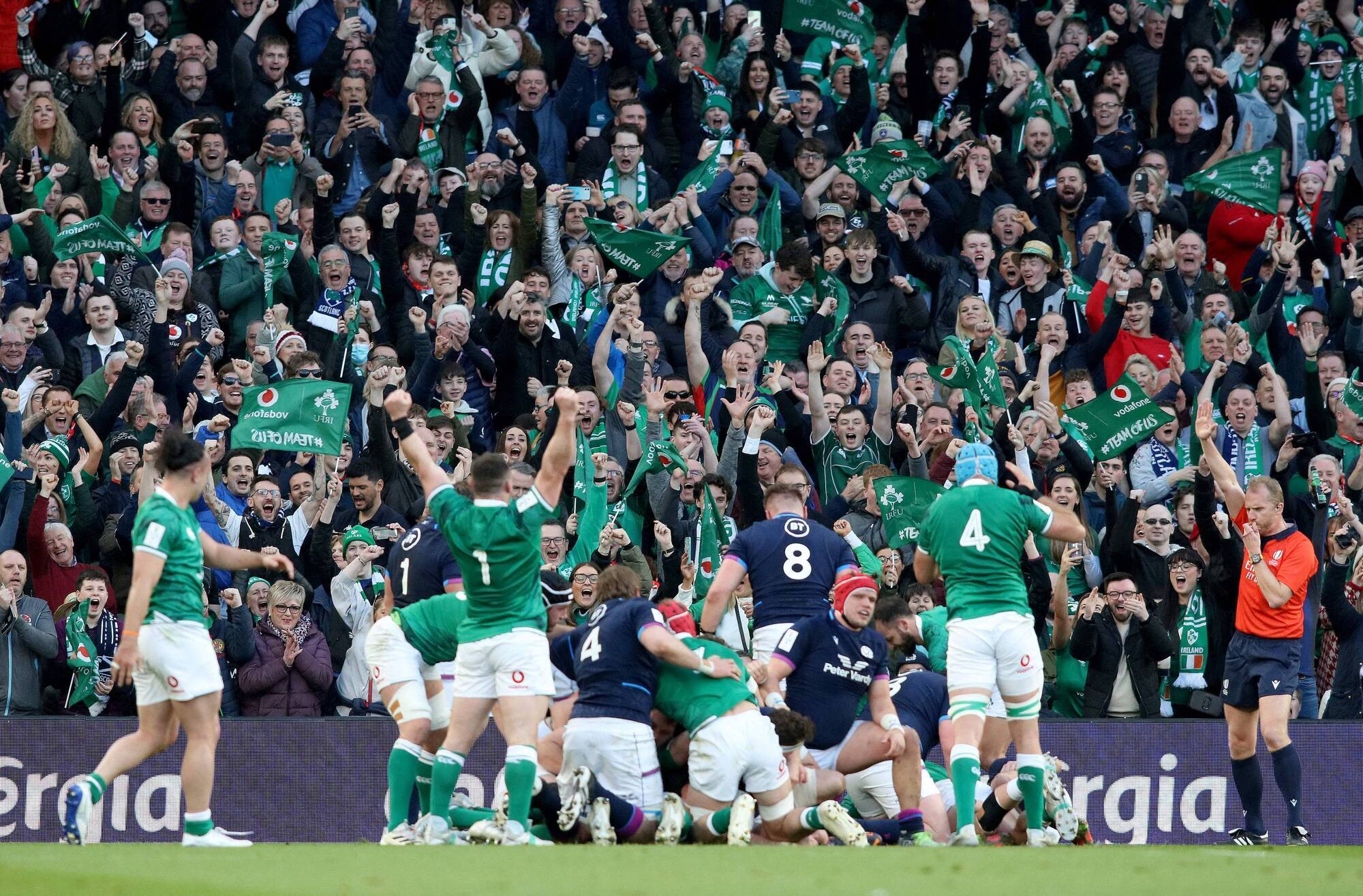
Ireland supporters celebrate as Ireland's hooker Dan Sheehan scores the first try during the Six Nations international rugby union match between Ireland and Scotland at the Aviva Stadium in Dublin, on March 19, 2022. (Photo by Paul Faith / AFP) (Photo by PAUL FAITH/AFP via Getty Images)
Six Nations rivalries are all created equal but some are more equal than others.
France and England have Le Crunch, an historic confrontation with its roots in the Norman conquest, kept festering through the centuries by Napoleon and terrible British cooking.
Rivalries with England, of course, are a subset of their own. The Celtic nations all have beef with Les Rosbifs, mostly because of having their villages burned by uninvited and frankly ill-mannered English soldier types. As such, mentions of Owain Glyndwr, proud Edward’s army and Cromwell are standard when it comes to test matches against the old enemy.
In this ancient context, the raw material for rivalry between Wales, Scotland and Ireland seems either muted or non-existent. To those outside of the Celtic triplets, any suggestion of genuine rivalry is laughable, rugby’s version of the Multiverse Spiderman meme. Are they not, the detached observer would argue, three sides of the same coin? Subtle differences yes, but small, rain-lashed, freckle-faced nations with historical chips on their shoulder must stick together, no?
Of course, things are not that simple. The three Celtic nations have managed to stoke up reasonable levels of mutual antipathy thanks to rugby’s version of what Freud called the narcissism of small differences. These differences can be perceived in the traditional sociological make-up of the three nations’ rugby-playing populations: Scotland (Edinburgh solicitors and Border sheep-farmers), Ireland (Dublin solicitors and Limerick dockers) and Wales (Coalminers. Sadly, there are no solicitors in Wales. The English banned them, I think).
Wales and Ireland, for example, managed to rustle up a decade of healthy enmity thanks solely to the shit-stirring presence of Warren Gatland. A personal vendetta against his former employers in the IRFU aside, Gatland took great sport from winding up his erstwhile opposite number, Joe Schmidt, the Welsh coach’s relationship with his tightly-wound neighbour akin to that between Homer Simpson and Ned Flanders. Gatland did later admit that he motivated his Welsh players to take particular pleasure in beating Ireland by reminding them how often they got stuffed by the same players when lining out for their club teams.
And so, to Sunday’s latest Celtic grudge match. The importance of the meeting of Scotland and Ireland at Murrayfield in the context of this Six Nations is not in doubt. For Ireland it is a further step on the road to what would be only a fourth ever Grand Slam. For Scotland, victory would end two decades of sustained Six Nations rubbishness.
Not since the days when Budge Pountney roamed free and Kenny Logan was not merely Mr Gabby have Scotland been a serious force in Rugby’s Greatest Championship™. There have been great victories and waves of optimism but few serious tilts at a title. They have never finished higher than third and the Wooden Spoon wrestled from Italy’s grip on four occasions is about all they have to display in the trophy cabinet.
But now, like a horse trainer who has turned a flighty colt into a seasoned thoroughbred, Gregor Townsend seems to have shaped Scotland’s erratic talents into something of substance. Win on Sunday and they would go from bums to genuine contenders. They might need a favour from England in Dublin on the last day, but they would finally have arrived as a Six Nations force.
All of which lofty aspirations have been viewed with amusement in Ireland. The jive talk ahead of this one was kicked off by the former Leinster out-half Andy Dunne, who predicted on Newstalk radio that the Irish players would relish putting the upwardly mobile Scots “back in their box”. The inference was that Scotland are, in the local parlance, uppity patter merchants.
Dunne’s comments were greeted with righteous indignation in Caledonian circles. Pessimism is innate in Scotland because they have much to be pessimistic about. What had the Scots done beyond having the temerity to aspire to something slightly beyond chronic mediocrity? Where is the kilted Cassius Clay here? Is this not, in fact, a media attempt to engender rivalry where none exists, with Dunne cast as softly spoken, normal-haired Don King?
Now, the brewing pseudo-rivalry between Scotland and Ireland is hardly the worst in confected sports entertainment. This is, after all, an age when people buy pay-per-view subscriptions to watch YouTubers box the heads off each other. And there do appear to be genuine sources of friction. Analysis of Hiberno-Scottish rugby relations this week have thrown up tetchy past meetings between Munster and Glasgow Warriors as well as a number of 2021 Lions selections that Townsend might have tilted in his boys’ favour.
But old players often have a nose for these things and Dunne is expressing something widely felt among those who’ve been at the coalface. Recently, this column found itself in the company of a batch of well-known former Irish internationals who were yakking about their noughties heyday, a decade in which Scotland managed a single solitary Six Nations win over Ireland. All agreed that the funniest thing about those victories was the sheer bemusement the Scots expressed after each thumping, like that of a bird who keeps flying into the same window.
If this is about the narcissism of small differences, then the one that Irish rugby folk perceive is that between aspiration and achievement. Scottish fans believe they can win on Sunday, whereas Ireland believe they should. Whereas Irish rugby has long been run with project management detachment, Scotland are forever Ally’s Tartan Army, off to win the 1978 World Cup. The recent defeat in France was a classic of the genre, down to the distilled Archie Gemmill of their second half fightback.
Compared to the historical grievances on show elsewhere, it’s a flimsy enough source of Six Nations rivalry. On the plus side, at least nobody’s village will get burned.