Eimear Ryan: What does GAA reveal about who we are?
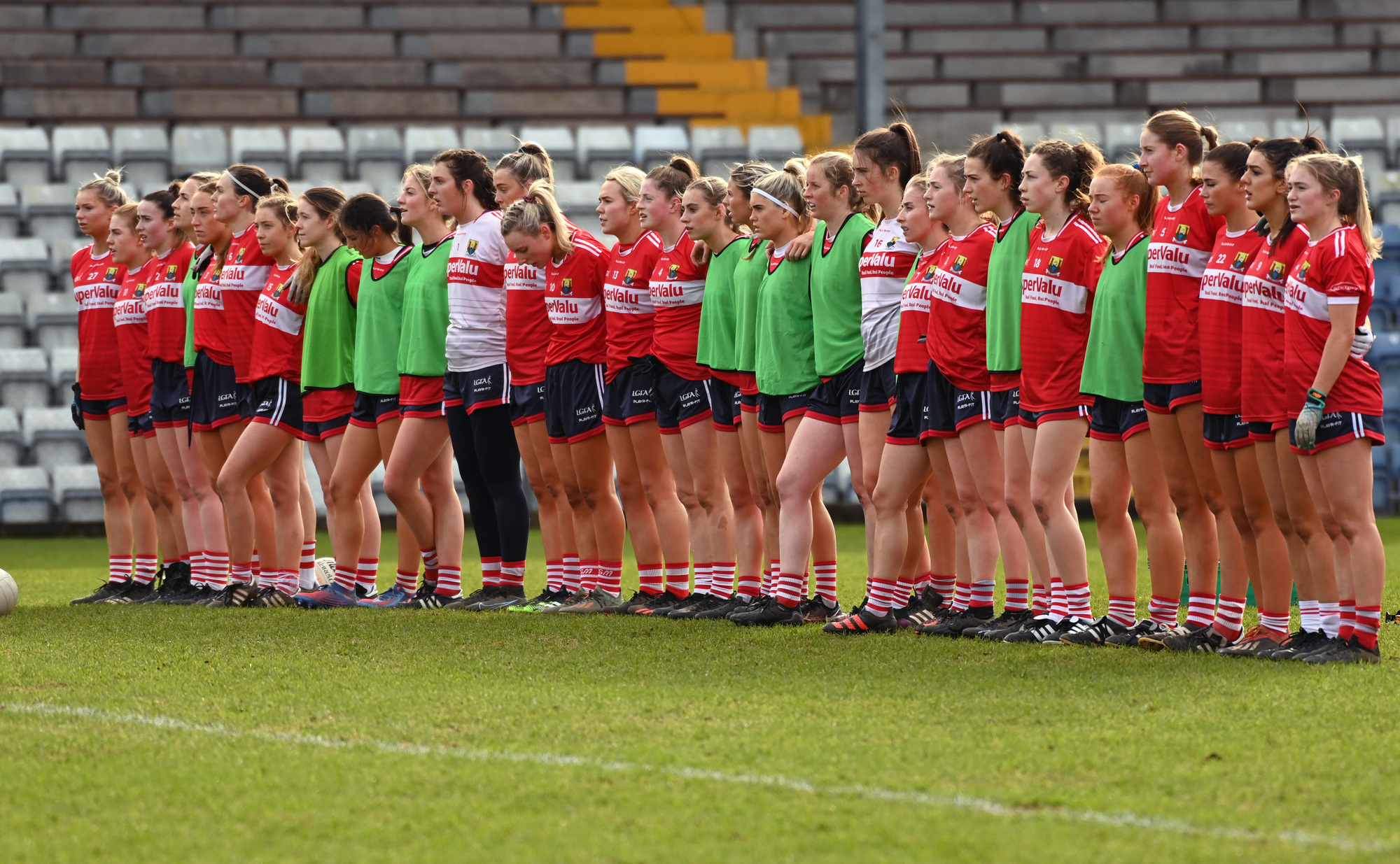
KIT-CHANGE: The Cork team line up against Dublin in the Lidl ladies national football league division 1 at Pairc Ui Rinn. Pic: Eddie O'Hare

I recently read Gabrielle Zevin’s excellent and much buzzed-about novel , which follows two young computer programmers as they navigate friendship, fame, parenthood, tragedy and grief throughout their young adulthoods.
In one scene, while making a pitch for a new video game, a character quotes the Canadian media theorist Marshall McLuhan: "The games of a people reveal a great deal about them." Immediately I thought – what does the GAA reveal about us?
I promptly went down a McLuhan rabbit-hole on Wikipedia. The full quote is even more interesting: "Games are popular art, collective social reactions to the main drive or action of any culture," McLuhan wrote, adding that games were projections of a community’s social and political ideals.
"As extensions of the popular response to the workday stress, games become faithful models of a culture. They incorporate both the action and the reaction of whole populations in a single dynamic image."
GAA people already know all this, of course. It’s hard to think of another organisation that lays more claim to the pulse of the nation, that prides itself on being the one constant through-line in every parish and community in Ireland. And if we are revealed by our games, there is much about Gaelic games that flatters us as a people.
We’re entertaining and dynamic. We’re highly skilled. We’re family - and community-oriented. We’ve managed, for the most part, to avoid many of the problems that plague other sports, such as corruption, doping, and obsession with money.
But Gaelic games and its surrounding culture also shows up some of the flaws in our national psyche. You only have to look at relatively recent history. We might think of ourselves as inclusive, but we’re only now formally making room for women within the GAA structure. We can be conservative and inflexible, as the missed opportunity of the Katie Taylor fight demonstrates.
The Kilmacud-Glen debacle showed that we can be passive, even passive aggressive, hoping that a problem will go away by itself instead of addressing it upfront.
Setting high standards – a virtue – can quickly become problematic when it demands too much of players, something highlighted by Colm O’Rourke when he criticised the clashes between college and intercounty football: "I think it is an absolute disgrace what is happening with the best of young players, because they are so willing to give of themselves … The GAA talk about player welfare, well this is the ultimate in player abuse."
The GAA doesn’t set out to abuse its players, but there’s a wilful blindness at play that means that players – most often young players, as O’Rourke highlighted – get chewed up and spat out by the system.
The amateur ethos of the association is admirable in theory, but can quickly become exploitative, with players not viewed as the assets they are but instead taken for granted as cogs in various competitive machines. If the association is serious about sustaining amateurism into the future, it needs to work both ways. There has to be work-life-play balance for players, and playing hurling or football cannot be all-consuming. At the moment, players are being pulled between two conflicting realities: GAA ideals on the one hand, and the demands of elite sport on the other. It’s a thread that seems ready to snap.
***
While sports science focused on women remains a tiny percentage of sports science overall, there is a growing consensus that training and coaching methods should be tailored more to women’s physiology, especially in elite team sport. As the prevailing wisdom goes, women are not small men, and there is an increasing awareness that different approaches are needed in some respects when it comes to female players.
A long overdue and simple change: women’s teams in multiple codes have begun to migrate away from having white togs as part of the kit. More and more teams are taking into account the ways in which women’s cycles can affect their athletic performance; coupled with this is the very sensible realisation that sportswomen might not be filled with confidence if they have to wear white shorts when it’s their time of the month.
Early indications of this trend came last summer when the England women’s soccer team, fresh off their Euros success, approached their kit supplier Nike to indicate that they wanted to change the colour of their togs going forward. (It’s astonishing that the all-white strip ever became the standard for the women’s team; the England men’s team have often featured navy shorts down the years.)
A number of Women’s Super League clubs followed suit. On the home front, Antrim ladies football team changed from white togs to green, and Kerry have just unveiled their sharp-looking black togs for the 2023 season. Even Wimbledon has recently relaxed their strict all-whites rule in deference to female players. And in December, the AFLW rolled out a league-wide policy, mandating that all clubs should have coloured shorts for both their home and away kits.
Richmond player Gabby Seymour said of the new policy: "We’ve got enough things to worry about, so it's nice just to have one extra stressor taken away … We want every female player we can get – so if that’s one little thing that we can do that makes girls feel more comfortable to play, then I think that's an awesome outcome."
In the course of reading up about the shorts policy, I came upon another bit of trivia about Aussie rules gear which blew my mind: the shirt worn by teams is called a ‘guernsey’. It had never before occurred to me that the jersey worn in team sports might be named for the Channel Island, but if the short-sleeved version is a guernsey, then it stands to reason that the jersey is named for Guernsey’s larger neighbour. What’s more, the guernsey is also sometimes referred to as a ‘gansey’; another Wikipedia rabbit-hole awaits.