Kieran Shannon: Penalty heartbreak happens to the best of them
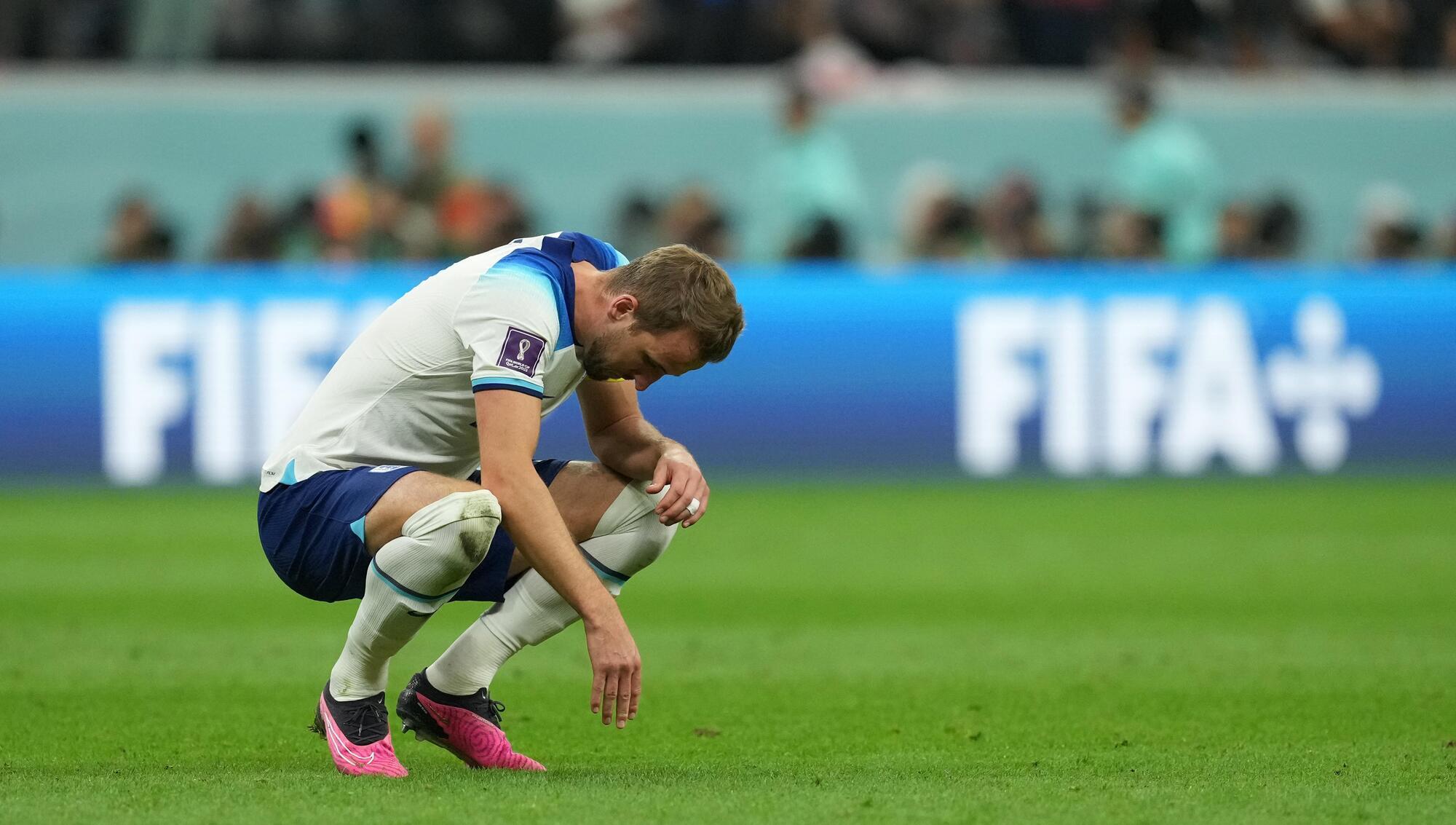
HEARTBREAK: England's Harry Kane appears dejected following defeat after the FIFA World Cup quarter-final match at the Al Bayt Stadium in Al Khor, Qatar. Pic: PA

If it’s any consolation to Harry Kane, it has happened to the best of them.
On Saturday night we found ourselves not for the first time comparing and contrasting England’s current talisman and that of his 1990s predecessor, one Alan Shearer. Newcastle’s finest, we momentarily thought, would have nailed that penalty because he’d have had the nerve and bottle for it.
After all he had demonstrated such virtues on a similar stage. When England last exited a World Cup as heroically and defiantly as this – 1998 against Argentina having played most of the game with 10 men – he scored not just in the penalty shootout his team ultimately lost but was also successful from the spot during the game itself. It had been something similar two years earlier at Euro ’96. After scoring the opening goal in the semi-final against Germany, he slotted away his penalty in the shootout as well only for a teammate, a certain Gareth Southgate, to fluff his.
But it was then we remembered, there was an occasion – a massive one in fact – when even Shearer fluffed his lines and a spot kick as well. In 2003 Newcastle looked primed for the group stages of the Champions League; they just had to overcome Partizan Belgrade in a qualifying tie. But that tie ended up going to penalties, and with the very first effort in that shootout Shearer stepped up and duly blazed it over the crossbar, costing Newcastle the tie. The very man you would have wanted to have taken that penalty had blown it – sky high.
Geir Jordet, the Norwegian sport psychologist and an expert on penalties in football, would have known the dynamic at play. Having studied every penalty taken in every major international championship since 1976 and plenty more besides, he’d deducted a particular phenomenon.
“A superstar, your number one performer will feel more responsibility than others in deciding moments of a competition.”
He’d the data to back it up. From those Euros in 1976 up to the 2010 World Cup, he’d calculated that the most internationally-recognised players – that is your Ballon D’Or winners, your European or African Players of the Year and Golden Boot winners – actually had a lower successful rate in penalty shootouts (73 percent) compared to forwards in general (80 percent).
He – we – can go through the most obvious of names. Zico – and Socrates – in ’86. Platini in the very same game. Van Basten in ’92. Baggio in ’94. Beckham in 2004. Lampard in 2006. And that’s without mentioning the club game. Kempes and Brady in the Cup Winners Cup final of 1980. Shevchenko in the Champions League final of 2005. Ronaldo and Anelka in 2008. In 2012 even the two best players of their or anyone’s generation, Ronaldo and Messi, contrived to mess up a head-to-head Champions League final by each missing from the spot in their respective semi-final shootouts.
And so it has continued in the decade that’s followed. There’s been a lot of talk, and much of it justified, of France’s superior record of winning the big games and big moments, but only 18 months ago in their last major championship they exited having blown a 3-1 lead to Switzerland and their main man Mbappe was the only player to miss in the penalty shootout. Mo Salah scored the penalty that sent Egypt to the 2018 World Cup but then missed one against Senegal that cost them going to the 2022 tournament. Now Kane has joined that list of greats being so mortal. For all the Golden Boots you might win, it does not make you immune to pressure. In fact, as Jordet’s studies have shown, it can even make you more vulnerable.
Jordet has also noted a couple of other factors that made Kane susceptible to missing. In recent years the Norwegian has broken down in precise detail the various important stages of taking a penalty. A key stage is the support the penalty-taker gets from teammates following the awarding or now in the age of VAR, the potential awarding of a penalty. Liverpool, he has noted, have been very vigilant and good at ensuring their penalty-taker is shielded from opponents trying to play mind games with them before they take that crucial slot. Jordan Henderson has been such a protector and last Saturday night for Kane’s first penalty he was indeed again that bodyguard, calling for and grabbing the ball quickly, then handing it over to Kane and escorting him to the penalty area, ensuring no French player was able to get in his ear.
By the time of Kane’s second penalty though Henderson was off the field; he had just been substituted. And Jordet was taken by the fact that for the first 30 seconds after the VAR decision Kane was alone, with only France players around. “Not necessarily a problem,” he’d note, “but it left him vulnerable.” Eventually Mason Mount and then Jude Bellingham stepped in, the latter escorting Giroud out of the penalty area, but was it too reactive and too late?
What happened following Kane’s miss was also telling. Jordet’s work has spoken about the importance of emotional contagion and how various parties respond to a successful or unsuccessful penalty. In 2004 Holland won their first penalty shootout in a major championship, edging Sweden. For Jordet it swung on Sweden’s Christian Wilhelmsson simply trudging back to the centre circle with his head down after scoring, compared to Holland’s next taker, Roy Makaay, wheeling away in delight after scoring from his effort. Sweden duly missed their next kick, not least because of the emotional contagion and atmosphere Makaay’s reaction had triggered.
For Jordet it was striking that after Kane’s miss, almost the entire French team swarmed around Lloris (and Kane) with not a single English player in sight before Bellingham again eventually emerged to give his captain a hug and some words. “Where were the other England players?” asked Jordet. “They understandably had enough (to do) with themselves and need to regroup but it remains they all except Bellingham turned their backs on Kane.”
England and Southgate have made huge strides in terms of looking out for the minor details Jordet delves into and cultivating the kind of team culture that he would espouse. A line we read recently from a close friend of the tragically late Grant Wahl comes to mind. In Three Ring Circus, a look into the LA Lakers era of Shaq, Kobe and Phil Jackson, Jeff Pearlman wrote of the team they faced in the 2000 western conference finals, “These Blazers were not those Blazers.” In other words, they were a more resilient, dogged, hardened team than their predecessors.
So it is with Southgate’s team. This England is not that England, just as the Mayo team of the 2010s was not that Mayo, or the Spurs of the past decade are not the Spurs that Fergie so witheringly referenced. But, it’s almost like the better and closer they get to going all the way without getting there, the more they become the Most Mayo, the Most Spursy, the Most England, more than the Best Mayo, the Best Spurs, the Best England.
And even the best of their best fall and fail hardest. Cillian O’Connor has made some of the best big-time plays Croke Park has seen the past 10 years – a late penalty against Dublin in 2015 to bring a semi-final to a replay, a stupendous give-and-go point from 45 yards to bring the 2016 final to a replay – yet those plays are overshadowed by late missed frees in the last games of 2016 and 2017.
Now Kane has become their O’Connor in every sense. They will go again, and may finally reach their Everest, but the closer they get, the higher and harder it seems to get. To overcome and make history, they’re nearly going to need to get every little thing right or finally get lucky.