Colin Sheridan: Argentina antics humanise Lionel Messi and co
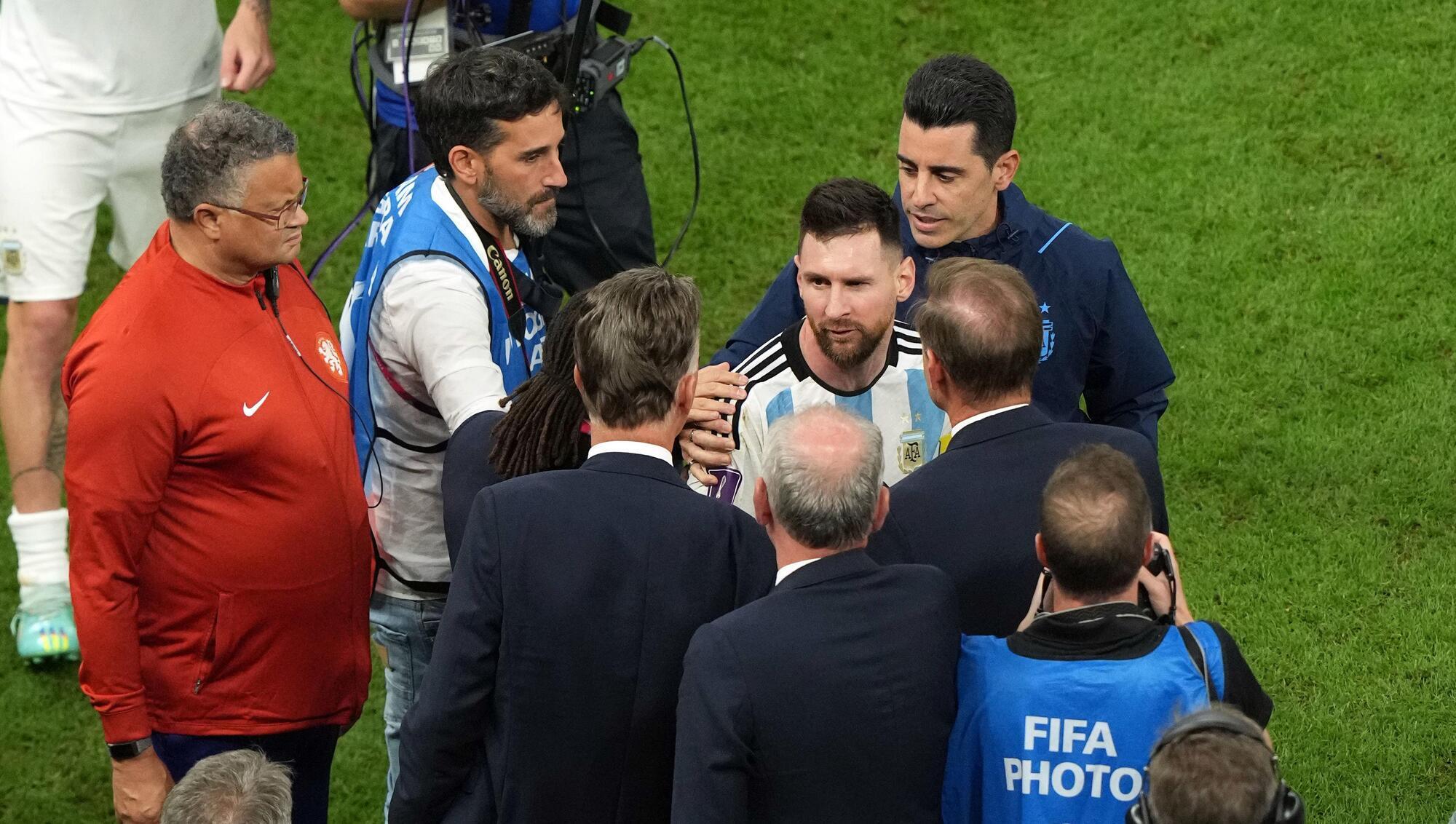
CLASH: Argentina's Lionel Messi with Netherlands manager Louis van Gaal following the FIFA World Cup Quarter-Final at the Lusail Stadium in Lusail, Qatar. Pic: Peter Byrne/PA Wire
When Mayo’s Lee Keegan tossed his GPS unit at Dean Rock, just as the Dubliner was about to break Mayo hearts and kick his team to glory in that epic 2017 All-Ireland final, you can be fairly certain the Westport man wasn’t thinking about personal legacy. Had Rock missed (and Mayo somehow found the resolve to kick a winner), the flying GPS would've become a catalyst for conversation the country over. Snugs and marts, those never ending queues outside country funeral homes; all would’ve played host to any number of diverse opinions on the matter, from the disgusted to the impressed.
Keegan's act would’ve become as much a part of the story as Mayo ending their seemingly unendable famine. To the Dubs - and the many others from Mayo fatigue - Keegan would be understandably cast as a pariah for his petty act of gamesmanship. In Mayo, his reputation as an heroic warrior long established, they probably would have renamed the Holy Mountain after him. Throwing the GPS was the most definitive rebuke to the notion that Mayo were too soft, too popular, too unwilling to “do whatever it took” to win. It didn’t work, even so the Dubs were understandably enraged at Keegan’s “shithousery”. In his column for , Charlie Redmond called it a “new low for Gaelic Football''.
Although a different code, by that (admittedly needy metric), newer lows were reached on Friday night as Argentinian players taunted and goaded their Dutch opponents after beating the Netherlands in a penalty shoot-out and sending them packing from the World Cup. The clash was a classically ill-tempered affair, 17 yellow cards and multiple bench-clearing flare-ups, all bookended by Messi’s fleeting genius and a Dutch free-kick routine straight from the playground.Â
When teams surrender two goal leads, especially to a team as chaotically frantic as Argentina, you expect them to fold in the subsequent shoot-out, thus amplifying the tragedy of their collapse. Not this time. Their flagrant dislike for their opponents made them more defiant and remarkably less nervous. The more the Dutch provoked them, the more belligerent and unbreakable La Albiceleste became.
If the on field histrionics were enough to have purists the world over hiding behind the couch, the post-match carry-on was a masterclass in how to lose friends and alienate people. Leo Messi, long derided as being devoid of any discernible personality, morphed into Tony Soprano at the Bada Bing, interrupting a TV interview to chide a passing Dutch player ("What are you looking at, you fool?”) before turning his derision to the tournament's most sacred cow, much loved Netherlands manager Louis van Gaal.
The reaction across media - both social and traditional - was almost unanimously damning of the “graceless” and “classless” Argentinians. This was not football, etc. Which, I have to say, I found more than a little confusing. Sure, nobody should use this game or the Argentinian behaviour as a teaching tool for kids, but, far from being appalled by the petulant and sometimes vengeful carry on of Messi and company, I was utterly enthralled by it.Â
Do we not consistently chastise modern soccer players for not caring? For being out of touch with reality? For being overly managed aliens who can’t even send a text themselves without running it by an equally overpaid communications manager? I, for one, am sick of players talking to their opponents with their mouths hidden behind their hands, apparently to avoid lip-readers dissecting their sycophantic conversations, before they swap jerseys with each other at half-time. I don’t like Roy Keane for destroying Alfe Inge Haaland and then standing over him, snarling, but I understand him.Â
That’s what made the Argentinian reaction so compelling to me. It was relatable. Petty, yes, but oh so relatable. Is pettiness not one of the most relatable human reactions? It stripped back every cent Messi has ever earned. It rubbalised the unscalable walls of the Parisian compound he lives in. It humanised this God-like footballer to such an extent he appeared less an otherworldly genius, more a scorned farmer tricked out of a sliver of land. Far from being above the contrarian antics of his otherwise mediocre teammates, he was completely immersed in them, making him a far more believable person in the process.
Yes, the optics were bad, but, by Jesus, they were honest. Rather than live by the idealistic sentiments of Rudyard Kipling's classic poem If (the “triumph and disaster” one), our Latin American cousins would rather go with their own, more cynical version, But. It won't win them too many friends, and likely not a World Cup either, but by being themselves, they have at least won the right to keep fighting for what they believe they deserve. No lip reader or image consultant will change them. In the words of Leonard Cohen, they are ugly, but till Tuesday night at least, they still have the music.
It’s been billed - rather sarcastically - as the most lopsided trade in American sports history. In a scene befitting an episode of the spy drama The Americans, 6 foot 9 inch Olympic and WNBA star Britney Griner briefly crossed paths with Russian arms dealer Viktor Bout on the tarmac of Abu Dhabi international airport. The unlikely encounter - a de facto prisoner swap - was the final act of diplomatic negotiations between two countries barely on speaking terms.Â
Griner, arguably the greatest women's basketballer in history, was arrested in Moscow and later convicted of carrying marijuana oil into Russia last February, a crime for which she received a nine year sentence. Bout, on the other hand is a notorious arms dealer, serving a 25 years sentence in US prison. Prosecutors in the United States said the arms he sold or brokered fuelled conflicts and supported regimes in Afghanistan, Angola, the Democratic Republic of the Congo, Liberia, Rwanda, Sierra Leone and Sudan. For all of this, he earned the ominous nickname, The Merchant of Death. His story was the loose basis for the Nicholas Cage movie The Lord of War.
Griner, too, can at some point expect the movie treatment, but given the undoubted trauma her heavy handed incarceration inflicted upon her, it’s unlikely to be at the top of her to-do list as she reintegrates into American life. Her wife, Cherelle Griner, spoke of their family being whole again. The pair had only spoken twice by phone since February. A slam duck for the Joe Biden administration, you would think? The society Griner returns to, however, remains a divided one.Â
There are many in America who see her as less deserving of exchange than another prisoner, Paul Whelan, who was convicted of spying by Russia and has been imprisoned since 2020. Whether it's because Whelan is an ex Marine and Griner is black, gay, a democrat and a woman is interesting, but, today at least, irrelevant. It was never an 'either/or'. Griner is home, and hopefully free to play basketball again.
Whether or not you completely believe Martin O’Neill’s account of how his handling of the Declan Rice and Jack Grealish cases was guided as such by his self-professed altruism as cold reality, it was healthy to hear the quiet bit said out loud by one of the main characters in the theatre.Â
The bottom line for O’Neill was, the better the two players became, the less likely they were to choose to play for Ireland. His decision to not “coerce” the players, as he told Talksport last week, has been justified in his eyes by the world class players they’ve become. It’s a bitter sweet thought, and instructive to how we still see ourselves; ultimately inferior. If the father believes it, the kids will too.
The beauty of sporting calendars, much like the actual seasons, is that by the time one event exhausts itself to the point of burnout, you can’t wait for the next to start. You get sick of the heat of the World Cup? Wait until the national leagues begin.Â
The July finish to last year's championship season has only further whetted appetites. There’ll be no need for air conditioners in Brewster Park come the January 28. Bring it on.