Eimear Ryan: Coaching male teams is the next great evolution of female sport
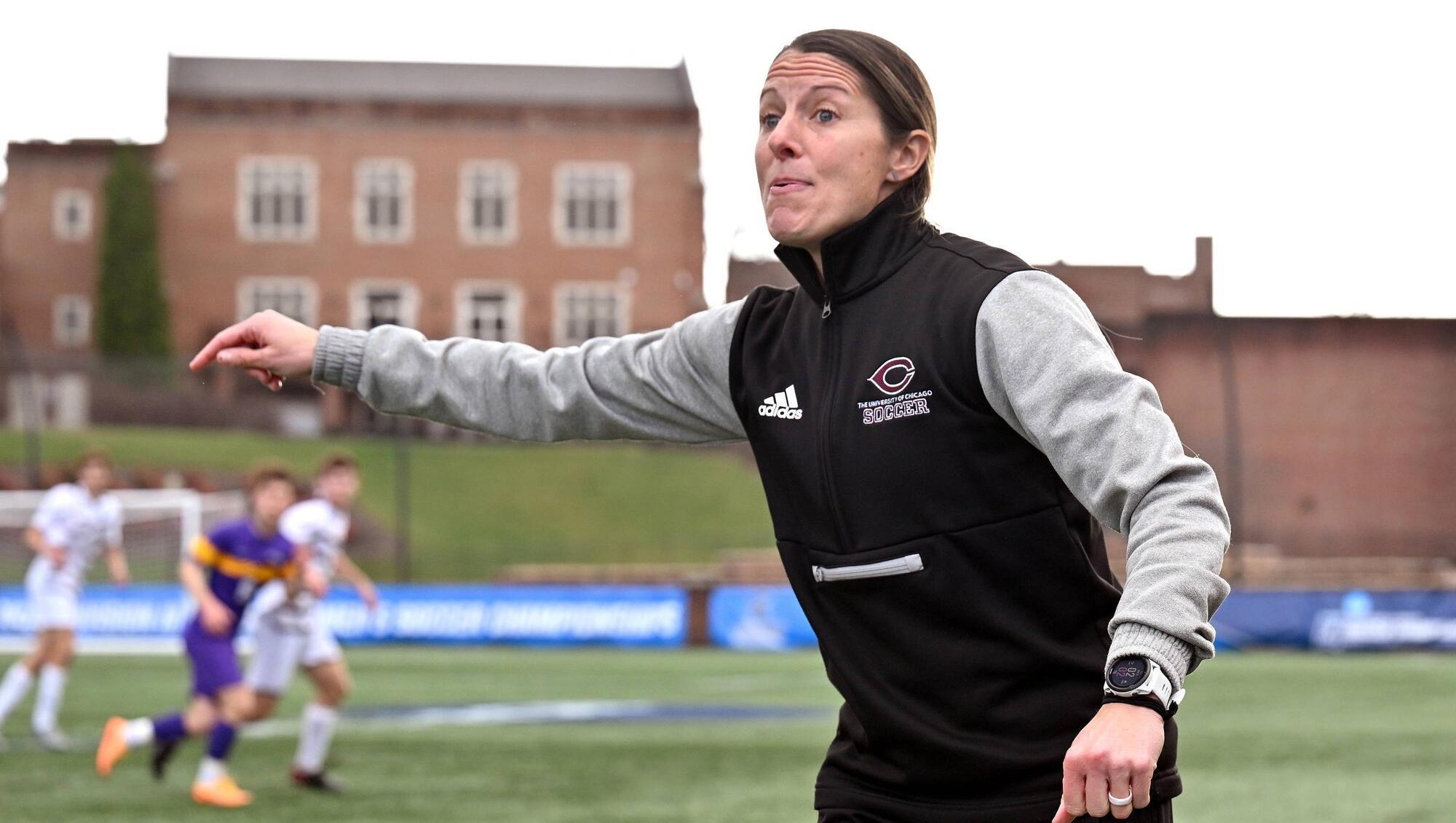
HISTORY MAKER: Head coach Julianne Sitch of the University of Chicago Maroons directs her team in the final minute of their win against the Williams College Ephs during the Division III Men's Soccer Championship held at Kerr Stadium on December 3, 2022 in Salem, Virginia. The Maroons won the national championship, 2-0. Pic: Grant Halverson/NCAA Photos via Getty Images

Last weekend, Chicago native Julianne Sitch made history when she became the first woman to coach a men’s soccer team to a US national collegiate title. Her charges, the Chicago Maroons of the University of Chicago, finished the season unbeaten, with 22 wins, no defeats, and one draw – against NYU, the only other team in the league coached by a woman. Moreover, it was the university’s first ever national title in soccer. Not bad for Sitch’s first year in the job.
In the post-game celebrations, after dousing Sitch with an alarmingly large barrel of blue Powerade, her players were quick to praise her. Captain Griffin Wada had never had a female coach before. "She’s just a calm presence," he told CBS. "I’ve had a lot of coaches in the past who were yelling on the sideline or freaking out at the ref."
Perhaps a female coach circumnavigates the cliché, familiar to us from Hollywood sports movies, of the drill-sergeant coach: barking orders, losing his cool, issuing punishment press-ups and laps. But as Sitch, a former professional player with the Chicago Red Stars, pointed out: "Every coach has something different to offer … [it’s about] finding the best coach that fits regardless of gender." She would like for her success to be interpreted as "just opening up the doors for everybody."
Closer to home, there’s Áine Kinsella, another trailblazer who has just been appointed assistant manager for the Wexford senior football panel, after two years in a stats role with the Wexford senior hurlers. The former Carlow ladies footballer got her coaching start with the Carlow hurlers under Colm Bonnar, and remarkably, her extensive coaching experience at club and county level has all been with men’s teams.
On a recent episode of , Kinsella was confident that this is only the beginning of female involvement in the coaching of men’s teams: "People forget that female sport is still in its infancy in this country in relative terms to its male counterpart. So much time, energy and investment has been given to increasing female participation numbers in sport … But I think now, the current generation that are playing – maybe girls in their teens – the same logical progression from playing to coaching and managing is going to develop there now that already exists in the men’s game … I think that’s what’s going to happen over the next decade – it’s going to become the next great evolution of female sport in this country."
She added that for any women who are interested in coaching, there’s never been a better time, what with the recent launch of a mentorship programme for female coaches in Gaelic games, and with the likes of Elaine Harte (Tipp football), Mags Darcy (Wexford hurling), Cliodhna O’Connor (Dublin football) and Julie Davis (Armagh football) leading the way by bringing their energy and expertise to traditionally male-only spaces.
"We only have to push the door now," Kinsella said. "Sometimes I think because you have to battle for so long in certain regards as women that we almost expect the door to be locked against us … I think this door is waiting to be pushed. We only need to give it a little nudge and then just step through into the space."
**************************************
I’m an anxious player; always have been. I’m an anxious person, full stop: always braced for the next thing coming down the tracks, always slightly suspicious of good fortune, always like a bag of cats before matches, my knee bouncing rapidly up and down as I sit in the dressing-room. I always thought this was a terrible disadvantage in sport, with its focus on positive visualisation and ‘next ball’ optimism. Sure, pre-match nerves are normal, but I was always envious of my teammates who seemed to be able to take matches in their stride, even to enjoy the pressure.
Coach Ray Boyne’s Twitter account, @AnalysisGAA, had an excellent post on this very topic recently. He cut together two clips: one of Ronan O’Gara speaking on a Virgin Media Sport panel; another of Roy Keane on a road trip with former England international Micah Richards. In the first clip, ROG speaks with admirable honesty about nightmare days as a kicker when he might have scored zero from five. On those days, if the team was six points down, he’d be thinking: "Please don’t score. That means I have to take this conversion." But, with experience, he grew to love the pressure and revel in the responsibility.
Keano, for his part, monologued about his anxious approach to games: "I was a worrier on the pitch. I was a negative person on the pitch. We might be winning one or two-nil, we might be ten points clear – I was never relaxed … My career was based around fear, Micah. Fear of losing, fear of ending up not winning a trophy, fear of ending up going back to Ireland without having won a medal or made a few bob. My career at United, particularly my role at United when I was doing that sitting role, where I was protecting the back four – it suited me down to the ground ’cause I was a worrier … Every time a player got the ball I was expecting them to lose it."
It was reassuring to watch these clips – O’Gara on overcoming anxiety, Keane on making his anxiety work for him – and to know that the anxious player doesn’t have to change their personality to be successful. That would be impossible, anyway. Anxiety, in an evolutionary sense, is meant to protect us: to keep us watchful, and to prevent us from getting into dangerous situations. Taken to an extreme, these feelings can be debilitating, but maybe in the right quantities they can be useful, in sport as well as in life. A baseline of anxiety might mean that when the pressure comes on, we’re not surprised. We may even be mentally prepared. Maybe, even in this era of positive thinking, there’s a place for the anxious player.