Eimear Ryan: Cloud over World Cup after rainbow warriors buckle
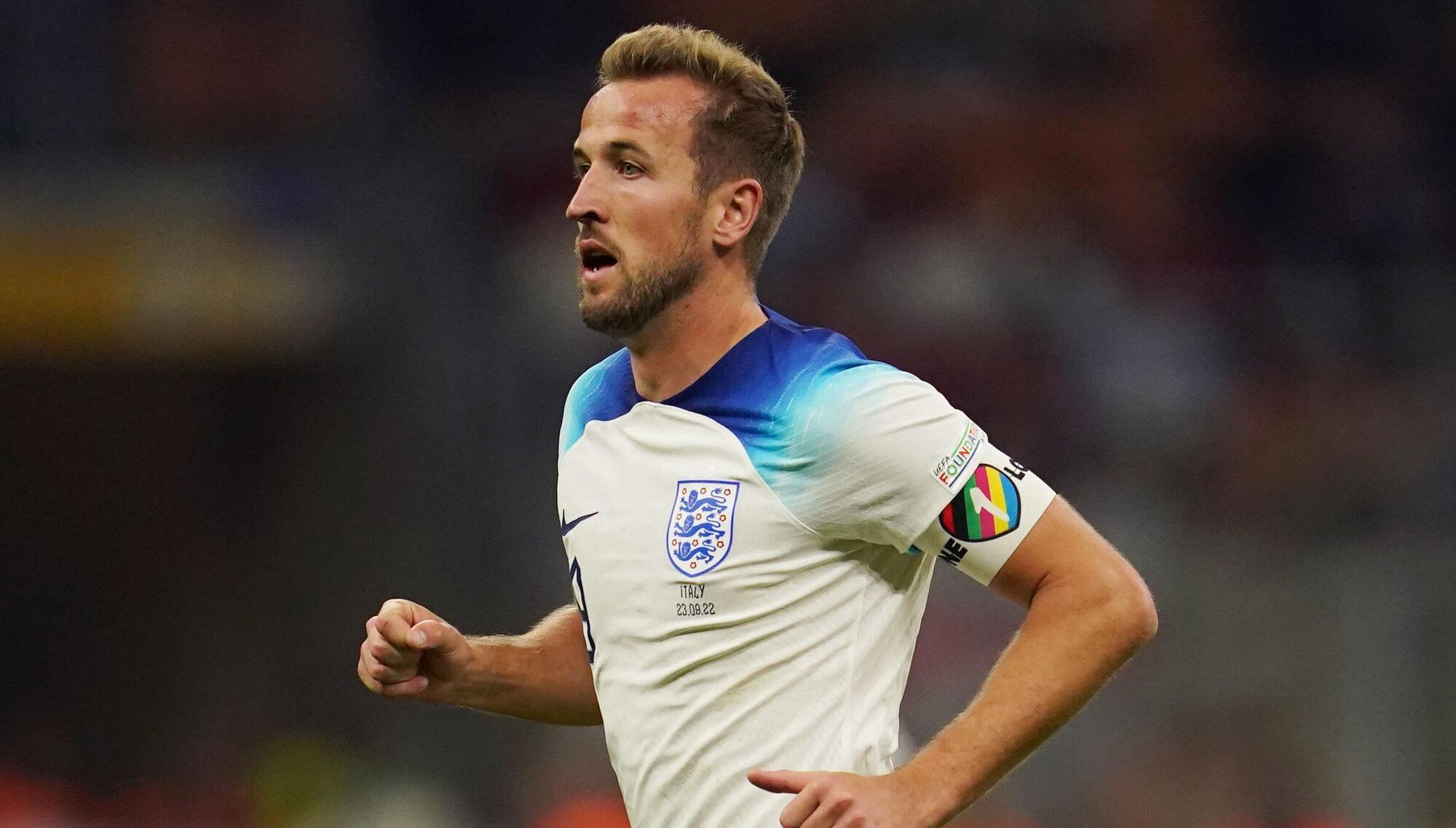
BACKED DOWN: England's Harry Kane with the One Love armband. The players backed down from wearing them in Qatar due to the threat of a booking. Pic: Nick Potts/PA Wire
It was a well-meaning, if ultimately hollow gesture. Seven European nations playing in the World Cup – England, Wales, the Netherlands, Denmark, Switzerland, Germany and Belgium – pledged that their captains would wear a rainbow-coloured armband during their games to promote diversity and inclusion. If it seemed like a tiny symbolic action in the face of a host nation that criminalises homosexuality and has a terrible human rights record, well, it was. But it was something.
On Monday, the day that England and Wales played their first fixtures, the seven national teams released a joint statement explaining that Fifa had ruled that any player wearing the armband would be booked before the match started. They were prepared to pay fines, the statement continued, but not to put their players in a situation where they might be booked – and they were no longer going to wear the armband.
It was disappointing, to say the least, that the seven teams balked at the first sign of difficulty. Standing up for what’s right isn’t a costume that you put on to make you look good. Meaningful protest is always supposed to make people uncomfortable, to be inconvenient, even to cost something. What sort of message does it send that these national teams were so easily cowed?
As Rob O’Hanrahan of Virgin Media News tweeted: "Very difficult to come out in a sport where your teammates may not risk a yellow card to support you."
Roy Keane, on ITV Sport, was equally withering, viewing the armbands as a missed opportunity. "That would have been a great statement. Do it for the first game, get your yellow card, what a message that would’ve been from Kane or Bale," he said. "Take your medicine and then the next game you move on, you don’t wear it because obviously you don’t want to be getting suspended. I think it was a big mistake. I think both players … should have stuck to their guns and done it."
The toothlessness of the European captains was all the more apparent when contrasted with the courage of the Iranian team, who opted not to sing their national anthem in solidarity with protests in Iran following the recent death, in police custody, of 22-year-old Mahsa Amini; or with former Arsenal and England player Alex Scott, a gay woman who prominently wore the One Love armband while broadcasting from Qatar for the BBC.
In the last five years, Colin Kaepernick, Megan Rapinoe, Naomi Osaka and others have shown us how it’s done. In fact, throughout history, sportspeople have made brave, meaningful, political stands for issues that they believed in – and in some cases, have been punished for those stands with more than a yellow card.
"I ain’t got nothing against no Viet Cong," Ali said famously, when asked why he was refusing to go fight in a war half a world away. Declaring himself a conscientious objector, he added that the Vietnam War was against his Muslim faith. As a result, in 1967 he was stripped of his heavyweight titles, banned from boxing for three years, and convicted of draft evasion by an all-white jury. While he immediately appealed the sentence, and managed to stay out of prison, he became a reviled figure in the US and received death threats. He returned to boxing in 1970, and in June 1971 – soon after his famous bout with Joe Frazier – the US Supreme Court overturned his conviction.
For the first 75 years of its existence, the Boston Marathon was a male-only race, as women were considered physiologically incapable of running 26 miles. Some women disagreed. In 1966, Bobbi Gibb tried to enter the race officially, but was rejected by the organisers; instead, she hid in some bushes near the starting line and then jumped into the pack, wearing a hoodie to obscure her gender. She finished in the top third of the race, in a time of three hours and 21 minutes, but because she was not an official entrant and had no race number, her achievement was not officially recorded.
Kathrine Switzer, another runner and a student at Syracuse University, was inspired. She registered for the 1967 race under the name ‘K.V. Switzer’ and had a male friend collect her race number. Like Gibb, she wore a hoodie to hide her face and hair, but when the hood slipped down a few miles into the course, she was accosted by race organiser Jock Semple. He attempted to rip off her bib number and force her off the course – an event that was captured by photographers. Switzer shrugged Semple off with the help of some of her male competitors and finished in a time of four hours and 20 minutes. In 1972, women were officially invited to register for the Boston Marathon for the first time: eight signed up. This year, 12,100 women ran the marathon, including 75-year-old Val Rogosheske, who was one of the original eight in 1972.
Probably the most iconic protest in sporting history. After winning gold and bronze, respectively, in the 200m at the Olympics in Mexico City, US athletes Tommie Smith and John Carlos wore black gloves on the podium and raised their fists aloft in a Black Power salute as the ‘The Star-Spangled Banner’ played. Peter Norman, the Australian athlete who won silver, wore a human rights badge in solidarity with Smith and Carlos. All three were booed in the stadium, kicked out of the Olympic village, and subjected to severe criticism in their respective homelands. As the years passed, however, that moment on the podium was recognised for the act of bravery it was. The three athletes reunited in 2005 at San Jose University for the unveiling of a statue commemorating their protest. At Norman’s request, his place on the podium was left empty, so that members of the public could stand in his place and feel what he felt.