Kieran Shannon: Have Gareth Southgate's England found the sweet spot?
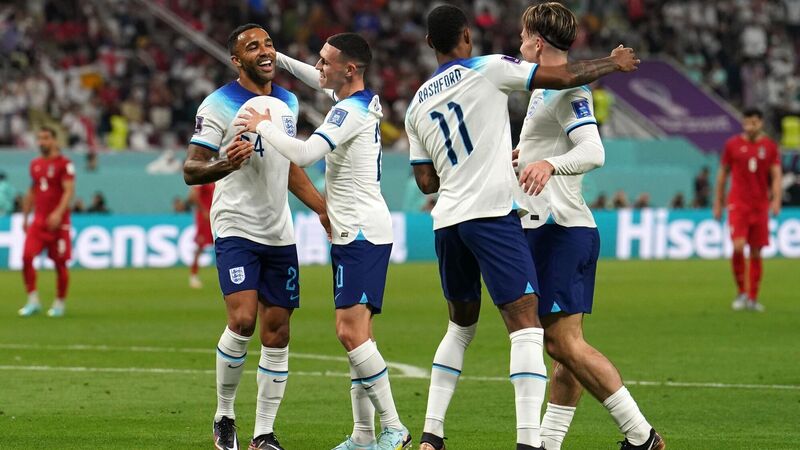
FAST START: Left to right, England's Callum Wilson, Phil Foden and Marcus Rashford celebrate after Jack Grealish (right) scores their side's sixth goal of the game during the FIFA World Cup Group B match at the Khalifa International Stadium in Doha, Qatar. Pic: Martin Rickett/PA Wire
Okay, so it’s only started but at least they’ve got off to a start this time.
The first summer this column was of age to follow a major soccer tournament and one with England in it was Italia '80. Not that anyone called it that at the time or since. It was before Sport Billy and Espana ’82 and a far cry from Italia '90 with all the hype, romance and nostalgia it would evoke with its soundtrack of Nessum Dorma and Ole Ole Ole and its packed, colourful stadia. About the only ugly thing about the 1990 World Cup was the football itself (and the behaviour of some English fans) whereas virtually everything about Europa '80 was grim.
The football: it had no Kempes, Zico, Platini, Maradona; though it was won by the man they called the Monster, Jimmy Magee would save that salutation for Horst Hrubesch’s intervention in a penalty shootout at the infinitely more glam Espana ’82. The stadia with all its empty, stone seats: the average attendance for any group game not featuring the hosts was a paltry 14,500, while the Italian side of Zoff and Tardelli played in front of crowds only half the size of those that would roar Baggio and Schillaci on only a decade later.
And then there was England: its team and its supporters.
There’d been so much anticipation going into the tournament for both parties. The fans, as it was the first time in 10 years England had made it through to a major tournament. The team, as it featured the European footballer of the year in Kevin Keegan and players from Nottingham Forest and Liverpool who had annexed the previous four European Cups between them. And initially it seemed such optimism was warranted.
Twenty-six minutes into their opening game against Belgium, Ray Wilkins scored an exquisite, Le-Tissier-like goal. But three minutes later Jan Ceulemans, who’d come to haunt Irish supporters a couple of years later, levelled matters. Goaded by Italian ‘neutrals’ celebrating the goal, England’s already-notorious following charged at them, triggering a riot squad to move in and unleash tear gas. After English fans flung some of the canisters onto the pitch, the game had to be suspended for five minutes for Peter Shilton to be treated, the gas to disperse and visibility to be restored on the pitch.
In many ways it set the tone for that tournament and so many that followed for England. The shadow of violence, though that lessened somewhat through the decades, and then the inevitable letdown from the team itself.
England failed to make it out of their group at those 1980 Euros; there were no further goals in that game against Belgium (although if VAR was around back then, it’s likely Tony Woodcock’s strike would have stood), then they lost 1-0 to Italy in Rome, meaning their 2-1 win over Spain was purely academic.
Their tournament record would improve marginally after that, making it to the knockout stages of 10 further tournaments before the advent of Gareth Southgate as their manager. But part of the reason why they continuously fell well short of going all the way was because it would take them so – too – long to ever get going.
In England’s seven European Championships appearances following Europa '80 they continued to fail to win their opening game. In ’88 they ran into Packie Bonner, in 2000 Figo, in 2004 Zidane, while every other first-day out they could only muster draws; even the enthralling campaign of Euro ’96 was a slow-burner, beginning with a humdrum 1-1 draw with Switzerland. Not until Raheem Sterling found the net in Wembley against Croatia the summer before last did they finally break the duck and even that was a tense, turgid affair.
They haven’t been much quicker out of the blocks at World Cups. To their credit they were like a bullet out of the chamber at Espana ’82, Bryan Robson scoring after 27 seconds against France with what was to then the quickest goal a World Cup had known; they’d beat the eventual World Cup semi-finalists 3-1 that afternoon in Bilbao and would finish the tournament unbeaten, not even losing a penalty shootout; Brazil weren’t the only team that went out cruelly in that particular World Cup.
But that was pretty much the outlier. Before Gary Lineker caught fire at Mexico ’86, they lost 1-0 their first day out to Portugal. Even 1990, the World Cup of Gazza, started with a turgid 1-1 draw with Ireland. Add it all up and between them beating Romania 1-0 in 1970 when they were defending world champions to 2018 when Southgate was at the helm and Harry Kane scored an injury-time winner against Tunisia, England’s opening day record at the World Cup consisted of just three wins out of eight.
Combine that with their record at the Euros and you’re talking about just three wins out of a possible 16: Robbo in ’82, a 2-0 win against Tunisia in Marseilles and a scrappy victory over Paraguay thanks to an own goal.
Of course there were tournaments where they turned it around, somewhat. Lineker with his golden boot in Mexico ’86. Shearer with his at Euro '96 and that glorious demolition of the Dutch. Owen at 18 at France ’98, Rooney at 18 at Euro 2004. But too often they were hamstrung by a slow start and all the pressure it invited, not least because it seemed they were ill-equipped and unprepared to deal with pressure from the offset.
Rooney himself in the form of another riveting column in the at the weekend gave us an insight as to possibly why. The wrong formations. Not enough competition for places in 2006 (“Sven said, ‘If everyone’s fit this is my starting XI’”) and almost too much competition for places in 2010 (“Fabio took not just his provisional squad but players who knew they’d be on standby; we had a training game and the standby lads were steaming into tackles”). Focusing on the wrong things, like asking Matthew Upson to drop four kilos and a sport psych who you had to meet instead of ask to meet.
Under Southgate though there’s less of a circus, more structure, better research and prep. And it’s showing in the results. Under Southgate England have not just reached the last four of the two full tournaments he’s presided over. They’ve won their opening game at all three tournaments where he’s been at the helm.
True, beating Iran isn’t something that qualifies you as a world-beater. It wasn’t like they were playing a Portuguese side with a Figo or a French team with a Zidane or Henry like they would have had at multiple Euros. But what made Monday so distinctive and promising was that they beat Iran well. They cut loose and cut them open in a way they never did against a Tunisia or a Morocco or USA in campaigns of old.
Maybe Southgate, criticised previously for his tactical and selectorial conservatism, has hit upon that perfect sweet spot between defensive stability while allowing his attacking players express themselves. For only the second time since 1982 they won their opening game by more than a goal and for the first time ever win it by more than two, let alone by four.
We’re not saying it’s coming home. But they’ve got going a whole lot earlier and better than they normally do.