Larry Ryan: Colouring in a 40-year journey to Glasgow
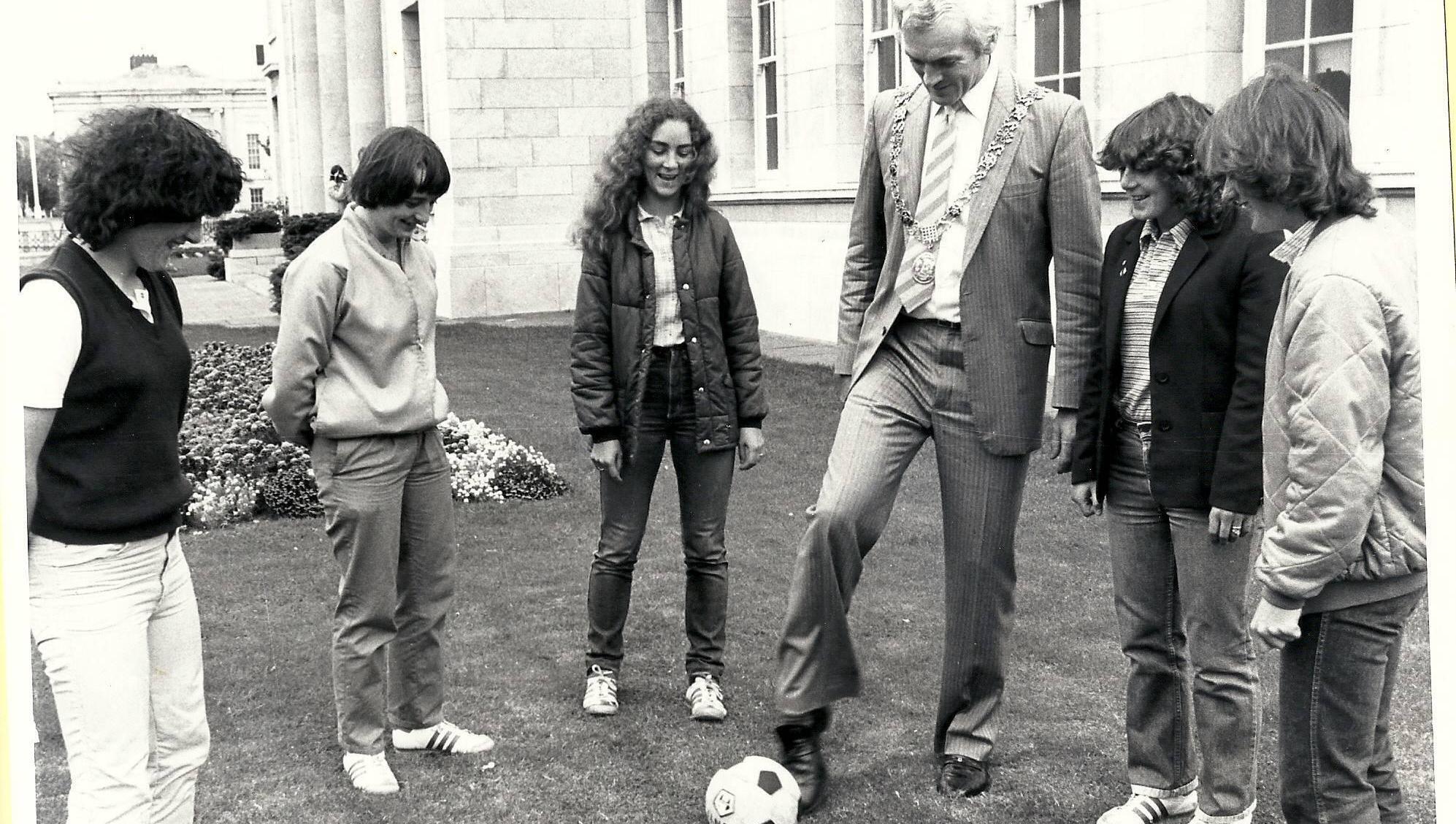
TRAILBLAZERS: Five Ireland internationals from Cork pictured with Lord Mayor Hugh Coveney at the City Hall in 1982. From left: Ann Goggins, Chris Condon, Caroline Nagle, Hugh Coveney, Lord Mayor, Chrissie Buckley, and Noreen Herlihy.
Photo: Cork Examiner

During a week like this, in Cork anyway, you can’t but be drawn into nostalgia and reverie, feeling the guiding hand of history. The Little All-Ireland. The Barrs and the Rockies. Cashmans and McCarthys. Going up Barrack Street or back through the village. Feuds and rivalries and fun on the factory floors of Ford and Dunlop.
You’re sucked into archives. Colour in black and white. The Cork Examiner, October 11, 1982. Monday morning after their last final meeting. Haughey urged to resign side by side on the front page with the Barrs’ three in a row coronation. Inside Michael Ellard teases out how the silver symbol was retained. ‘Superb Barrs masters on all fronts.’
Flick back through the Mondays. Three weeks earlier. September 20th. Romania 19 Munster 8. ‘Brave Munster’ - the headlines affords them their full title. “Forget the scoreline, as stirring a Munster performance as I have seen.”
Familiar names everywhere, to those of a vintage. Frank Stapleton should be fit for Rotterdam on Wednesday, prays Eoin Hand. Turn over to the story of an era. ‘Kerry’s dream turned into a nightmare’ by Seamus Darby. But room still — the pages seemed more elastic then — on the same spread for the Barrs’ county U21 football glory, overcoming Nemo. Hurling keeper Ger Cunningham stuck the key goal, from a pass by Dave Barry. Not a bad combination.
It’s a reminder what a scaffold sport has in the past. How names and heroes and legends echo through the ages, lending context and glamour to new feats.
Men’s sport anyway.
Tucked in the bottom corner of a page, that Monday, down below the results of AUL soccer games and the Youths league, one more score is listed. Ladies International in Dunfermline: Scotland 3 Republic of Ireland 0. There is no match report.
It was Ireland women’s first ever competitive qualifier, for the 1984 Euros. There wouldn’t even be a World Cup to dream of for another nine years. Forty years on, in a week Ireland returned to Scotland to take care of business, you might drift back to the beginning of the journey in Dunfermline, if you’d ever heard a single thing about that game.
You wouldn’t have a hope of finding out who played, but for trojan voluntary research at places like the womensfootballarchive.org. “Sometimes there is little or nothing on the web about legendary players or stories of the past. This site aims, in some small way, to start putting that right.”
Christina ‘Chrissie’ Buckley played and she takes the call. Utterly bemused to be tracked down. Chrissie doesn't recall much about Dunfermline, only trains and buses and boats and staying at people’s houses in Dublin. She reckons she played 10 or 11 times for Ireland, and it would be hard to find out which it is. She scored, the year before, a lob against Northern Ireland. Though she was a defender by trade, often a sweeper, despite standing only 5 foot 1.
She grew up on the northside of Cork, rubbing shoulders with football names that resonate. Miah Dennedy, her cousin Jerry Finnegan, Cork Hibs royalty.
She was well able, out on the streets, with the boys. “Though you’d be sort of called ‘half a man’, which was horrible really.” She played for Killeady, for Cork Celtic and Cork Rangers and, against the odds, for Ireland.
“There were a few of us outside Dublin. A couple of Limerick and Waterford girls. We had to work harder for it.”
In an article by Barbara O’Connell for the , former Cork Celtic and Cork Rangers manager Tommy O’Donovan sketched the dynamic: “Chrissie Buckley and Ann Goggins were the first two internationals to come out of Cork and they set the scene for other Cork girls to get recognition. But they also had to fight harder to retain their places as they were seen as ‘outsiders’.”
Chrissie praises a visionary gaffer willing to scout beyond the Pale. “Tony Kelly gave the country people a chance. He opened doors for us.”
The year after Dunfermline, she had her first child, so she’d been out for a while, when Tony Kelly rang again, a few weeks after the birth. “Are you fit enough?”
“I told him I was. My husband had the baby every morning and I was out in the field behind the house, doing all the training Tony had sent me.
"So I told him, ‘you better give me a chance’.”
She returned against Northern Ireland and played on for years.
Would she have loved a career in the game, if such a notion was even entertained then?
“Of course. I wanted to do everything. Paula Goggins and Ann Goggins, we’d kill each other here in Cork. We thought we were as good as anyone. And if we made it coming from Cork, we were. We didn’t get it easy.”
She’s reluctant to throw out too many names, in case she forgets someone. She remembers playing for Ireland with Helena Stapleton, a centre-forward in the mould of her brother Frank.
She blazed more trails. One evening, her playing career winding down, a referee sickened her. “He was obnoxious, to be honest. Telling us girls can’t slide tackle, that kind of thing. I said nobody would talk to me like that again.”
She applied to become a referee and became one of the best. The first woman to ref a schoolboys National Cup Final in 2000. She reffed them all in Cork. Denise O’Sullivan at Wilton. Clare Shine at Douglas Hall. “What a player. And Megan Connolly at Corinthians, brilliant.”
She reffed in the National League, abandoned a match when a manager refused to leave the dugout. She reffed the Women’s League Cup Final. Louise Quinn lifted the cup for Peamount. Stephanie Roche got the winner.
“They give you the match ball. And would you believe, I took it out of the cupboard and pumped it up this week. It was gone flat.”
She was pumped up with pride. Watching Louise and Denise and the rest. And listening to Stephanie.
She plays golf now, off 18, and enjoys it. “But it wouldn’t be like the soccer.” Not her passion.
They get together still, seven or eight of the old Cork Celtic crowd. A few weeks ago it was at her house. It started out as a thing they did after one of them suffered a bereavement. “Just to make sure everyone was ok.”
They were still going at half 1 in the morning. “Not a drop of drink either. Just tea and 7-up.” Piecing together old games, looking back at days like Dunfermline. Drawn into nostalgia and reverie. But having to colour in their own history.
They looked ahead to Glasgow. Could they do it? Could they finish the job started 40 years ago?
“I was so proud of them. Proud as punch. I texted Denise after the final whistle. What a lovely, fantastic girl.”
She hopes it will open doors for the next generation, now that they have heroes and legends whose stories are getting told.