Kieran Shannon: Is Spain the greatest sporting country in the world?
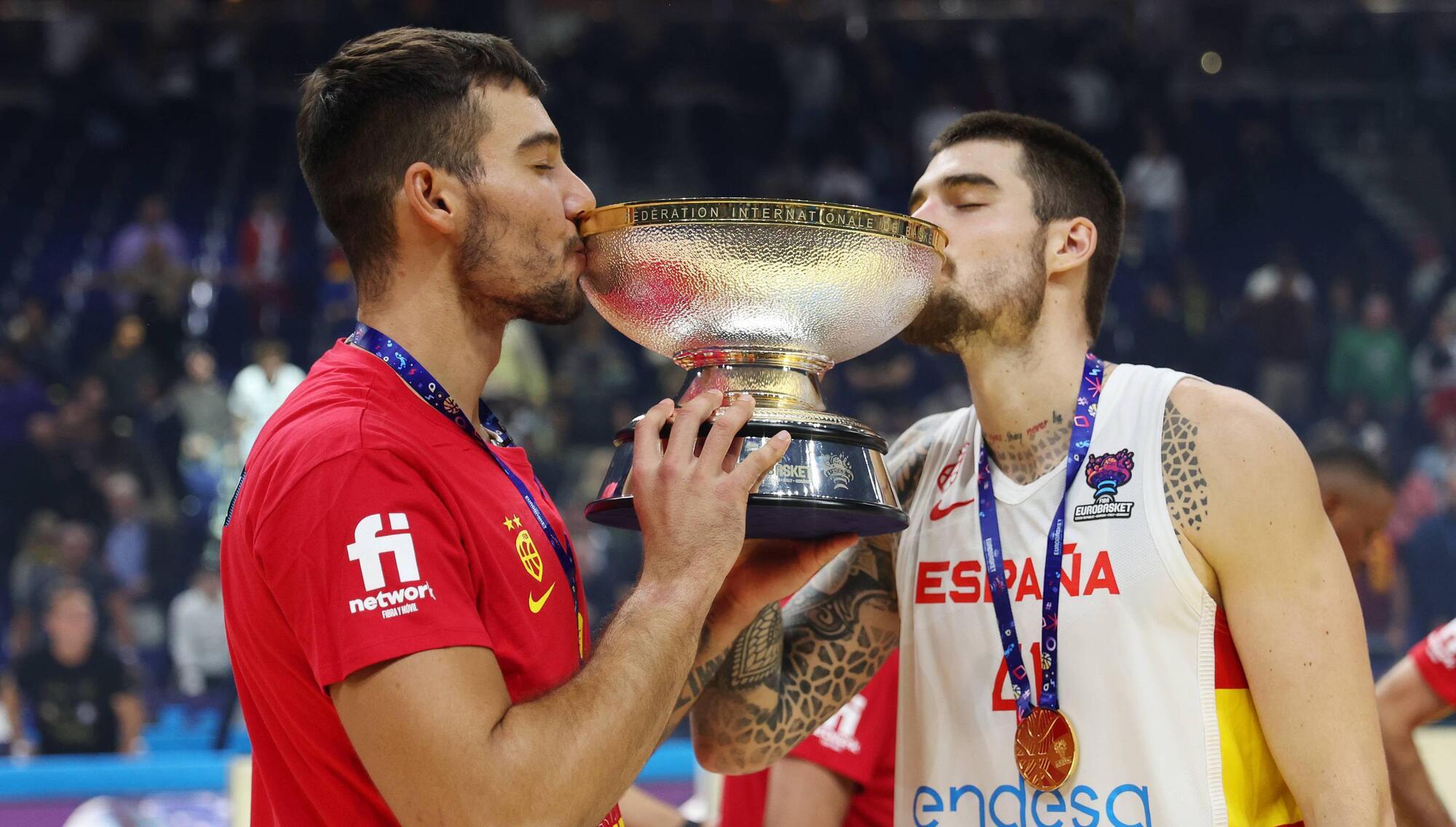
BROTHERS IN ARMS: Willy Hernangomez and Juancho Hernangomez of Spain kiss The Nikolai Semashko Trophy following their side's victory in the FIBA EuroBasket 2022 final in Berlin. Pic: Maja Hitij/Getty Images

We like to think and claim that we’re a great sporting nation but then a Spanish team or athlete wins yet again to put things in perspective – and us in our place.
Last Sunday night, just seven days after Carlos Alcaraz Garfia at 19 became both the US Open champion and the number-one ranked men’s player in world tennis, the Spanish men’s basketball team beat France in the final of Eurobasket, the equivalent of the Euros in the continent’s and world’s second-most popular team sport.
In a way it was a surprise. France were silver medallists to the USA at last year’s Olympics and featured several NBA stars, most prominently Rudy Gobert, a perennial All Star and defensive player of the year. The only two active NBA players on the Spanish roster were the Hernangomez brothers: Juancho, previously best-known for starring as Bo Cruz alongside Adam Sandler in the highly-acclaimed Netflix movie Hustle, and his brother Willy, a role player with the New Orleans Pelicans.
The same month Hustle was released, Juancho was released by the Utah Jazz, only to be picked up on a one-year league minimum salary by the Toronto Raptors. An NBA player he and his brother may be; NBA stars, like their compatriots the Gasol brothers genuinely were, they ain’t.
Yet that’s what they played like last Sunday night in Berlin. Juancho, who had been averaging a mere 11 points a game for the tournament prior to the final, transformed into the Cruz character that he played and Sandler’s found in Hustle, going for 27 points, including shooting a remarkable seven out of nine from three-point range. Willie, the tournament MVP, chipped in with 14 points. But it wasn’t so much how the Hernangomez brothers played above themselves. It was how their national team once again played greater than the sum of their parts.
Over the past 23 years the Spanish men’s team have won four Eurobaskets, medalled at the other seven, won two FIBA World Cups and twice taken a US team with Kobe Bryant and LeBron James at their peak to the wire in the Olympic gold medal game.
In short, no other country in the sport has the knack of making the most of its resources. The golden generation of the Gasols may be gone and retired but their legacy is not. Apart from winning the senior Eurobasket, the country this past summer won the U20 and U18 Eurobaskets, finished second in the U16s and came second only to the USA in the U17 World Cup.
It is even extending to the women’s game. This past summer the country competed in the A level of European or world competition at U16, U17, U18 and U20 female competition. And again they medalled in every grade, winning the U20 Eurobasket, finishing runners-up only to the US in the U17 World Cup and losing by four points or less in the U16 and U18 Eurobasket finals.
It is an exceptional record, even allowing for the country being the sixth-most populous in Europe.
And yet within the country itself basketball is not an exception.
In almost every major team sport Spain are hugely competitive.
Their men’s national football team remain the only country to have won three consecutive major tournaments (the 2008 Euros, 2010 World Cup and 2012 Euros). Its golden generation of Xavi and Iniesta may now be gone just like the Gasols but it is not as if the country have become irrelevant; remember that they were only beaten on penalties by eventual champions Italy in the semi-finals of last year’s Euros.
Their men’s Olympic handball team has medalled at four of the past seven summer games.
No country this century has won more Davis Cups; this November they’re bidding for a seventh since the turn of the millennium, whereas the most anyone else has won is three.
And that’s to say nothing of all the outstanding individual athletes the country has produced the past couple of decades. Nadal. Garcia. Alonso.
So how do you explain their excellence, particularly in team sport? A major catalyst was the country hosting the 1982 World Cup and the 1992 Olympics, triggering a huge interest and subsequent financial investment in sport, especially publicly-owned facilities.
But their real competitive advantage which even the American basketball community has conceded is their approach to coaching. In the States the sport has been traditionally very drill-oriented. Post-Franco Spain has been more about letting the players play and decide. Let the game – and mistakes – teach them, not necessarily the coach.
Jota Cuspinera, a coach within the Spanish national programme, expanded on this theme on an interview with the Basketball Immersion podcast.
“When I was coaching our U16 and U18 national teams I’d watch our opponents in the warm-up and say ‘How can we beat these guys? They’re better physically, are probably more skilled than us.’
“But we let our players solve a lot of their problems. We leave them a lot of space so they can find their own solutions to play. We give them the chance to make their own decisions on court. When they do something but they don’t achieve the goal – say to get a basket – we don’t focus on the result but on what they are trying to do.
"And if we find they’re trying to find a good solution we let them do it again. We let them try different solutions by themselves instead of always telling them what to do. For sure we tell them things to do but we’re not always saying ‘You’ve got to do this’ and ‘You cannot do this.’ It’s ‘Try it. And if it works, do it again. And it doesn’t work, try something else.’ We give them the freedom.”
Sunday night in Berlin was a case in point. Again they did not have the superior physical or technical prowess, but what they had was a remarkable synergy and capacity to make the right decision. Just like all their underage teams that had podium teams earlier in the summer.
Long after their golden generations, Spain look set to continue delivering gold for generations more to come.