Paul Rouse: Death of a Saturday football newspaper tradition
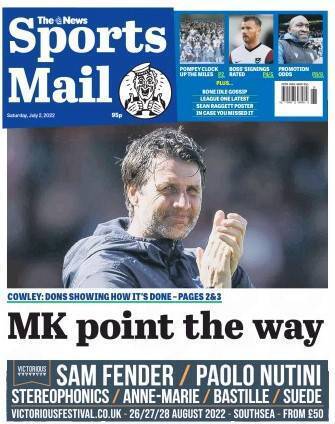
Last edition of the Sports Mail

When the Premier League kicks off a new season this weekend, there will be something missing from the experience of supporters for the first time since leagues were established in England in the mid-1880s.
This month has brought the closure of the last existing dedicated matchday newspaper: the ‘Sports Mail’ in Portsmouth.
This was a tradition that sat right of the English soccer for decade after decade. It belongs in a world of flat-capped men leaving factories on Saturday lunchtimes, clanking through turnstyles for 3pm Saturday matches. standing in their tens of thousands on swaying terraces, and afterwards drinking pints of bitter in public houses.
Matchday newspapers tied the whole day together. They were rushed to print on Saturday, their last pages held to include the scores from around the leagues as they were telegrammed through to offices. At the heart, also, were reports of games written at incredible speed so that the papers would be on sale by 6pm (at the latest) on Saturday evenings, barely an hour after matches finished.
This ‘Saturday Final’ edition of newspapers was printed in pink or green or blue pages to distinguish them – and the ink was still warm on the pages, its smudges part of their allure.
The attraction of the paper lay also in the competitions that they ran for ‘Spot the Ball’; this was never easy, but always felt doable.
And of course, as almost always, there was a connection with gambling. Running through the pool numbers allowed readers to see if they had made their fortune on a Saturday night.
As Tim Adams has written, all of this has now been overcome by smartphones: “It is, like everything else, always in your pocket or on your screen, searchable in the sleepless early hours, tweetable over a lunchtime sandwich. Like all news, unmoored from its allotted time and place, its pink or green physicality, it has lost a little of its specific magic.”
This magic first revealed itself with the publication of the ‘Sports Argus’ in Birmingham in 1882. It was printed on pink paper and centred on the exploits of Aston Villa.
Almost immediately, the idea of publishing a Saturday evening special edition of a newspaper spread across the cities of the United Kingdom in tandem with the extraordinary spread of soccer in the 1880s and 1890s. This was a spread which was manifest, in the first instance, in interest in the FA Cup and then in the Football League which was established in 1888.
This new form of the organisation of sport (through clubs competing in cups and leagues under the control of governing bodies) allowed for commercialisation on an unprecedented scale. It involved the building of dedicated football grounds (for the first time) and the payment of players.
To fill grounds and pay players demanded people to pay through the gates and – in an incredibly mutually beneficial partnership with soccer leagues – newspapers became central to an information, advertising, entertainment and star content creation system. The production of special editions of newspapers on Saturday evening emphasised the lust for soccer, for news of soccer and for the conversation that flowed from this.
And it spread also to Ireland – though not to Dublin.
In the 1880s and 1890s, soccer in Ireland was dominated by Belfast. It was there that the first clubs were organised into league and cup competitions. And it was there that the idea of a newspaper dedicated to soccer appeared through the publication in 1888 of the ‘Ulster Cyclist and Football News’. This was renamed the following year as the ‘Ulster Football and Cycling News ‘ and 407 editions were published between then and 1896, when the paper closed.
By the way, every edition of this newspaper has now been digitised and sits in the digital archive of the British Newspaper Archive (along with digital copies of many other national and regional Irish newspapers), which can be accessed through this website: britishnewspaperarchive.co.uk.
This newspaper was essentially replaced by ‘Ulster’s Saturday Night’ which was later renamed ‘Ireland’s Saturday Night’. It was originally printed on pink paper, and was part of the ‘Belfast Telegraph’ group of papers.
When the paper eventually closed in 2008, the then editor of the Telegraph, said: “At the height of its popularity in the 1930s, 1940s, 1950s and 1960s, Ireland’s Saturday Night’ was an instant source of information on a wide variety of sports which took place throughout Northern Ireland every Saturday.” The problem by 2008, of course, was that “instant” now found a new meaning.
Despite enduring for more than a century – and thriving across the heyday of newspapers – the collapse of the traditional 3pm Saturday kick-off during the Premier League era after 1990 was a disaster for ‘Saturday Final’ newspapers.
What also mattered was the disaggregation of the sporting traditions of English cities. It was not just the Football League scores that were included, but also extensive coverage of local leagues in soccer and rugby. This created a sense of unity within a city and across a sport. The decline of park leagues also gave the sense that what happens in the stadia of the Premier League is now entirely divorced from the amateur sporting world of junior soccer.
But it is technological change that has finally undone the place of the matchday newspaper. It is a tribute to the resilience of the newspaper as a tradition that it survived so many previous technological changes which might have brought a much earlier demise.
The reading out of soccer results on the radio from the mid-20th century was the first significant threat. The next was the arrival on BBC Grandstand of the ‘Vidiprinter’, whirring away as it showed on screen the results of matches as they arrived live in the television studio.
A further step came with the arrival of Teletext, a service which gathered momentum through the 1990s. It was not unknown for people to sit staring at pages which listed matches underway in England, waiting for them to change, with news of a goal. From Ceefax to Aertel, this felt like cutting-edge access to information that could define the happiness of a weekend.
Ultimately, though, it is the triumph of the Internet which has destroyed the last remnant of this Victorian practice. The provision of immediate access to information about the progress and result of matches – even those not being broadcast live – left the Saturday editions dependent on nostalgia and tradition. These are, it is true, potent selling points, but they are also always vulnerable to being overwhelmed by forces of relentless technological modernisation.
That the newspaper in Portsmouth survived long after those in other cities collapsed in the early years of this millennium is testament to the quality of the people who produced it and to the culture of the city.
But culture is dynamic and change has the inevitable quality of bringing an end to everything.