Colin Sheridan: Mercifully, there's nothing straight-setsy about Joyce's Galway 
The All Ireland football championship has found an unlikely running companion in Wimbledon this year, and, true to form, as the tournament progresses, the storylines develop
Colin Sheridan: Mercifully, there's nothing straight-setsy about Joyce's Galway 

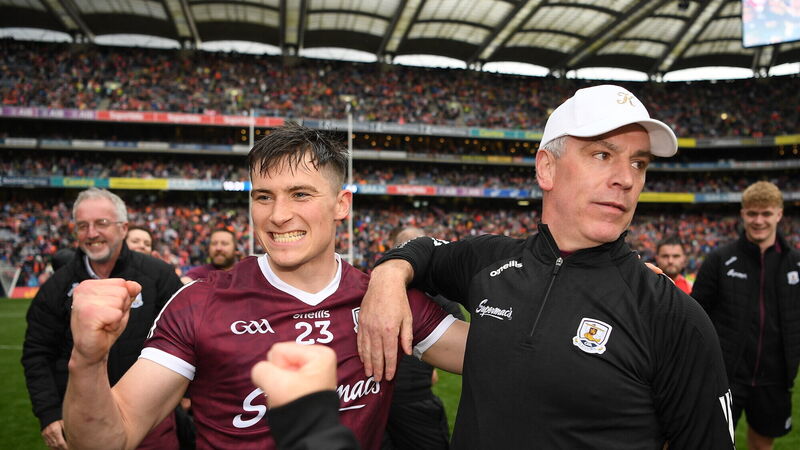
Galway manager Padraic Joyce and Finnian Ó Laoi celebrate after the GAA Football All-Ireland Senior Championship Quarter-Final match between Armagh and Galway at Croke Park, Dublin. Pic: Ray McManus/Sportsfile

And then there were four. The All Ireland football championship has found an unlikely running companion in Wimbledon this year, and, true to form, as the tournament progresses, the storylines develop. 

On one side of the draw, a couple of obvious candidates in Dublin and Kerry, dutifully fulfilling their obligations to tradition and reality by impressively unimpressing in their double-digit disposal of plucky quarter-final opposition, barely dropping a set. 

On the other, Galway, the housewive's favourite, wooing audiences with their fancy footwork and drop shots, and Derry, an outlier, like a lad home from Chicago crashing a wedding, turning heads and prompting whispers with underarm serves and curious tactics.

Ok, ok. Maybe I’m reaching here. Maybe I’m flogging a handy metaphor the way Djokovic and the Dublin footballers flog opponents. Maybe I’m guilty of observing the most Irish of Anglo-Irish rituals - watching four consecutive hours of tennis from SW19 on a Saturday evening in mid July and suddenly believing I’m Matt Doyle. 

Maybe, but, as I sat, transfixed by Nick Kyrgios and Stefanos Tsitsipas on Saturday, I couldn’t help see parallels between their championship and ours, and more importantly, gain a greater understanding of why we need to celebrate the outliers, the creators and the bad boys, for it wasn’t for them, life would be very straight-setsy for everyone.

Kyrgios and Tsitsipas - like Galway and Armagh the Sunday before - was sport at its absolute best. There was none of the “look at the mutual respect!” bullshit that smothers Nadal and Federer encounters like a sanctimonious quilt. Nor was there the predictability of brilliance that turned the All Blacks demolition of Ireland earlier the same day into an uncomfortable bore. 

No, this was sporting theatre in its purest and most thrilling form. Two flawed, mercurial characters whose dislike for each other grew with every passing rally, bringing the genius tennis player out of each other. There was sledging and foul language and smashed tennis balls and booing and a couple of post-match press conferences that were the furthest thing from the all-white, strawberries and cream facade the All England Lawn Tennis and Croquet club likes to project. In fact, the only thing that would’ve enhanced the drama was if the Greek Tsitsipas swung for the Australian Kyrgios at the net.

In the end, Kyrgios won, displaying a talent becoming a potential Grand Slam champion, and a temperament that is probably not. This brings us to the alluring imperfection of Galway. Last Sunday, as injury time approached between the Tribesmen and Armagh, the country collectively rose from its comfortable couch to boil the kettle and prepare for Mayo and Kerry, only to return cup-of-tea in hand, to find Galway had executed a collapse Wall Street would be proud of. 

And that was only the start of it. The melee, undoubtedly inspired by Armagh’s treatment of Galway's two star forwards Shane Walsh and Damian Comer, and Galway's Kyrgios levels of gamesmanship in trying to kill the clock and limp to victory, preceded a period of extra-time so chaotic it would give the control freaks in Dublin a coronary. 

Many have pointed to Shane Walsh's intercepted audacious cross-field pass late in the game as representative of Galway’s prohibitive naivety. Perhaps, but Walsh’s willingness to try the audacious rather than play the percentages may be exactly what’s required to beat Dublin or Kerry in a final, should they make it. There will be no protecting leads in that circumstance, which is just as well, because, when you consider the evidence of last week's endgame in the context of similar self-sabotage against Mayo earlier this summer, Galway are not good at it.

What they are good at is allowing their best players to play. Rob Finnerty’s form may be a revelation to a wider audience, but to those who have watched his quiet progression from boyish bit-player so serious senior can testify, he is that rarest of birds. A team player, Finnerty will shoot, miss, and keep shooting. It has for too long seen him fall foul to the dreaded shepherd's hook, but Padraic Joyce seems finally won over to Finnerty’s charms. He is often in Walsh’s and Comers' shadow, but judging by the grin on his face last Sunday, where Finnerty’s name appears on the credits does not seem to bother him.

The second coming of Damien Comer, too, points at humility and self-sacrifice not exactly synonymous with Galway football these last two decades. When he first burst onto the senior inter-county scene eight seasons ago, he was a bull in a china shop. His size and pace made him stand out as a player capable of anything. In truth, he carried Galway in many games back then. 

Injury and the inevitable poor form that followed suggested a player that had played too hard, too much, too soon. He reappeared in the COVID struck Connacht final of 2020 a shadow of his former self. Two full seasons on, 28 years young, he is hitting his prime with the burden of leading the Galway attack shared with Walsh and Finnerty.

Walsh, too, has finally arrived. Always a fast-twitch player capable of greatness in moments rather than some sustained effort, he has developed into a leader without having to compromise his trademark creativity. Much of this is down to that shared burden. As Mayo learned to their detriment in big games, you do not want Cillian O’Connor chasing down Dublin attackers on your own 21 yard line. For Galway to continue to grow and succeed, they must protect Comer and Walsh, particularly, from the water carrying duties. That they want to do it is admirable. That doesn’t mean they should.

Which brings us to their heartbeat. Sean Kelly. The silent assassin. He has become as pivotal to Galway as Lee Keegan was to Mayo. Kelly’s worth may be less obvious to the naked eye, but his effect on those around him is just as dramatic. If Galway wish to continue their transition from dilettante to disruptor, they must trust the Moycullen man to do the dirty work he so desires. 

If Galway do, they just might become greater than the sum of their already impressive parts. 

The odd underarm serve won’t hurt them either.

More in this section

Sport

Newsletter

Latest news from the world of sport, along with the best in opinion from our outstanding team of sports writers. and reporters

Cookie Policy Privacy Policy Brand Safety FAQ Help Contact Us Terms and Conditions

© Examiner Echo Group Limited